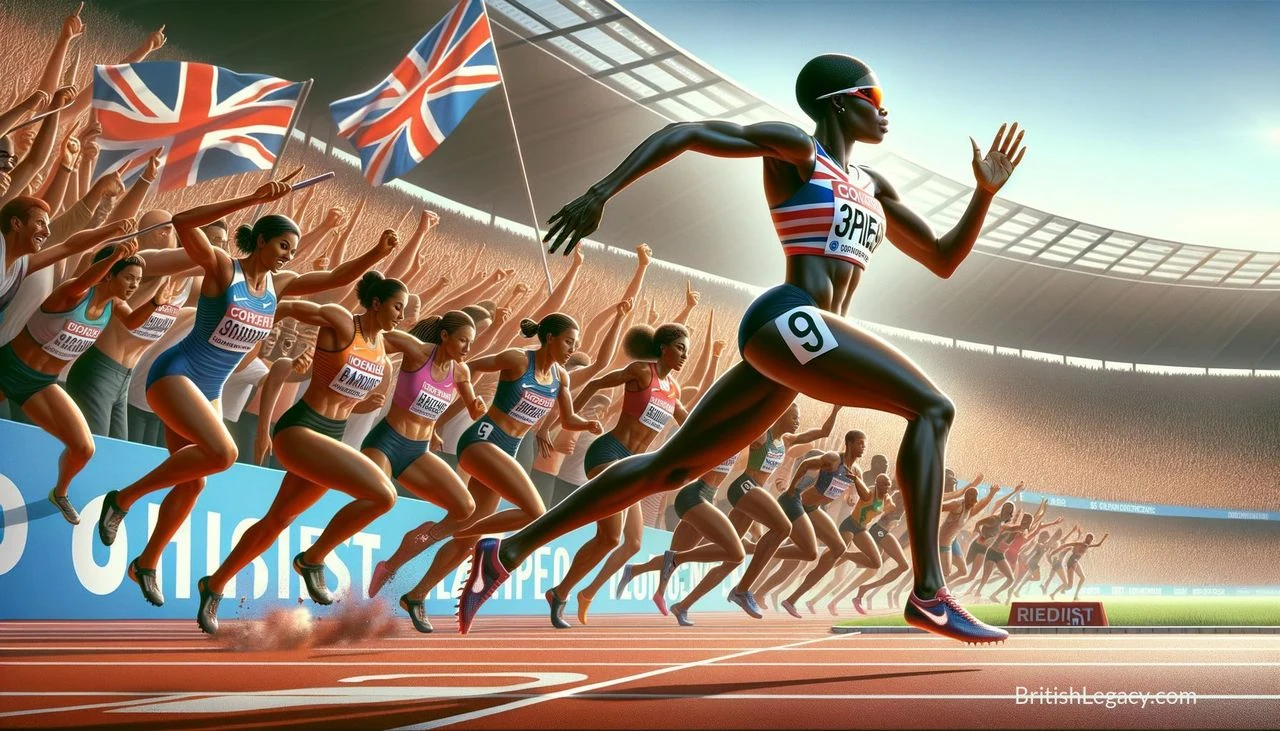
Dina Asher-Smith’s career has been shaped by range: she has won major titles from 60 metres indoors to 200 metres outdoors, and has repeatedly contributed to Great Britain’s relay teams. Her 2019 world 200-metre title made her the first British woman to win that event at the World Championships. It was one part of a season in which she also took silver in the 100 metres and the 4 × 100-metre relay, becoming the first Briton to win three medals at a World Championships.
From Orpington to the junior ranks
Geraldina Rachel Asher-Smith was born in Orpington, London, on 4 December 1995. She attended Perry Hall Primary School and Newstead Wood School, where she achieved nine A* grades and two As at GCSE. In 2014, she gained three A-levels and went on to study history at King’s College London, graduating with a BA in 2017.
She joined Blackheath and Bromley Harriers and competed internationally from 2011. Her early results offered more than a glimpse of future promise: aged 13, she ran 300 metres in 39.16 seconds, a time recorded as the world age-best. She won English Schools titles over 200 metres in three age groups, and in 2013 took the European junior 200-metre title in Rieti. She also helped Great Britain win the 4 × 100-metre relay there, setting a UK junior record with her teammates.
In 2014, Asher-Smith won the 100 metres at the World Junior Championships in Eugene. That year also brought a setback at senior level: after qualifying for the 200-metre final at the European Championships in Zurich, she withdrew with a hamstring injury. Her senior international debut had come the previous year, when she was the youngest athlete selected for Great Britain and Northern Ireland’s World Championships team. She won a relay bronze in Moscow.
Breaking through at senior level
At the 2015 European Indoor Championships, Asher-Smith won silver in the 60 metres and equalled the British record. Later that year she became the first British woman to run a legal 100 metres in under 11 seconds, clocking 10.99 at the London Anniversary Games. At the World Championships in Beijing, she finished fifth in the 200 metres in a British record of 22.07 seconds.
Her first Olympic Games followed in Rio in 2016. She placed fifth in the 200 metres, then won bronze in the 4 × 100-metre relay alongside Asha Philip, Desiree Henry and Daryll Neita. At the European Championships that year, she claimed gold in the 200 metres and silver in the relay. In 2017, after breaking her foot in a training accident, she returned to finish fourth in the 200 metres at the World Championships in London and take relay silver.
In 2018, she won the 200-metre bronze and relay gold for England at the Commonwealth Games on the Gold Coast. The European Championships in Berlin brought a remarkable three golds: the 100 metres, 200 metres and 4 × 100-metre relay. Her times of 10.85 and 21.89 seconds set British records. The 200-metre mark made her the first British woman to run the distance in under 22 seconds.
Doha, Tokyo and the demands of competition
Asher-Smith reached the high point of her individual career at the 2019 World Championships in Doha. She won silver in the 100 metres in a British-record 10.83 seconds, then took the 200-metre gold in a personal best and British record of 21.88. A further silver followed in the relay. The three-medal haul made her the first Briton to win three medals at a World Championships. That year she also became Diamond League champion over 100 metres.
She arrived at the postponed Tokyo Olympics in 2021 as a contender in the short sprints, but a hamstring injury sustained at the British Championships affected her campaign. She did not reach the 100-metre final and withdrew from the 200 metres. She returned for the relay, helping the British team win bronze after setting a national record in the heats. The result echoed her Rio relay medal, but the Games also showed how quickly injury can alter an individual programme.
At the 2022 World Championships in Eugene, she won bronze in the 200 metres and finished fourth in the 100. An injury during the relay prevented Britain from challenging for a medal. She later took European silver in the 200 metres. In 2023, she broke the British indoor 60-metre record, running 7.03 seconds in Birmingham. Minor injuries and a nerve problem affected her outdoor season, and she finished eighth in the 100 metres and seventh in the 200 at the World Championships in Budapest.
New seasons, familiar standards
At the 2024 European Championships in Rome, Asher-Smith won the 100 metres and a second gold as part of the relay team. At the Paris Olympics, she finished fourth in the 200 metres, just two hundredths of a second from bronze, and won silver in the 4 × 100-metre relay. She later won the 100 metres at the Lausanne Diamond League in a season’s best 10.88 seconds.
She continued to compete across a broader range in 2025, running personal bests in the 400 metres and winning the British 200-metre title in a championship record of 22.14 seconds. At the World Championships in Tokyo, she finished eighth in the 100 metres, fifth in the 200 and fourth in the relay. In 2026, she won the British indoor 60-metre title and reached the final at the World Indoor Championships. At the European Championships in Birmingham, she took bronze in the 200 metres and gold in both the women’s and mixed 4 × 100-metre relays. Those relay victories brought her European Championships gold-medal total to eight. She was appointed an MBE for services to athletics in the 2025 New Year Honours.
Beyond the track
Asher-Smith’s public work has included writing as well as competition. Her article, “Think racism hasn’t affected me? It’s there almost every day”, won the International Sports Press Association’s Sports Media Award for Best Column of 2020. She described it as her “first gold medal for writing”. The award recognised work that brought her perspective on racism into sports journalism, rather than limiting her public profile to race results.
She has also received honorary doctorates from Canterbury Christ Church University, the University of Kent and the University of Exeter. Her sporting life has included changes of coaching base: after working with John Blackie for 19 years, she announced in 2023 that their coaching partnership would end and moved to Austin, Texas, to work with Edrick Floreal. In 2025, she said she had left Floreal’s training group and was being coached in London. These shifts sit alongside a career sustained over more than a decade at the top level.
Why Dina Asher-Smith deserves a place in British Legacy
Asher-Smith’s place in British sporting history rests on results that are both distinctive and sustained. Her 2019 Doha campaign combined a world title in the 200 metres with silvers in the 100 metres and relay: three medals at one World Championships, a first for a Briton. She was also the first British woman to break 11 seconds in the 100 metres and the first to run the 200 in under 22 seconds. Those achievements gave British sprinting new benchmarks, while her European titles and Olympic relay medals show that her contribution was not confined to one championship or one event.
Her record also illustrates what a long international career demands. She returned from a broken foot to compete at the 2017 World Championships, managed an injury-disrupted Olympic campaign in Tokyo, and continued to win at European level through 2026. In relays, her medals belong to teams, and that collective record is an important part of her story: teammates have shared the work of turning individual speed into national results. Away from the track, her award-winning writing on racism and her academic study of history add documented dimensions to her public life. Asher-Smith’s British legacy is therefore not a general claim about national character. It is the specific record of a sprinter who has set records, won across different formats and remained a leading member of British teams across successive generations of championship competition.
Sources
Dina Asher-Smith (revision 1375247157) · Dina Asher-Smith
Adapted in part from Dina Asher-Smith by Wikipedia contributors, under CC BY-SA 4.0. Text has been edited and combined with the existing article; this adapted text is shared under the same licence. Contributor history.