
Gary Lineker’s career brought together two kinds of recognition: the instinctive finishing of one of England’s outstanding strikers and the ease of a broadcaster who could make football a familiar weekly conversation. He scored six goals at the 1986 World Cup, won the tournament’s Golden Boot and finished his playing career with 48 goals in 80 England appearances. After retiring in 1994, he became the presenter of Match of the Day, a role he held from 1999 until 2025. The path between those achievements ran from his hometown club, Leicester City, through Everton, Barcelona and Tottenham Hotspur, before a final playing spell in Japan.
A Leicester beginning
Gary Winston Lineker was born in Leicester on 30 November 1960. He joined Leicester City’s youth academy in 1976 and turned professional in 1978. His senior debut came on New Year’s Day 1979, in a 2–0 win over Oldham Athletic. He was part of the Leicester side promoted from the Second Division in 1980, and became a regular in the first team the following season.
His scoring developed as Leicester moved between the divisions. He scored 26 goals in the 1982–83 Second Division season as the club won promotion, then 22 in his first full First Division campaign. In 1984–85, his 24 league goals made him joint top scorer in the division. Across his Leicester league career, he made 194 appearances and scored 95 goals. The club’s place in his story endured beyond his playing years: in 2002 he led a consortium investing in Leicester City as it faced administration, helping the club avoid liquidation.
From Everton to European football
Everton signed Lineker in 1985. In his first season he scored 30 league goals and 40 in 57 games in all competitions. He was the leading scorer in the First Division and received both the PFA Players’ Player of the Year and the Football Writers’ Association Footballer of the Year awards. Everton finished second in the league and reached the FA Cup final, where Liverpool won 3–1 despite Lineker scoring the opening goal.
After the 1986 World Cup, Lineker joined Barcelona, managed by fellow Englishman Terry Venables. He scored twice on his debut and finished his first league season with 20 goals. Barcelona won the Copa del Rey in 1988 and the European Cup Winners’ Cup in 1989. His role changed under Johan Cruyff: after playing mainly as a centre-forward, Lineker was moved to the right wing, and his league goal return fell in his final season. Across three seasons, he scored 42 goals in 103 La Liga appearances.
In 1989, he returned to England with Tottenham Hotspur. He scored 24 league goals in his first season and won the First Division’s top-scorer honour again. Tottenham beat Nottingham Forest 2–1 in the 1991 FA Cup final, giving Lineker a major English trophy. He scored 67 league goals in 105 appearances for Spurs. His final club was Nagoya Grampus Eight in Japan. After two seasons affected by injury, he announced his retirement in September 1994.
England: the Golden Boot and two World Cups
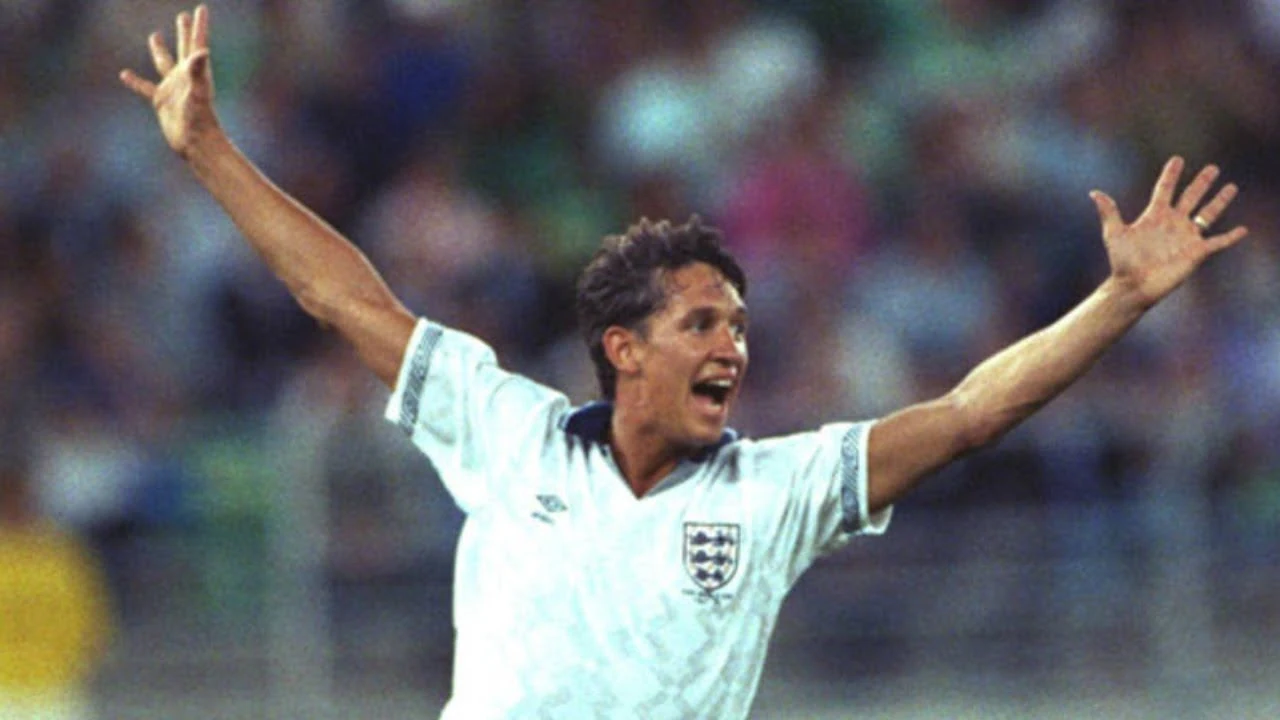
Lineker made his England debut in 1984. At the 1986 World Cup in Mexico, he scored six goals in five matches and became the first English player to win the tournament’s Golden Boot. His hat-trick against Poland helped England through the group stage; he also scored twice against Paraguay. His goal against Argentina came in a quarter-final England lost 2–1, with Diego Maradona scoring both goals for Argentina.
Four years later, Lineker scored four times as England reached the semi-finals of the 1990 World Cup. His equaliser against West Germany took the match to extra time, before England lost on penalties. Lineker retired from international football in 1992 with 80 caps and 48 goals. He was England’s second-highest scorer at the time of his retirement; he is now fourth in the all-time tally. He never received a yellow or red card during his playing career and received the FIFA Fair Play Award in 1990.
A new role in football broadcasting
After retiring, Lineker began working in broadcasting, first as a football pundit and then as a presenter. He appeared as a team captain on the BBC sports quiz They Think It’s All Over from 1995 to 2003. In 1999, he succeeded Des Lynam as the BBC’s lead presenter for football coverage, including Match of the Day. He presented the programme until the end of the 2024–25 Premier League season, making his tenure the longest of any presenter of the show.
His work extended beyond the weekly highlights programme. He presented the BBC’s live coverage of football tournaments, the London 2012 Olympic Games and the 2014 Commonwealth Games, and worked on coverage for broadcasters including Al Jazeera Sport, NBC Sports Network and BT Sport. In 2018 he co-founded Goalhanger, a media company that produces podcasts including The Rest Is Football, which he hosts with Alan Shearer and Micah Richards.
Lineker’s public comments on political issues also brought questions about the responsibilities of a prominent BBC presenter. In March 2023, a dispute over his criticism of the government’s asylum policy led the BBC to ask him to step back from presenting temporarily. Colleagues withdrew from their programmes in solidarity, and Match of the Day went ahead without its usual studio presentation. The BBC and Lineker later announced that he would return while the corporation reviewed its social-media guidance. In 2025, after a separate controversy over a social-media repost, he apologised and announced that he would leave the BBC at the end of that season.
Why Gary Lineker deserves a place in British Legacy
Lineker’s place in British sporting history rests first on a record built across club and international football. He was joint top scorer in England’s First Division with Leicester City, then won the same distinction with Everton and Tottenham Hotspur. His 1986 World Cup Golden Boot remains a defining England achievement: six goals made him the tournament’s leading scorer and the first English player to win the award. In 1990, his goals helped take England to a World Cup semi-final. These milestones give his career a particular connection to the national game: his most celebrated performances came both in the competition’s greatest international spotlight and in the domestic league and cup.
His later work extended that connection from the pitch to the living rooms where football is watched and discussed. For more than 25 years, Lineker presented Match of the Day, guiding viewers through the weekend’s games and making the programme a continuing part of British football broadcasting. His presenting career was not simply an afterthought to his playing days: it became a substantial second chapter, supported by work on other sports coverage and, later, podcasting. His record also makes room for complexity. Public debate over his use of social media and the BBC’s expectations of its presenters exposed a real tension between personal expression and institutional impartiality. Taken together, his goals, honours and long broadcasting career make Lineker a figure whose influence spans English football’s players, audiences and media.
Sources
Gary Lineker (Wikipedia revision) · Gary Lineker
Adapted in part from Gary Lineker by Wikipedia contributors, under CC BY-SA 4.0. Text has been edited and combined with the existing article; this adapted text is shared under the same licence. Contributor history.
.jpg)