
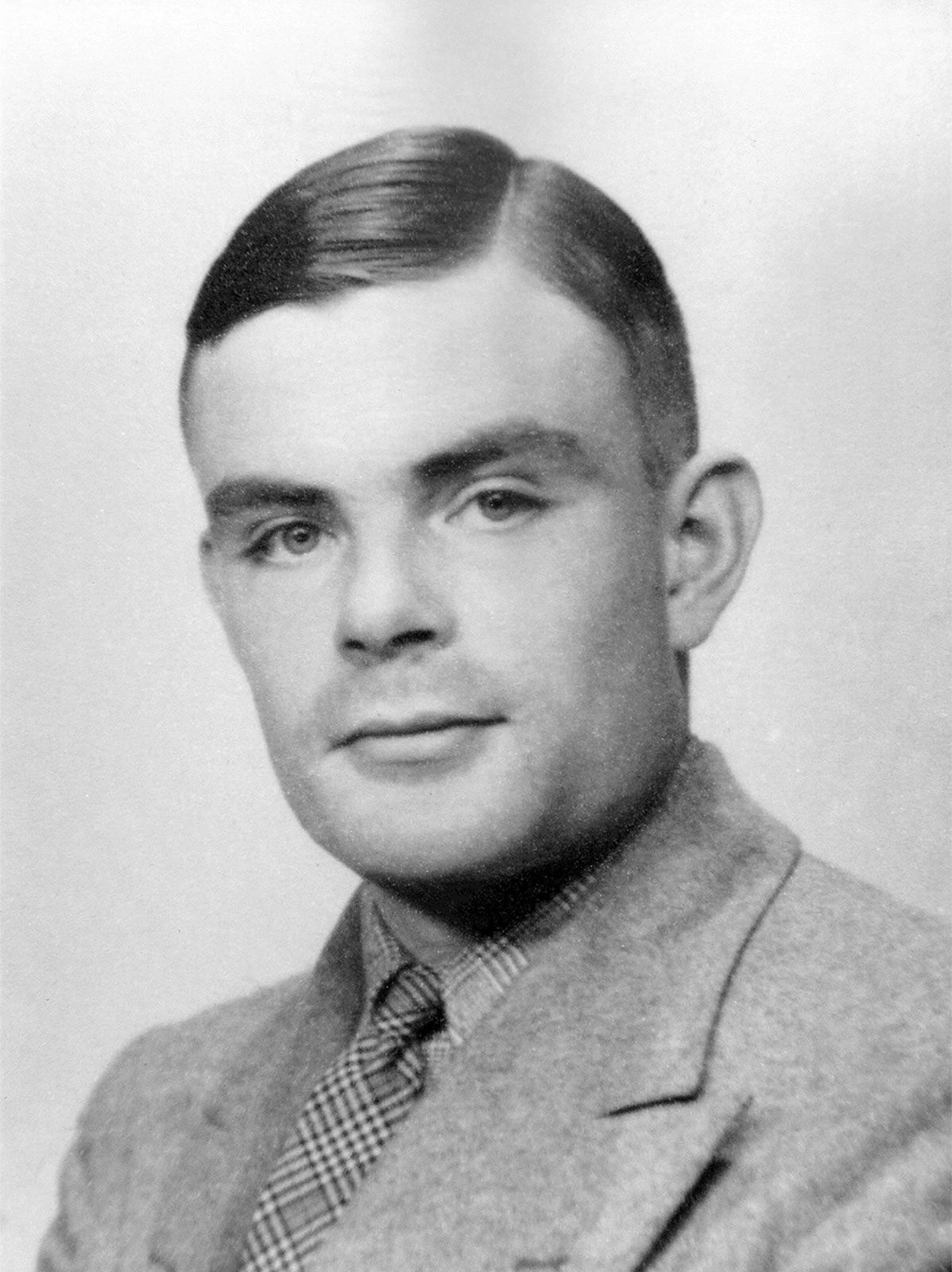
Alan Mathison Turing moved between abstract mathematics and urgent practical problems. He asked what could be calculated by a machine, helped develop methods for reading German wartime ciphers, and later explored whether a computer might appear intelligent. His work ranged from the foundations of theoretical computing to patterns in living organisms. Yet the country that honoured his wartime service also prosecuted him for homosexual acts, which were criminal offences in Britain at the time. His story combines intellectual achievement, wartime secrecy and a belated reckoning with that injustice.
School, Cambridge and a new model of computation
Born in Maida Vale, London, on 23 June 1912, Turing was educated at St Michael’s in St Leonards-on-Sea, Hazelhurst Preparatory School and Sherborne School in Dorset. He was drawn to mathematics and science, although Sherborne’s educational culture placed greater emphasis on classical subjects. He tackled advanced mathematical problems before he had studied elementary calculus and engaged with the work of Albert Einstein.
At Sherborne he formed a close friendship with Christopher Morcom, whose death from complications of bovine tuberculosis in 1930 deeply affected him. Their shared interest in science and Turing’s continuing correspondence with Morcom’s mother were part of the personal history that accompanied his later work. Turing went on to study mathematics at King’s College, Cambridge, where he gained first-class honours. He was elected a Fellow of King’s in 1935.
At Cambridge, Turing considered a fundamental question: could every mathematical problem be settled by a precise procedure? In his 1936 paper, “On Computable Numbers, with an Application to the Entscheidungsproblem”, he described hypothetical machines that could follow rules to perform calculations. These became known as Turing machines. The model gave a formal account of computation and helped show that some problems cannot be solved by any algorithmic procedure.
The paper also described a universal machine capable of carrying out the work of any other computation machine. That idea offered a powerful way to think about general-purpose computing: rather than building a separate machine for each task, a single machine could follow different instructions. Turing’s account remains central to theoretical computer science, in part because it made the underlying idea of computation comparatively clear and direct.
From September 1936 to July 1938 he studied at Princeton University under the mathematician Alonzo Church, earning a doctorate in 1938. His thesis, Systems of Logic Based on Ordinals, developed ideas about ordinal logic and relative computing. By studying machines supplemented with additional information, he explored problems that ordinary Turing machines could not solve. This work extended his investigation of the limits of computation rather than treating machines as tools with unlimited powers.
At Bletchley Park: reasoning against Enigma
Turing began part-time work for the Government Code and Cypher School in September 1938, concentrating on the German Enigma cipher alongside the codebreaker Dilly Knox. On 4 September 1939, the day after Britain declared war on Germany, he reported to Bletchley Park, the country’s wartime codebreaking centre. As with other staff, the Official Secrets Act bound him to silence about his work.
At Bletchley he led Hut 8, responsible for German naval cryptanalysis. His approach built on information supplied by the Polish Cipher Bureau, which had shared details of Enigma’s wiring and its methods of decryption. Turing developed a broader attack that used a “crib”: a likely fragment of plaintext. By testing the relationships between that fragment and an intercepted message, codebreakers could search for possible rotor positions and plugboard settings.
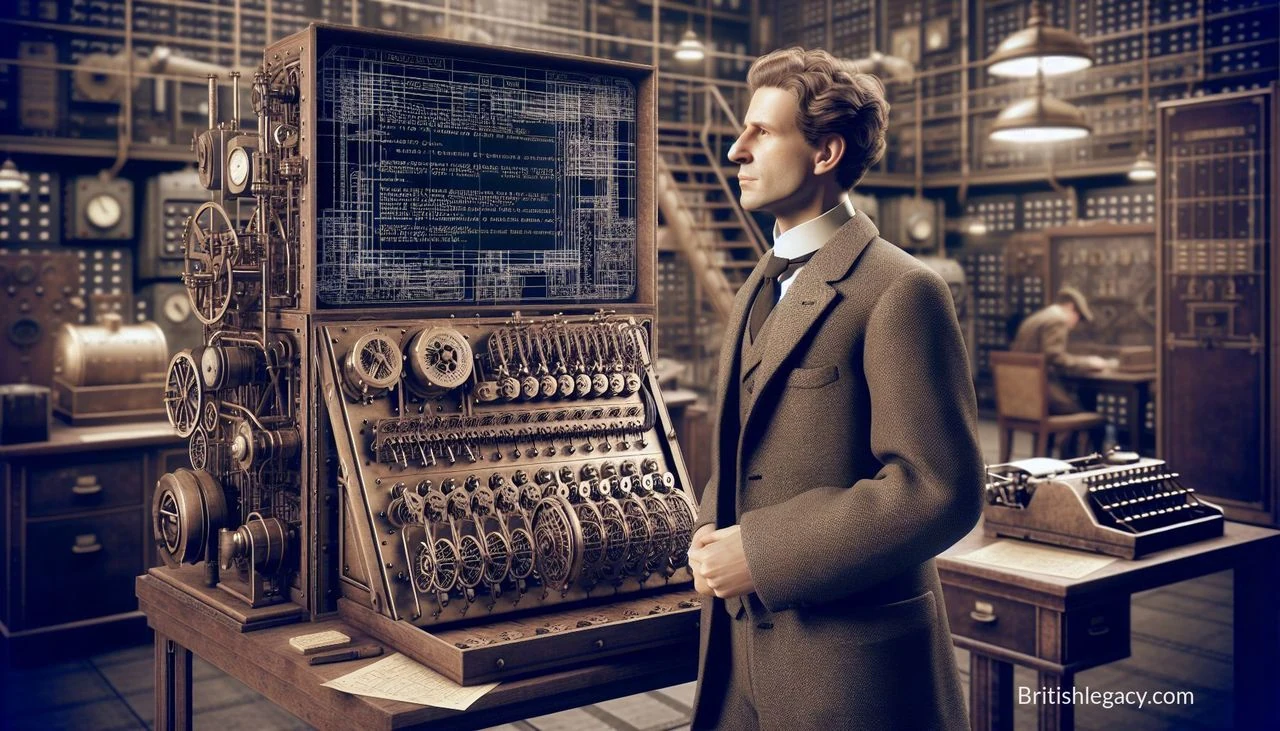
The electromechanical bombe turned this reasoning into a faster search. For each candidate setting, it followed chains of logical deductions and rejected combinations that produced contradictions. Most possibilities could therefore be discarded, leaving a smaller number for closer examination. The first bombe was installed on 18 March 1940. Gordon Welchman suggested an enhancement, and the resulting machine became one of the principal automated tools used against Enigma. It built on the earlier Polish bomba kryptologiczna; it was not an isolated invention detached from work already done by others.
Turing’s contribution to wartime cryptanalysis went beyond the bombe. He developed Banburismus, a statistical method that helped make more efficient use of the machines, and solved the essential part of the German navy’s more complex indicator system. He also devised Turingery, a method for working out the wheel settings of the Lorenz cipher machine, known at Bletchley as Tunny. These methods show how mathematical and statistical reasoning could guide the practical work of breaking different forms of cipher.
In late 1941, Turing joined Hugh Alexander, Stuart Milner-Barry and Gordon Welchman in appealing directly to Winston Churchill for more staff and equipment. Churchill ordered that their needs be met as a matter of extreme priority. More than 200 bombes were operating by the end of the war. Turing’s wartime service was recognised with his appointment as an Officer of the Order of the British Empire in 1946, although the nature of his work remained secret for many years.
The precise effect of Ultra intelligence on the war cannot be measured with certainty. The official war historian Harry Hinsley estimated that it shortened the war in Europe by more than two years, while acknowledging that his estimate did not account for other eventualities. That qualified assessment is more useful than presenting the outcome as a calculation with a single certain answer. Turing’s place in the work was substantial, but the breaking of German ciphers was a collective undertaking that drew on prior Polish work and the efforts of many people at Bletchley Park and beyond.
Machines, intelligence and the shape of living things
After the war, Turing worked at the National Physical Laboratory on the Automatic Computing Engine, or ACE. His paper of 19 February 1946 gave the first detailed design for a stored-program computer. A stored-program machine could keep its instructions in memory, allowing it to perform different operations without being rebuilt for each task. The project did not develop as he had hoped, but the design brought his theoretical work into the territory of practical computer architecture.
In 1948, Turing joined Max Newman’s Computing Machine Laboratory at the University of Manchester and contributed to the development of early Manchester computers. He also considered how to discuss machine intelligence without relying on an abstract definition of what intelligence is. His proposed test framed the issue through conversation: could a machine respond in a way that a person could not reliably distinguish from another human being? The Turing test remains a lasting and contentious point of reference in debates about artificial intelligence. It did not settle what intelligence means; it gave later debate a concrete question to examine.
Turing’s interests also reached into cybernetics, an area connecting subjects such as neuroscience, computing and artificial intelligence. He joined the Ratio Club, a London dining club for researchers with related interests, and discussed both computing machinery and biological form. The breadth of this work was not a departure from his mathematical approach. In different fields, he sought ways to express complicated processes as precise models and then examine what those models could explain.
In “The Chemical Basis of Morphogenesis”, Turing used mathematical models to investigate how chemical processes might produce patterns in living organisms. He predicted oscillating chemical reactions, including the type later associated with the Belousov–Zhabotinsky reaction, first observed in the 1960s. His work brought questions of pattern formation within reach of mathematical analysis and established a connection between the logic of formal models and the structures found in nature.
During the war, Turing also worked on secure communications. With Donald Bayley at Hanslope Park, he helped develop Delilah, a portable machine for secure voice communication. It was completed too late for wartime use and was not adopted, though Turing demonstrated it by encrypting and decrypting a recording of a Winston Churchill speech. He had also consulted with Bell Labs on SIGSALY, a secure voice system used in the later years of the war. These projects formed another strand of his work: using technical ingenuity to address the practical challenge of protecting communications.
Conviction, death and recognition after his lifetime
In 1952, Turing was prosecuted for homosexual acts, then criminal offences in the United Kingdom. He accepted hormone treatment as an alternative to imprisonment. The prosecution and treatment belong to the historical record of a scientist whose work had served Britain, but whose private life was punished by the law of the time.
Turing died from cyanide poisoning at his house in Wilmslow, Cheshire, on 7 June 1954, aged 41. An inquest determined that his death was suicide. The supplied accounts also record evidence consistent with accidental poisoning, including the possibility that fumes from an electroplating experiment were involved. The cause and circumstances should therefore be described with care: the inquest’s finding is established, but the possibility of accidental poisoning remains part of the account. His remains were cremated at Woking Crematorium on 12 June 1954.
Public recognition of the injustice of his prosecution came much later. Following a petition begun in 2009, Prime Minister Gordon Brown issued an official apology for the “appalling way” Turing had been treated. Queen Elizabeth II granted him a pardon in 2013. The informal term “Alan Turing law” refers to a 2017 United Kingdom law that retroactively pardoned men cautioned or convicted under historical legislation outlawing homosexual acts.
His scientific contribution has also become more visible. Turing’s portrait appears on the Bank of England £50 note, first released on 23 June 2021, the anniversary of his birth. An annual award for innovation in computing bears his name, and statues and memorials have helped bring his story into public view. These honours cannot reverse what happened to him, but they reflect the growing recognition of work that official secrecy had kept from public understanding during his lifetime.
Why Alan Turing deserves a place in British Legacy
Alan Turing deserves a place in British Legacy because his work connects lasting intellectual ideas with practical service. His model of computation helped define what it means for a machine to follow instructions and what lies beyond algorithmic solution. At Bletchley Park, he applied mathematical reasoning to German naval Enigma and helped specify the bombe, a machine that made the search for possible settings more efficient. That achievement belongs within a wider history of codebreaking, including the prior Polish work on which British efforts built. Turing’s wartime contribution was significant without needing to turn a shared enterprise into the story of one solitary inventor.
His British legacy also includes the work he pursued after the war. The ACE design linked theory with the architecture of stored-program computers; his test for machine intelligence gave a durable form to a difficult question; and his research into morphogenesis applied mathematics to the emergence of patterns in living things. Together, these strands show how one rigorous way of thinking could travel across disciplines and help shape later inquiry. The public recognition of his life, from the 2009 apology and 2013 pardon to the 2017 law and his appearance on a British banknote, carries a different lesson. Britain benefited from Turing’s work and also subjected him to unjust treatment. Remembering both is essential to an honest account of his place in the country’s scientific and public history.
Sources
Adapted in part from Alan Turing by Wikipedia contributors, under CC BY-SA 4.0. Text has been edited and combined with the existing article; this adapted text is shared under the same licence. Contributor history.
_(crop).jpg)