
At the start of the twentieth century, chemists had arranged the elements into a periodic table, but one question remained: what gave their sequence a physical basis? Henry Gwyn Jeffreys Moseley answered it by measuring the characteristic X-rays emitted by different elements. His results showed that an element’s place in the sequence was connected to the positive charge of its nucleus. Atomic number was no longer just a useful label; it described a measurable property of the atom.
Moseley was born in Weymouth, studied at Oxford and carried out his decisive research at the University of Manchester under Ernest Rutherford. In a career that lasted only a few years, he helped explain awkward cases in the periodic table, identified places where elements were missing and brought new precision to the rare-earth series. In August 1915, aged twenty-seven, he was killed while serving with the Royal Engineers at Gallipoli. His scientific achievement needs no imagined future work to make its importance clear: the experiments he completed had already changed how the elements could be understood and ordered.
From Weymouth to Rutherford’s laboratory
Henry Gwyn Jeffreys Moseley was born in Weymouth, Dorset, on 23 November 1887. Friends knew him as Harry. His father, Henry Nottidge Moseley, was a biologist and professor at Oxford who had taken part in the Challenger expedition. His mother, Amabel Gwyn Jeffreys, was the daughter of the Welsh biologist and conchologist John Gwyn Jeffreys; she later became British women’s chess champion.
Moseley attended Summer Fields School and Eton College, winning the chemistry and physics prizes at Eton in 1906. He went on to study at Trinity College, Oxford, and graduated with a Bachelor of Arts degree in 1910. The supplied accounts differ on the classification of his degree, so it is safer to state the qualification without assigning a class. His reputation rests on what he went on to do in the laboratory, not on a disputed examination detail.
After Oxford, Moseley became a demonstrator in physics at the University of Manchester, where he worked under Ernest Rutherford. The atom was a subject of active investigation. Researchers were testing models of its internal structure and asking how its positive charge was arranged. Chemists, meanwhile, were working with patterns in the properties of the elements. Moseley’s experiments brought those lines of inquiry together: he sought a way to test whether the order of the elements corresponded to something physically real inside their atoms.
His early research also included experiments on beta particles from radium. In 1912 he showed that high electrical potentials could be obtained from a radioactive source. The work has been described as an early atomic battery, though it did not produce the million-volt potential needed to stop the particles. This research formed part of a wider experimental career, but the work that made Moseley’s name came from a different kind of radiation: X-rays emitted by elements.
How X-rays revealed the elements’ order
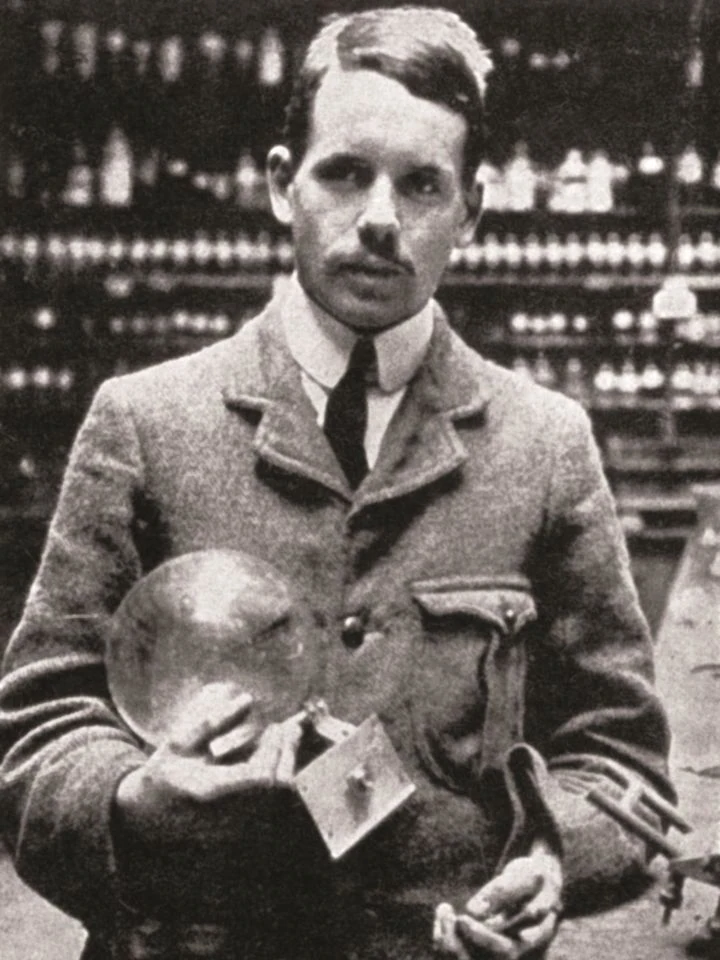
In 1913, Moseley studied the X-ray spectra of a range of elements, mostly metals. In the experiments, electrons were fired at a metal target. The resulting changes within the atoms produced X-rays with characteristic properties. Moseley sent the rays through crystals, observed their diffraction and used the results to calculate their wavelengths. The wavelengths, and the related frequencies, varied systematically from one element to the next.
This was demanding experimental work, not simply a matter of applying a finished technique. Moseley drew on the crystallographic advances of William Henry Bragg and William Lawrence Bragg and helped develop the equipment and methods used in his research. Softer, lower-frequency X-rays could be absorbed by air or paper, so detecting them sometimes required apparatus to be adapted for work in a vacuum. The measurements depended on both the design of the experiment and the reasoning used to interpret its results.
The relationship Moseley established between the frequencies of characteristic X-rays and the sequence of the elements became known as Moseley’s law. In the mathematical pattern, the square root of the frequency varies systematically with atomic number. The finding showed that the elements’ sequence was not an arbitrary numbering scheme. Moseley concluded that each successive element had one additional unit of positive nuclear charge. Later physics identified the number of those positive charges with the number of protons in the nucleus; that later identification should not be confused with the particular experimental conclusion Moseley reached.
His result connected the chemical ordering of the elements with the developing physical account of the atom. Rutherford’s model placed positive charge in the nucleus, and Moseley’s measurements provided evidence that this charge was related to atomic number. The work also supplied experimental support relevant to the emerging theory associated with Niels Bohr. It gave chemistry a firmer account of elemental sequence while contributing to physics’ investigation of nuclear structure.
Resolving anomalies and finding gaps
Before Moseley’s experiments, atomic number could be treated as a sequence number that generally followed atomic mass, with adjustments when chemical properties suggested a different arrangement. Cobalt and nickel made the difficulty plain. Their masses are close, and cobalt’s is slightly greater, so an ordering based only on mass would put nickel first. Yet their properties and their proper places in the table indicated cobalt followed by nickel. Dmitri Mendeleev had trusted chemical evidence when it conflicted with mass; Moseley’s measurements showed that this ordering also had a physical basis.
The periodic table was not an invention waiting entirely for Moseley. Chemists had already identified meaningful patterns, and Mendeleev had made judgements that proved sound. Moseley’s contribution was to demonstrate a measurable principle that explained why the order worked. X-ray evidence gave scientists an objective way to distinguish successive elements and to understand why atomic mass alone could not determine their positions.
Once the sequence could be measured, gaps became informative. Moseley’s work identified missing places at atomic numbers 43, 61, 72 and 75. Those positions were later filled by technetium, promethium, hafnium and rhenium respectively. He did not discover those elements; his experiments established where they belonged. He also found strong evidence that there were no other gaps between aluminium and gold. The table could now do more than arrange known substances: it could indicate what remained unknown and help researchers test claims about the identity of elements.
The rare-earth elements presented a particularly difficult problem. Chemists had struggled to establish how many belonged in the series and how they should be ordered. Some were difficult to separate, while similar substances and impure samples complicated identification. Moseley’s measurements showed that the lanthanides, from lanthanum through lutetium, occupied fifteen places. That result supplied a clearer framework for a group whose membership and arrangement had been hard to settle by chemical comparison alone.
The implications reached beyond tidying up a diagram. An element’s position could be tested against its X-ray signature; a mismatch could prompt a closer look at the evidence or the sample. The periodic table became more exact and more useful as a means of reasoning about elemental identity. Moseley’s measurements helped turn a successful classification into a framework that connected chemistry with the structure of matter.
Oxford, war and a lost research career
Moseley returned to Oxford in 1913, where he had laboratory facilities but little formal support. He intended to continue his research, including further work on the rare-earth elements. When the First World War broke out in 1914, he left research and volunteered for the Royal Engineers. He served as a technical officer in communications during the Gallipoli campaign, which began in 1915.
On 10 August 1915, Moseley was shot and killed at Gallipoli, in the Ottoman Empire. He was twenty-seven and has no known grave. His name is commemorated on the Helles Memorial. His death ended a career that had already produced work of lasting importance.
Scientists regarded the loss as serious, and later accounts have speculated that Moseley might have received a Nobel Prize. Such speculation cannot establish what would have happened. What can be judged is the work he had completed: evidence for the physical meaning of atomic number, a way to resolve ordering problems and a more precise account of gaps in the element sequence. Those achievements make the loss intelligible without turning his biography into an imagined list of discoveries he never had the chance to make.
Oxford preserves apparatus and related material associated with his experiments. The Institute of Physics’ Henry Moseley Medal and Prize, awarded for early-career experimental physics, also bears his name. These memorials direct attention to the work itself: careful measurement, adapted instruments and a result that changed how scientists understood the elements.
Why Henry Moseley deserves a place in British Legacy
Henry Moseley deserves a place in British Legacy because his research, carried out at British institutions, established a physical basis for the periodic order of the elements. By measuring characteristic X-rays, he showed that atomic number corresponded to a systematic increase in positive nuclear charge. This helped explain why cobalt precedes nickel despite their relative atomic masses and made atomic number more than a convenient place-number. His work joined chemistry’s established classifications to experimental evidence about the atom.
The practical consequences of that evidence were substantial. Moseley identified gaps at atomic numbers 43, 61, 72 and 75, later occupied by technetium, promethium, hafnium and rhenium, and clarified the fifteen places of the lanthanide series. These findings made the table more precise and more capable of guiding further investigation. They helped researchers distinguish a genuine gap in knowledge from a problem of classification or an uncertain sample. The lasting value lies not only in the names and numbers, but in the testable method that connected them.
His British connection is specific: he was born in Dorset, educated at English schools and Oxford, and conducted the research that established his reputation at Manchester under Rutherford. British institutions continue to preserve and commemorate his experimental work. Its importance, however, is international. Scientists and students everywhere use a periodic table whose ordering depends on the principle Moseley helped establish. His place in British Legacy rests on a contribution rooted in British scientific life that became a shared tool for understanding matter: a clearer standard of evidence, a more reliable sequence of elements and a foundation on which later chemistry and physics could build.
Sources
Henry Moseley — Wikipedia, revision 1374927969
Adapted in part from Henry Moseley by Wikipedia contributors, under CC BY-SA 4.0. Text has been edited and combined with the existing article; this adapted text is shared under the same licence. Contributor history.

.jpg)