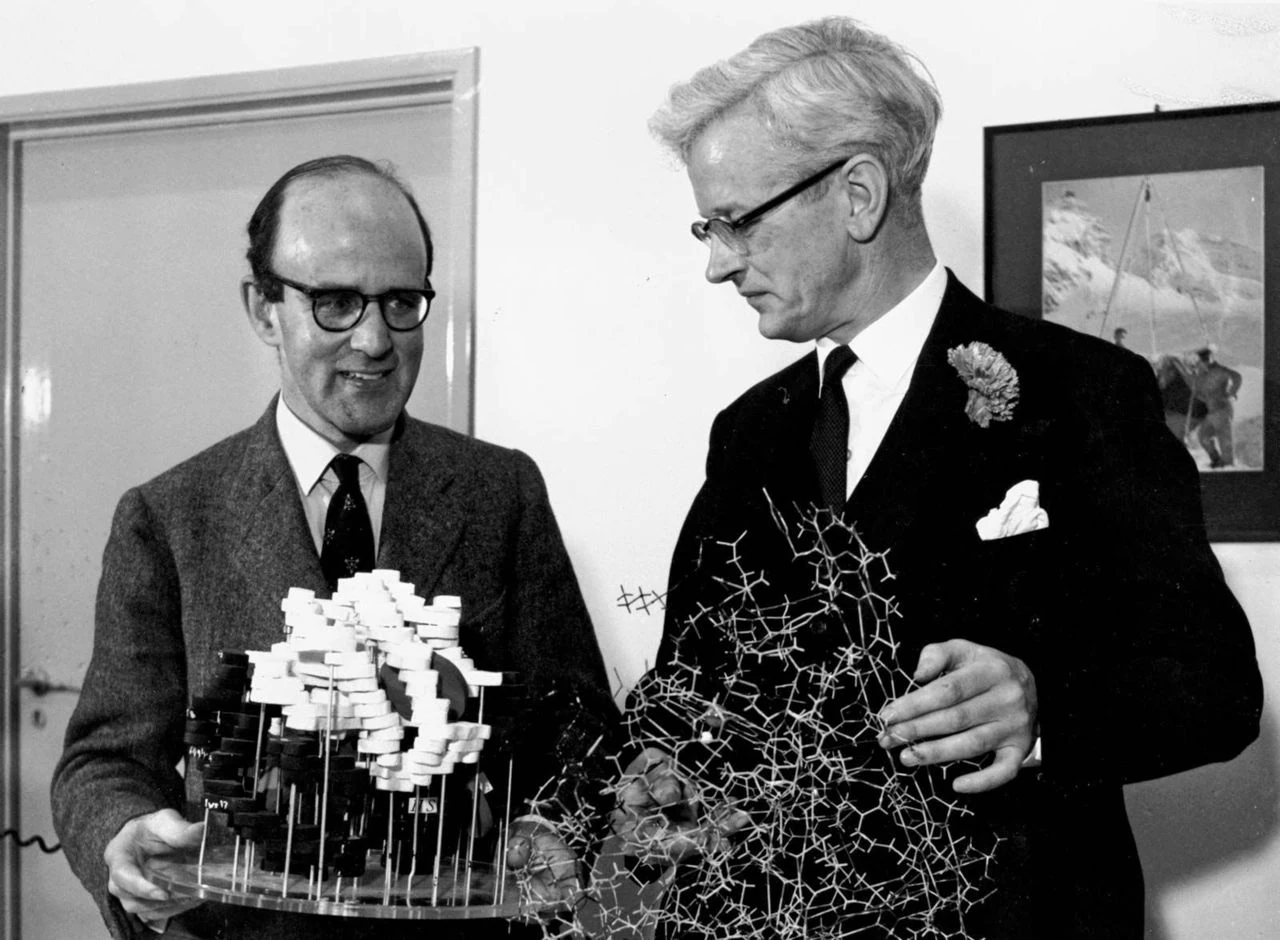
Haemoglobin carries oxygen through the body, but knowing what it does is not the same as understanding how it works. To answer that question, scientists needed to see the protein’s three-dimensional structure and explain how its shape changes as it takes up and releases oxygen. Max Perutz devoted much of his career to making that structure visible. His work helped establish practical ways to determine protein structures and linked the physical form of a molecule to its biological function.
Born in Vienna, Perutz came to Cambridge in 1936. His career there joined a long investigation of haemoglobin with the creation of a research unit that became the Medical Research Council’s Laboratory of Molecular Biology. His life also encompassed wartime internment, work on a project involving reinforced ice, a Nobel Prize and a continuing interest in public writing. His British connection rests on the research and institution he helped build in Cambridge, not on his place of birth.
From Vienna to the Cavendish
Perutz studied chemistry at the University of Vienna. When he arrived in Cambridge, he intended to work in biochemistry, but instead joined J. D. Bernal’s crystallography group at the Cavendish Laboratory. X-ray crystallography had been used to study simpler substances. Perutz took on the difficult question of whether it could reveal the architecture of proteins: large, complex molecules whose structures many researchers doubted could be determined.
Encouraged by Bernal, he chose crystals of horse haemoglobin for his doctoral research. Haemoglobin was a compelling subject: abundant in blood and essential to carrying oxygen from the lungs to the body’s tissues, yet too complex to understand from a chemical formula alone. To explain its activity, researchers needed to know how its atoms were arranged and how the molecule’s shape changed. Perutz’s choice committed him to a problem that would occupy decades of work.
War interrupted that work. After Germany took control of Austria in 1938, Perutz’s family escaped to safety. Perutz himself was interned in 1940 as an enemy alien and sent to Canada, despite being anti-Nazi. Efforts by British scientists and the Royal Society helped secure his release, and he returned to Cambridge in January 1941.
During the war, he also worked on ice and glaciers and contributed to Project Habakkuk. The project explored whether reinforced ice could be used to construct floating airbases in the Atlantic. It was a striking departure from protein research, but reflected a wider interest in the properties of materials and what they might make possible. After the war, Perutz returned to haemoglobin and the challenge of recovering a protein’s structure from X-ray data.
The phase problem and a way through
When X-rays pass through a crystal, they produce a diffraction pattern of spots. Researchers can measure the spots’ intensities, but those measurements alone do not supply all the information needed to reconstruct the crystal’s three-dimensional structure. The missing information is known as the phase problem. Without it, scientists had part of the evidence but no reliable route from that evidence to a structural map.
Perutz’s breakthrough came in 1953. He compared diffraction patterns from an ordinary protein crystal with those from a similar crystal to which a small number of heavy atoms had been attached. Heavy atoms scatter X-rays strongly. Their effects offered reference points that made it possible to estimate the missing phases. The technique, known as isomorphous replacement, provided a practical way past a major obstacle in protein crystallography.
The method’s importance was not confined to one result. It helped make the determination of protein structures possible, including work on haemoglobin and myoglobin, the oxygen-binding protein found in muscle. A structure is not simply a picture of a molecule. It gives researchers a way to ask how the molecule’s arrangement relates to its behaviour, and how a change in that arrangement might alter its function.
This changed the questions researchers could investigate. Instead of treating a protein as a substance whose role could be described only in general terms, they could study its shape and consider how its parts were arranged. Perutz’s technical solution contributed to a broader scientific practice: using structural evidence to explain biological activity. The advance depended on sustained experimental work as well as a clear understanding of what information the diffraction patterns lacked.
Haemoglobin’s changing shape
Perutz revealed the structure of haemoglobin. Working closely with him, John Kendrew solved the structure of myoglobin. In 1962, the two men shared the Nobel Prize in Chemistry for their studies of the structures of globular proteins. The award recognised their contribution to understanding protein structures, rather than a single result considered in isolation.
Perutz and his colleagues went on to determine high-resolution structures of oxygenated and deoxygenated haemoglobin. By 1970, Perutz had proposed how the molecule changes between those states as it takes up and releases oxygen. This connected structure with action: haemoglobin’s ability to carry oxygen could be investigated through the way its form shifts. A familiar function of blood had become a problem that could be studied at the level of molecular structure.
That structural perspective also offered a way to investigate inherited haemoglobin disorders. Perutz studied several such diseases, including structural consequences associated with abnormal forms of haemoglobin in conditions such as sickle-cell anaemia. Researchers could ask what a particular molecular change meant for oxygen binding, stability and disease. This work formed part of a developing molecular approach to illness, seeking explanations in altered molecules as well as in observable symptoms and test results.
The significance should be stated carefully. The supplied accounts describe research that helped explain haemoglobin and its disorders; they do not establish that Perutz’s work itself produced particular treatments or diagnostic advances. Its contribution was to make structural questions about the protein open to investigation, giving researchers a more detailed basis for understanding how changes in haemoglobin relate to its function.
Creating a Cambridge research centre
Perutz’s role in British science extended beyond his own experiments. In 1947, with support from Lawrence Bragg and funding from the Medical Research Council, he established the MRC Unit for Research on the Molecular Structure of Biological Systems at the Cavendish. The unit brought together research at the meeting point of physics, chemistry and biology, where new approaches to investigating living matter were emerging.
The Cambridge environment included scientists whose work would become closely associated with molecular biology. Francis Crick arrived in 1949; James Watson joined the wider Cambridge molecular biology environment in 1951; and John Kendrew became Perutz’s close collaborator. In 1962, the unit became the MRC Laboratory of Molecular Biology, with Perutz as its chairman.
The institution mattered because ambitious research requires more than an individual idea. Scientists need colleagues, methods and a setting in which difficult questions can be pursued. Accounts of the laboratory emphasise intellectual seriousness, collaboration and the opportunity for younger researchers to take responsibility. Perutz helped shape a research culture in which scientists from different disciplines could work together on biological problems.
His honours included election as a Fellow of the Royal Society in 1954, the Royal Medal in 1971, the Copley Medal in 1979 and appointment to the Order of Merit in 1988. These distinctions recognised an exceptional scientific career. The laboratory he helped establish represents another part of his achievement: he contributed not only to discoveries but also to a Cambridge institution where other researchers could develop their own work.
Research, writing and public argument
Perutz continued scientific work in Cambridge after the haemoglobin research. Later, he turned part of his attention to neurodegenerative disease, particularly Huntington’s disease. He investigated whether repeated glutamine stretches in proteins might contribute to harmful aggregation. The subject differed from haemoglobin, but the questions again concerned the relationship between molecular properties and biological consequences.
He also wrote for readers beyond the laboratory. His essays and reviews appeared in books including I Wish I’d Made You Angry Earlier and Science Is Not a Quiet Life. His subjects included science, history, ethics and scientific controversy. This writing extended his contribution beyond research, bringing a scientist’s knowledge and arguments into public discussion.
Perutz was willing to criticise arguments he considered careless, including in debates about the philosophy of science and political violence. His public work defended scientific inquiry without treating scientists as infallible. Research and writing were distinct parts of his career, but both involved examining evidence, testing claims and explaining why an argument mattered.
Why Max Perutz deserves a place in British Legacy
Max Perutz deserves a place in British Legacy for a specific body of work carried out through his connection with Cambridge. Born in Vienna, he came to Cambridge in 1936 and pursued there a long investigation of haemoglobin’s structure. His approach to the phase problem helped researchers use X-ray crystallography to determine protein structures. His work on oxygenated and deoxygenated haemoglobin helped explain how changes in molecular form relate to the protein’s task of taking up and releasing oxygen. These are substantial contributions to British scientific history because they were made within, and helped strengthen, a British research setting.
His legacy is also institutional. Perutz established an MRC unit at the Cavendish that became the Laboratory of Molecular Biology. By bringing research across physics, chemistry and biology into one environment, he helped create a place where complex questions about living matter could be investigated collaboratively. A research centre can support new questions and researchers long after its founder’s initial work has been done; building such a setting was a contribution beyond any one discovery.
His studies of haemoglobin disorders connected structural biology with the effort to understand disease at the molecular level, while his books and essays carried scientific argument to a wider readership. The available evidence does not justify claiming that his work directly produced particular treatments, but it does show how he helped make proteins and their functions open to closer study. Perutz’s British legacy is concrete: research that made molecular structure more accessible, a Cambridge laboratory he helped build, and public writing that treated science as part of wider intellectual life. His story also reflects the contribution of a scientist born elsewhere whose career became closely tied to British institutions.