Stephen Hawking changed the way physicists think about black holes, and helped millions of other people think about the universe at all. His prediction that black holes emit radiation brought general relativity, quantum theory and thermodynamics into a single, difficult conversation. His career at Cambridge produced work that still prompts fundamental questions; his books carried cosmology well beyond the university. Hawking became a rare public figure whose name could lead readers from a bestseller list to the unsettled frontiers of theoretical physics.
Born in Oxford in 1942 and educated at Oxford and Cambridge, Hawking spent most of his working life in British universities. He held Cambridge’s Lucasian Professorship of Mathematics, once occupied by Isaac Newton, and became one of the country’s most recognisable scientists. His story is not simply one of exceptional individual resolve: it also reflects the support of colleagues, students, carers and technology that enabled his work to continue as motor neurone disease progressively restricted his movement and speech.
An Oxford education and a Cambridge beginning
Hawking was born on 8 January 1942 in Oxford and grew up chiefly in St Albans. At 17, he began studying physics at University College, Oxford, where he gained a first-class degree. He moved to Trinity Hall, Cambridge, in 1962 for postgraduate work in applied mathematics and theoretical physics. His doctoral thesis, Properties of Expanding Universes, addressed questions that would remain central to his career: how the universe changes, what its past can tell us and whether its history has limits.
In 1963, aged 21, Hawking was diagnosed with a slow-progressing form of motor neurone disease. He was initially told that he had only a short time to live. The disease gradually affected his movement and speech, but he continued his research at Cambridge. It is tempting to let that diagnosis turn his life into a simple story of triumph over adversity. A fuller account gives weight to the science itself, and to the practical support that helped make sustained research possible.
In the late 1960s, Hawking and Roger Penrose applied the mathematics of general relativity to gravitational collapse and cosmology. Their work showed that, under specified physical conditions, singularities are unavoidable: places where the ordinary description of space and time breaks down. Their 1970 paper made a singular beginning for a universe like ours a mathematical implication of the theory, rather than merely a speculative possibility. It did not solve every question about the Big Bang. It did make the universe’s history, and the limits of our physical description, central problems for cosmology.
Hawking’s contribution was not a claim that mathematics had answered every question of origin. It was a demonstration of what followed from particular assumptions about gravity and the universe. That distinction matters: the singularity theorems gave cosmologists rigorous grounds for asking where familiar physical laws cease to provide an adequate account. Hawking’s Cambridge thesis had already investigated singularities in cosmological models; the collaboration with Penrose helped bring these questions to the centre of modern cosmology.
Black holes, heat and quantum theory
Classical relativity describes a black hole as an object from which nothing, not even light, can escape. Hawking’s most famous prediction challenged the idea that this was the whole story. Applying quantum theory near a black hole’s boundary, he concluded that a black hole should emit thermal radiation. Over immense periods, it could lose energy, shrink and, in principle, evaporate.
The implication reached beyond the striking image of a black hole that is not entirely black. Hawking’s work connected black holes with temperature and entropy, concepts associated with thermodynamics. It brought the laws of heat into the study of gravity and gave black holes an important role in the search for a deeper account of quantum mechanics and gravitation. The question of what happens to information carried into a black hole became one of the problems that this work brought into sharper focus.
Hawking radiation remains a theoretical prediction rather than a directly confirmed observation from an astrophysical black hole. The question of how information is treated as a black hole radiates has prompted continuing debate and research. Hawking’s importance, then, lies not in having closed every argument. His work exposed tensions between major physical theories and gave researchers a demanding problem to pursue. That is one reason his ideas remain active in physics rather than merely attached to a famous name.
Hawking also worked on the laws governing black holes and their relationship to thermodynamics. In 1973, with James Bardeen, he developed the four laws of black-hole mechanics, drawing an explicit analogy with thermodynamics. This broader body of research helped establish black holes as more than exotic objects at the margins of astronomy: they became places where questions about energy, entropy and the foundations of physical law could be tested against one another.
A universe without a sharp beginning?
In work with James Hartle, Hawking explored another way of describing the universe’s earliest condition. Their 1983 proposal, usually called the no-boundary proposal or Hartle–Hawking state, used quantum theory to model the universe as a whole. It suggested that at the earliest stage there might be no sharp boundary in time. On that account, asking what happened “before” the beginning may be like asking what lies north of the North Pole: the familiar question of what comes next or came before may not apply in the same way.
The proposal is a scientific model, not a settled account of creation, and it remains open to debate. Its ambition was to bring the universe’s earliest condition within the reach of physics rather than to declare it beyond explanation. That combination of technical work and bold reframing recurs in Hawking’s career. He returned to questions about the beginning of the universe, the direction of time and the fate of information, often at points where familiar theories sit uneasily together.
Hawking’s scientific thinking also changed over time. The information paradox, for example, generated a long debate about whether information is lost when a black hole evaporates. In 2004, he conceded a bet on the problem to Don Page and Kip Thorne’s colleague John Preskill, and later described the question of information loss as a major mistake. The changing position is part of the record of a working scientist confronting an unsettled problem; it should not obscure the continuing importance of the questions his work helped define.
Cambridge, communication and public science
Hawking’s institutional home was the University of Cambridge. He became Lucasian Professor of Mathematics in 1979, a post he held until 2009, and later served as director of research at the university’s Centre for Theoretical Cosmology. He was elected a Fellow of the Royal Society in 1974 and received the Society’s Copley Medal in 2006. Those honours recognised a scientific career; they also marked the standing of a British university researcher whose work had become known far beyond specialist circles.
That wider recognition gathered pace with A Brief History of Time, published in 1988. It introduced readers to cosmology, black holes and the nature of time without turning the subject into a simple catalogue of answers. The supplied Cambridge Library account records that the book spent 237 weeks on the Sunday Times bestseller list. Hawking went on to publish further books for general readers, give lectures and take part in documentaries. With his daughter Lucy, he also co-wrote a series of children’s books about a boy named George and the universe.
Hawking’s popularity brought new attention to theoretical physics, but it also created demands on his time and privacy. The scale of the book’s reach is evidence of a particular achievement: readers were willing to spend time with difficult ideas about curved space, cosmic expansion and time’s direction. He did not need to pretend those ideas were easy in order to make them interesting. His public writing made the questions approachable while leaving their difficulty intact.
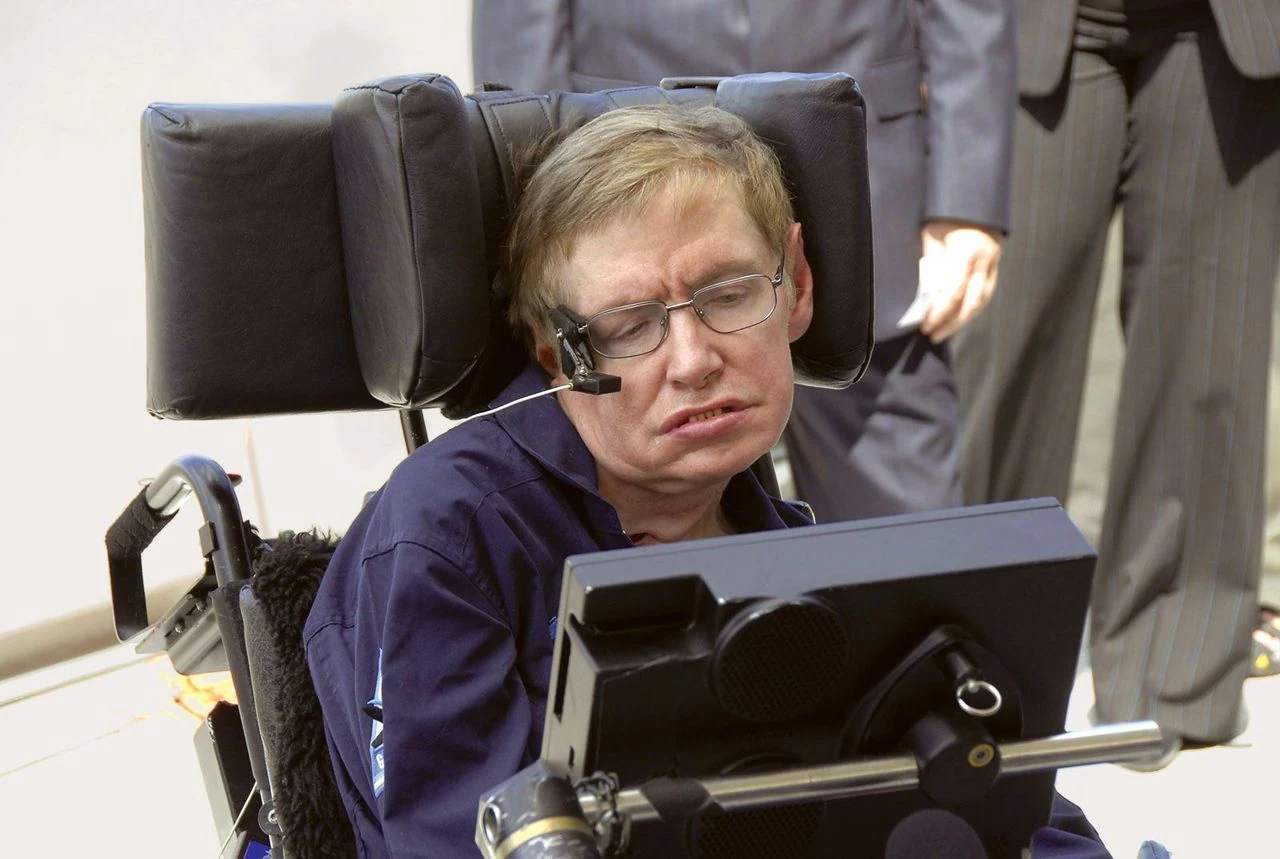
His electronic speech became another familiar part of his public presence. As his speech deteriorated, communication technology allowed him to select words and phrases; later, he operated his device using movements of a cheek muscle. The voice became recognisable to audiences around the world, but its significance was practical. It gave Hawking a means to communicate, lecture and continue his work as his physical abilities changed. His life with motor neurone disease should not be reduced to a symbol of willpower: the support of carers, engineers, colleagues and Cambridge’s academic community was also essential.
Honours, remembrance and a continuing argument
Hawking’s awards included the Adams Prize, the Royal Society’s Copley Medal and the Presidential Medal of Freedom, as well as many honorary degrees. In Britain, his election to the Royal Society and appointment to the Lucasian Professorship placed him within two important institutional traditions: the country’s scientific fellowship and Cambridge’s long history of mathematical scholarship. His work was also recognised through public honours, including appointment as a Commander of the Order of the British Empire and later as a Companion of Honour.
Hawking died in Cambridge on 14 March 2018, aged 76, more than five decades after his diagnosis. Following his cremation, his ashes were interred in Westminster Abbey, between the graves of Isaac Newton and Charles Darwin. The memorial stone bears an equation associated with the temperature of Hawking radiation. The location connects his scientific life to a national act of remembrance, while the equation recalls the research for which he is best known.
His career offers no simple division between scientific achievement and public fame. The books, lectures and media appearances brought cosmology into common conversation; the research behind them remained technically demanding and open to challenge. His theories continue to generate questions for physicists, while the public books remain an invitation to think about how the universe works. Both strands belong to the account of Hawking’s influence.
Why Stephen Hawking deserves a place in British Legacy
Stephen Hawking deserves a place in British Legacy because his work changed the questions modern physics had to confront. With Roger Penrose, he helped establish that singularities arise under broad conditions in general relativity, bringing the history of the universe into sharper scientific focus. His prediction of black-hole radiation joined quantum theory to gravity and thermodynamics, making black holes a proving ground for difficult questions about energy, entropy and information. The no-boundary proposal with James Hartle extended that ambition to the earliest description of the universe. These achievements were not just memorable ideas: they shaped continuing research and clarified where established theories meet their limits.
His British legacy also rests on the way he connected specialist research with a broad reading public. Educated at Oxford and Cambridge, Hawking spent his career at Cambridge, held the Lucasian Professorship and became a Fellow of the Royal Society. Through A Brief History of Time, lectures and later books, he invited readers to engage with cosmology without claiming that its hardest questions had easy answers. His communication technology enabled him to keep contributing as motor neurone disease restricted his speech and movement, with sustained support from people and institutions around him. The result is a legacy that joins scientific ambition, public explanation and the conditions that make intellectual work possible. Westminster Abbey’s memorial records national recognition, but the strongest reason to remember him is the work itself: Hawking helped make the universe both a subject of serious scientific inquiry and a subject ordinary readers could discuss.
Sources
Adapted in part from Stephen Hawking by Wikipedia contributors, under CC BY-SA 4.0. Text has been edited and combined with the existing article; this adapted text is shared under the same licence. Contributor history.