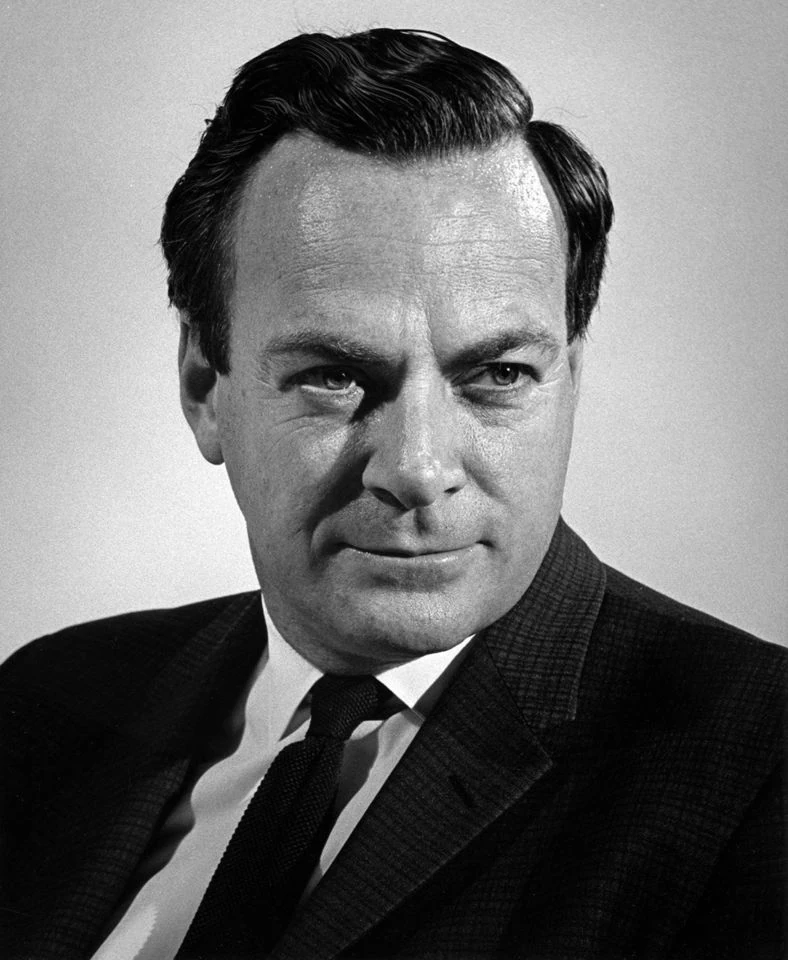
Richard P. Feynman made difficult physics visible. His diagrams gave physicists a way to represent interactions between subatomic particles, while his path-integral formulation offered a different mathematical route through quantum mechanics. The American theoretical physicist shared the 1965 Nobel Prize in Physics for work on quantum electrodynamics. A British connection is present in his record, but it needs to be described accurately: the supplied Wikipedia account identifies him as a foreign member of the Royal Society, not an honorary member, and does not support the imported article’s claim that he held a post at the University of Birmingham.
A young physicist in wartime
Born in New York City on 11 May 1918, Feynman studied at the Massachusetts Institute of Technology before completing a doctorate at Princeton University in 1942. His thesis, The Principle of Least Action in Quantum Mechanics, laid groundwork for the path-integral approach that became one of his best-known contributions. He developed an early interest in physics through mathematical problems and experiments, and his academic work quickly brought him into the circle of physicists tackling fundamental questions about matter and energy.
During the Second World War, Feynman joined the Manhattan Project, the United States programme to develop an atomic bomb. At Los Alamos he worked in the theoretical division, contributed to calculations and helped lead a group of human computers using punched-card machines. He also worked on safety procedures for the handling of enriched uranium at Oak Ridge. The wartime work was consequential, but it was only one part of a career that would return to the foundations of theoretical physics after the war.
Making quantum electrodynamics calculable
In the years after the war, physicists faced serious mathematical difficulties in quantum electrodynamics, the theory describing interactions between light and charged particles. Feynman developed a distinctive approach to those problems, using diagrams to represent particle interactions and organise calculations. The diagrams translated complicated expressions into a visual system that other physicists could learn and use. They became a practical tool in theoretical physics, not merely illustrations of an already settled idea.
Feynman’s work developed alongside that of other physicists. In 1965 he shared the Nobel Prize in Physics with Julian Schwinger and Sin-Itiro Tomonaga for their fundamental work in quantum electrodynamics and its consequences for elementary-particle physics. Feynman’s contribution was part of an international achievement; the diagrams that bear his name remain widely used in calculations of particle behaviour.
His path-integral formulation offered another way to approach quantum mechanics. Instead of describing a particle as following just one possible history, the formulation calculates by summing over possible histories. It complemented the approaches associated with Schrödinger and Heisenberg and grew from ideas in Feynman’s doctoral work. Alongside his work on QED, he studied superfluid helium, weak interactions and the structure of nucleons, developing the parton model to interpret scattering experiments.
Researcher, teacher and public explainer
Feynman’s influence extended beyond specialist research. At the California Institute of Technology, he gave the undergraduate lectures that became The Feynman Lectures on Physics, published with Robert Leighton and Matthew Sands. He also wrote for general readers, including The Character of Physical Law and QED: The Strange Theory of Light and Matter. His teaching emphasised clear reasoning and questioning rather than memorising a collection of results. The lectures have remained in circulation as an introduction to physics, though their enduring value does not mean every student found them easy.
He was also willing to examine the gap between scientific appearance and scientific substance. In his 1974 Caltech commencement address on “cargo cult science”, he argued for intellectual honesty and warned researchers not to fool themselves. In 1986, as a member of the commission investigating the Space Shuttle Challenger disaster, he demonstrated on television how cold affected the resilience of the shuttle’s O-ring material. The commission linked the failure to an O-ring that did not seal properly in unusually cold conditions. His public work in these cases joined explanation to a practical insistence that evidence should take precedence over reassuring claims.
What the British connection does—and does not—show
The imported article describes a 1947–48 tenure at the University of Birmingham and encounters with physicists Rudolf Peierls and Paul Dirac. The supplied Wikipedia account does not support that story: its account of Feynman’s workplaces names Cornell University and the California Institute of Technology, and it provides no Birmingham appointment. The claim that he spent significant periods in Britain, or that a Birmingham exchange shaped later breakthroughs, cannot therefore be presented as established fact.
A specific British institutional link is documented in the supplied reference: Feynman was elected a foreign member of the Royal Society in 1965. This is distinct from the imported article’s description of him as an honorary member. The wider reach of his work also entered British culture: the BBC made programmes about him, including The Pleasure of Finding Things Out and a 2013 drama about the Challenger investigation. These are concrete signs of British recognition and presentation, but they do not establish a British academic appointment or a particular influence on British research institutions.
Why Richard P. Feynman deserves a place in British Legacy
Feynman belongs in British Legacy not as a British-born scientist or as the holder of a British university post—the supplied evidence does not establish either—but as an American physicist whose work received formal recognition from a central British scientific institution. His election as a foreign member of the Royal Society in 1965 provides a precise, documented connection. It places him within the Society’s international scientific fellowship while preserving the distinction between recognition by a British institution and membership of the British scientific community by birth or employment.
His achievements explain why that recognition matters. Feynman’s diagrams gave physicists a durable method for representing particle interactions; his path-integral formulation offered a powerful approach to quantum mechanics; and his contribution to quantum electrodynamics was recognised by the Nobel Prize he shared with Schwinger and Tomonaga. His teaching and writing brought difficult ideas to audiences beyond research laboratories, while the BBC’s programmes and drama carried his work and public role to British viewers. Taken together, these links show how scientific ideas and reputations cross borders through research, institutions and public communication. A careful British legacy for Feynman is therefore not a claim of national ownership, but an account of documented recognition and exchange across the international scientific world.
Sources
Richard Feynman — revision 1375453389 · Richard Feynman
Adapted in part from Richard Feynman by Wikipedia contributors, under CC BY-SA 4.0. Text has been edited and combined with the existing article; this adapted text is shared under the same licence. Contributor history.