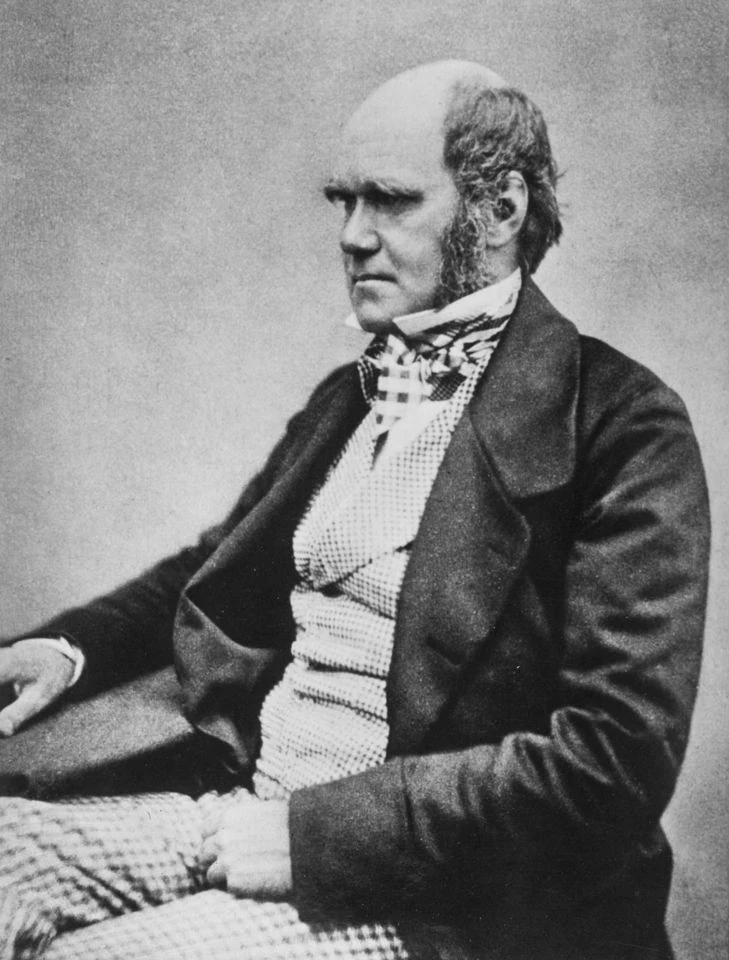
Charles Darwin did not arrive at the theory of natural selection in a sudden flash of inspiration. He spent years testing an idea against fossils, living organisms, experiments and the work of other naturalists. The result, developed in Britain and set out in On the Origin of Species, offered biology a powerful account of adaptation and the relatedness of life. Darwin’s achievement was not simply to propose that species change, but to assemble a sustained body of evidence for how that change could happen.
From Shrewsbury to Cambridge
Charles Robert Darwin was born in Shrewsbury on 12 February 1809. He attended Shrewsbury School and, in 1825, began studying medicine at the University of Edinburgh. The lectures failed to hold his interest and he found surgery distressing. Instead, he became absorbed in natural history, joining a student society and assisting the naturalist Robert Edmond Grant with investigations of marine invertebrates.
In 1828 Darwin moved to Christ’s College, Cambridge, where his studies included theology and natural science. He graduated with a BA in 1831. Cambridge brought him into the circle of the botanist John Stevens Henslow, whose encouragement helped him secure a place on HMS Beagle. Darwin sailed later that year on a surveying voyage that lasted until 1836.
Darwin was not the ship’s official naturalist, but he spent much of the journey ashore collecting specimens and studying geology and wildlife. Fossils of extinct South American mammals, the distribution of living species and differences between island animals and their mainland relatives all raised questions about how life had changed. His observations did not provide a finished theory; they gave him material to investigate. Darwin’s journal of the voyage also brought him a readership, while his geological work helped establish his scientific reputation.
How natural selection works
Darwin began to develop his theory after returning to England. By 1838 he had devised the central mechanism: individuals within a population vary, and more are born than can survive. If a variation helps an organism in its surroundings and can be inherited, those carrying it are more likely to leave descendants. Over generations, such differences can become more common. Darwin called this process natural selection.
The theory offered an explanation for adaptation without requiring nature to act with intention. It also supported common descent: the view that living species are connected through ancestry rather than fixed, unrelated forms. Darwin’s account drew comparisons with selective breeding, in which people choose which plants or animals reproduce. In nature, selection has no breeder directing it; its effects accumulate through the differing success of organisms in particular conditions.
Darwin worked on the theory for years before publishing. Alfred Russel Wallace independently reached a closely related idea. In 1858, their work was presented jointly to the Linnean Society of London. This shared announcement is an important part of the history: Darwin became the best-known advocate of natural selection, but he was not alone in arriving at it.
Down House: experiment, argument and publication
Darwin married Emma Wedgwood in 1839. In 1842 they moved to Down House in Kent, where they lived for the rest of his life. The house became the setting for sustained research rather than a retreat from scientific work. Darwin read, corresponded, took notes and conducted experiments, building and revising his case from evidence gathered across many areas of natural history.
His inquiries ranged from barnacles and pigeons to the survival of seeds in salt water. Work on domesticated animals helped him examine variation and inheritance; studies of other organisms tested the reach of his ideas. His geological research also continued. Darwin’s investigations of coral reefs and his extended study of barnacles formed substantial scientific work in their own right. The variety of these projects mattered: they helped him explore how organisms differ, how features can be inherited and how species might spread and adapt.
In 1859 Darwin published On the Origin of Species. Rather than presenting a brief declaration, it made a detailed argument through observations, examples and replies to anticipated objections. Its case for descent with modification and natural selection challenged the assumption that species were permanently fixed. The book provoked debate and made evolution a central subject of scientific and public discussion. Acceptance of evolution grew during Darwin’s lifetime, although many scientists initially remained unconvinced that natural selection was its principal mechanism.
A career beyond Origin
Darwin’s scientific writing was broader than his best-known book. His Journal of Researches, based on the Beagle voyage, established him as a popular author. He published on geology and zoology, and his work on barnacles earned him the Royal Society’s Royal Medal in 1853. His later research extended into plants, from orchids and climbing plants to carnivorous species and the movement of plants.
In The Descent of Man (1871), Darwin applied evolutionary thinking to human beings, placing humanity within the natural world. He also developed his account of sexual selection. The subject was controversial, but it followed from his wider argument that human beings, like other species, have a history shaped by biological processes. In The Expression of the Emotions in Man and Animals (1872), he examined continuities between human and animal behaviour. His books on plants and earthworms further show how widely he pursued questions about adaptation and the workings of life.
Later science revised and extended aspects of Darwin’s explanation. Genetics and the modern evolutionary synthesis supplied a stronger account of inheritance than Darwin had possessed. That development did not make natural selection irrelevant: it placed the mechanism within a broader scientific framework. Darwin’s work established evolution as a unifying way to understand both the diversity of life and the relationships among living things.
Death and commemoration
Darwin died at Down House on 19 April 1882, aged 73. He had expected to be buried at Downe, but colleagues and public and parliamentary support helped secure his burial in Westminster Abbey. The funeral took place on 26 April, and his grave was close to those of John Herschel and Isaac Newton. The decision marked a striking public recognition of a naturalist whose work had challenged familiar ideas about the history of life.
His British commemoration has also taken scientific and cultural forms. The Linnean Society established the Darwin–Wallace Medal to mark the 1858 joint presentation. Cambridge’s Darwin College, founded in 1964, bears the family name, and Darwin appeared on Bank of England £10 notes issued between 2000 and 2017. These reminders sit alongside the scientific influence of his work and the continuing public argument about what evolution explains.
Why Charles Darwin deserves a place in British Legacy
Darwin belongs in British Legacy not merely because he was born in Shrewsbury or is buried in Westminster Abbey, but because the evidence and institutions of his British life helped produce a theory with worldwide importance. Edinburgh and Cambridge shaped his early scientific interests; Henslow’s support helped put him aboard the Beagle; and London’s learned societies provided places where observations and arguments could be presented. At Down House, he turned a striking idea into a long, disciplined programme of research. The 1858 joint presentation with Alfred Russel Wallace and the publication of On the Origin of Species made that work part of British scientific history while changing biology’s account of life.
The value of Darwin’s achievement lies in the explanation itself. Natural selection connected variation, inheritance and the struggle to survive in a way that could account for adaptation over generations. Common descent gave the diversity of organisms a shared history. Darwin’s books on geology, barnacles, plants, human evolution and behaviour also show a working naturalist repeatedly testing how far his ideas could take him. Later science corrected and strengthened parts of his account, but the framework he helped establish remains central to evolutionary biology. His legacy is therefore not a claim that one person settled every question; it is a record of how careful observation, open argument and a powerful explanatory idea can reshape a field of knowledge.
Sources
Charles Darwin — Wikipedia revision 1371979350
Adapted in part from Charles Darwin by Wikipedia contributors, under CC BY-SA 4.0. Text has been edited and combined with the existing article; this adapted text is shared under the same licence. Contributor history.