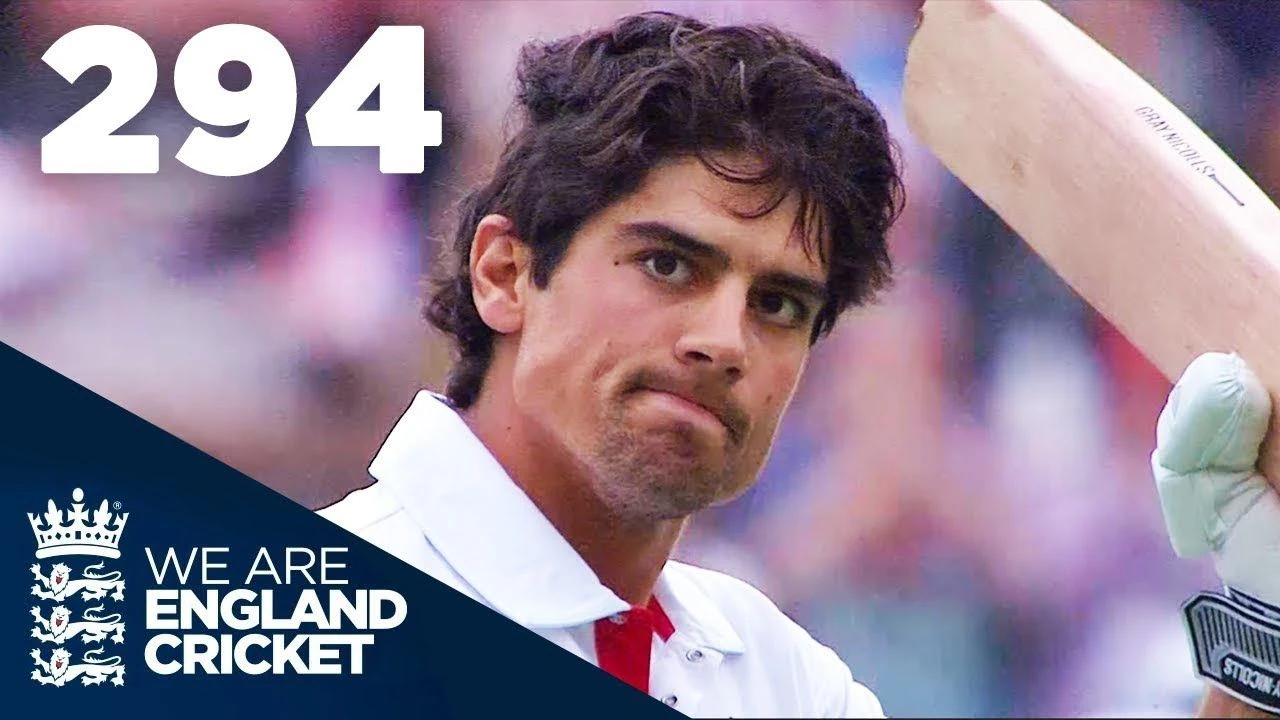
Alastair Cook began his Test career with a century against India and ended it, 12 years later, with another. Between those innings, the left-handed opener made 12,472 Test runs, captained England in 59 Tests and played 159 consecutive matches. His career was built less on spectacle than on concentration: he occupied the crease, accumulated runs and became one of the defining English Test cricketers of his generation.
A schoolboy opener from Essex
Cook was born in Gloucester on 25 December 1984. His mother, Stephanie, was a teacher from Swansea; his father, Graham, worked as a telecommunications engineer and played village cricket. The family lived in Wickham Bishops, Essex, where Cook began turning out for Maldon Cricket Club. By 11, he was playing in the adult Third XI. Cricket soon competed with another serious interest: music. He learnt clarinet, piano and saxophone, sang as a chorister and later became president of Bedford School’s Music Society.
At 13, Cook moved to Bedford School as a boarding pupil. He was already making an impression with the bat: when the Marylebone Cricket Club were short of a player for a match against the school, the 14-year-old Cook joined the visiting side and scored a century. Over the next four years, he made 17 centuries and two double-centuries for the school. In 2003, his final year, he scored 1,287 runs at an average of 160.87, setting a school record.
His progress was not confined to school cricket. Cook had joined the Essex Academy aged 16 and made his first-class debut for Essex in 2003, soon after leaving school. He scored 69 not out in his second innings in that first match. A maiden first-class century followed against Leicestershire in 2004. The next season brought further signs of his readiness for a higher level: he made a century in the opening match for the Marylebone Cricket Club and finished the County Championship season with four centuries. He also helped Essex win the Totesport League title.
A first Test century at 21
Cook’s England opportunity came in India in March 2006. Called into the touring side as a replacement for Marcus Trescothick, he made his Test debut aged 21. He scored 60 in the first innings and an unbeaten 104 in the second, becoming the 16th Englishman to make a century on Test debut. Later that year, he made his first Test century at Lord’s, against Pakistan, and added another in the following Test. On the 2006–07 Ashes tour, his 119 in the fourth Test was his first Ashes century. England lost the series, but Cook’s ability to stay in for long periods was already clear.
His early international career included both setbacks and rapid milestones. He made his one-day international debut in 2006 and his first ODI century the following year, against India. In 2007 he also made his Twenty20 International debut. His first Test century after a 15-month gap came in 2009, when he scored an unbeaten 139 against the West Indies. That innings came after England had been asked to bat again, and made him the youngest Englishman to pass 3,000 Test runs.
Cook’s defining stretch of Ashes batting came in Australia in 2010–11. He made 235 not out in Brisbane, then 148 in Adelaide and 189 in Sydney. His 766 runs were the most in the series, and England won the Ashes in Australia for the first time since 1986–87. He had spent more than 36 hours at the crease across the series. These innings demonstrated the qualities that shaped his reputation: patience under pressure, a strong technique and the stamina to make a long innings count.
Captaincy, records and difficult tours
Cook took over as England’s Test captain in August 2012 after Andrew Strauss retired. He made centuries in each of his first three Tests in charge against India, and England won the series 2–1. In December, he became England’s leading Test century-maker, passing the previous record against India in Kolkata. His captaincy encompassed contrasting results: England won the home Ashes series in 2013 and again in 2015, but were whitewashed 5–0 in Australia in 2013–14.
In the 2015 Ashes, England recovered from defeat in the second Test to win the series 3–2. Cook’s contribution was not limited to his own runs; it was a significant result during a period when the team faced pressure after a damaging tour of Australia. That year he also scored 263 against Pakistan in Abu Dhabi, an innings lasting 836 minutes. In May 2015, he passed Alec Stewart to become England’s leading Test run-scorer at the time. In 2016, against Sri Lanka, he became the first Englishman to reach 10,000 Test runs and the youngest batter to reach the landmark.
Cook led England in 59 Tests, an English record at the time, before stepping down in February 2017. He remained in the side under Joe Root. In the 2017 Boxing Day Test in Melbourne, Cook made an unbeaten 244, the highest Test score by an opener who had carried his bat. He passed 12,000 Test runs during the following Ashes series. His record of 159 consecutive Tests was another measure of the reliability that had marked his career.
On 3 September 2018, Cook announced that he would retire from international cricket after the final Test against India. In that match, his last, he scored 147. He became the fifth batter to make a century in both his first and last Test appearances. The innings brought a fitting close to a career whose two bookend hundreds were separated by more than a decade of sustained international batting.
Essex, recognition and life beyond international cricket
Retirement from England did not immediately mean retirement from cricket. Cook continued playing for Essex, the county he had represented since 2003, and helped the side win the County Championship in 2019. He scored his 24,000th first-class run in 2020 and his 70th first-class century in 2022. He retired from all forms of cricket in October 2023. He has also worked as a commentator on the BBC’s Test Match Special.
Cook’s work outside the game has included charity support. He took part in the Great City Race for Breakthrough Breast Cancer and modelled with fellow cricketers James Anderson and Stuart Broad for the Everyman Campaign, which raises awareness of testicular cancer. He is a patron of the David Randall Foundation, named for his childhood friend and opening partner at Maldon and in Essex age-group cricket; proceeds from Cook’s 2014 benefit year went in large part to the charity. His interests have also extended to farming, which he has described as a passion alongside cricket.
He was appointed an MBE in 2011 and a CBE in 2016 for services to cricket, and became a Knight Bachelor in 2019. Cook’s honours have also included selection for the ICC World Test XI and induction into the ICC Cricket Hall of Fame. They mark an international career whose strongest evidence is in the record books: 161 Tests, 12,472 runs and 33 centuries.
Why Alastair Cook deserves a place in British Legacy
Cook’s place in British sporting history rests on a specific achievement: he made sustained, high-level Test batting central to England’s success for more than a decade. His 12,472 runs and 33 Test centuries set a demanding standard, while 159 consecutive appearances speak to an unusual consistency of availability. The figures tell only part of the story. From his debut century in India to his final hundred at The Oval, Cook repeatedly gave England long innings at moments when the team needed them. His 766-run Ashes series in Australia in 2010–11 helped England win there, and he captained the side to Ashes victories at home in 2013 and 2015.
His significance is also rooted in the path he took through English cricket. Cook developed at Maldon and Bedford School, came through Essex’s academy and county side, and spent the years after international retirement playing for Essex again. That continuity connects school, club, county and national cricket in one career. As captain, record-holder and long-serving opener, he gave England a dependable presence across changing teams and tours. His later work with the David Randall Foundation and cancer-awareness campaigns extends his public contribution beyond results on the field. Cook’s legacy is not a claim about national character; it is a well-documented record of service to English cricket and a career shaped within its institutions.
Sources
Alastair Cook — revision 1369506115 · Alastair Cook
Adapted in part from Alastair Cook by Wikipedia contributors, under CC BY-SA 4.0. Text has been edited and combined with the existing article; this adapted text is shared under the same licence. Contributor history.