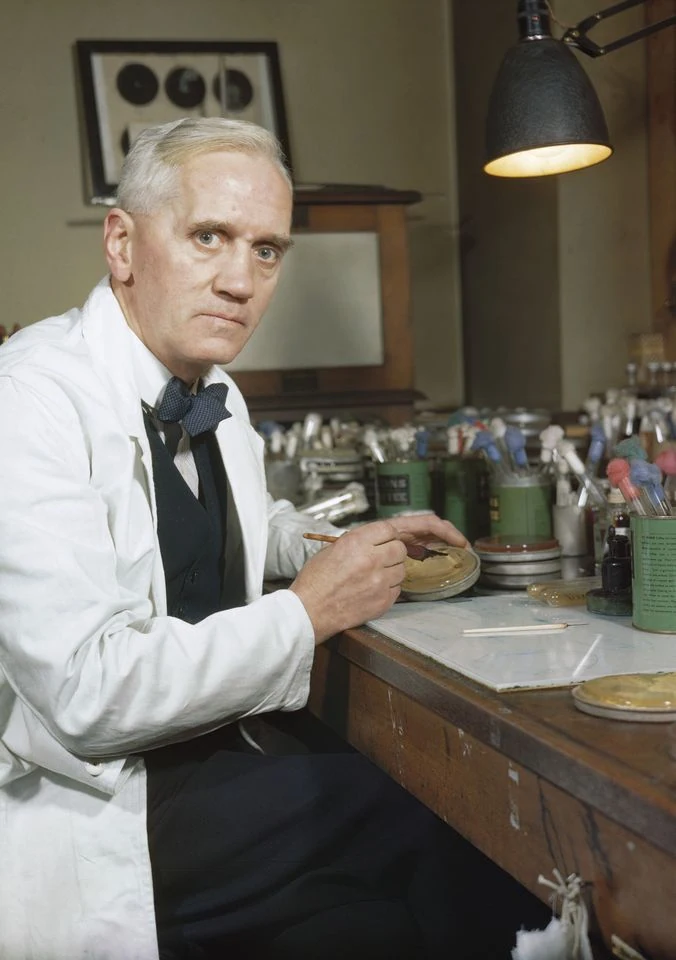
In 1928, Alexander Fleming noticed that a mould contaminating a laboratory culture had left a clear patch where bacteria could not grow. The observation, made at St Mary’s Hospital in Paddington, did not immediately produce a usable medicine. Fleming investigated the substance and named it penicillin; years of work by other researchers were needed to purify and produce it as a treatment. The distinction matters. Fleming’s discovery opened a path, but penicillin’s medical impact depended on a much wider team.
Fleming’s work belonged to a career spent asking how infection behaved and how it might be controlled. Before penicillin, he had identified lysozyme, a natural antimicrobial enzyme. His experience treating wounds during the First World War had made him question whether antiseptics could always help. Later, as penicillin came into use, he warned that careless treatment could encourage resistant bacteria. Across these episodes, his method was to observe, test and consider the limits of the tools available.
From Ayrshire to St Mary’s
Fleming was born on 6 August 1881 at Lochfield farm near Darvel, in Ayrshire. He attended Loudoun Moor School and Darvel School, then won a scholarship to Kilmarnock Academy. After moving to London, he studied at the Royal Polytechnic Institution. An inheritance from an uncle helped make medical training possible, and in 1901 he enrolled at St Mary’s Hospital Medical School in Paddington. He qualified in 1906 and joined the hospital’s research department as assistant bacteriologist to Almroth Wright, a leading figure in vaccine therapy and immunology.
Fleming’s early work was shaped by the practical problem of infected wounds. During the First World War, he served in the Royal Army Medical Corps and worked with colleagues in military hospitals in France. He saw soldiers die of sepsis and observed that antiseptics could harm tissue without reaching bacteria deep in a wound. In a 1917 paper, he described experiments explaining why antiseptic treatment could fail in such conditions. This experience informed his interest in tackling infection without worsening an injured patient’s condition.
After the war, Fleming returned to St Mary’s and continued his bacteriological research. In 1928, he became Professor of Bacteriology at the University of London. The hospital was not simply the setting for one famous observation: it was where he trained, built his career and carried out the work that led to both lysozyme and penicillin.
Lysozyme and the body’s defences
In 1921, while working with bacterial cultures, Fleming found that mucus from his nose inhibited bacterial growth. Further tests showed that a similar effect could be found in tears and other bodily secretions. He named the active substance lysozyme and reported the discovery in 1922. It acted against some bacteria, but had limited therapeutic potential because it was not effective against many disease-causing organisms.
Lysozyme did not become a widely used medicine. Its importance was different: it showed that the body has natural antimicrobial defences and demonstrated how an unexpected result could be turned into a research question. Fleming’s identification of the enzyme gives a fuller view of his scientific contribution. Penicillin was not his first discovery of an antibacterial substance, and his career was not confined to the finding that later made him famous.
The mould on the culture plate
Fleming had been studying staphylococci, bacteria that can cause infection. In September 1928, after returning from a holiday, he examined cultures left in his laboratory. One had been contaminated by a fungus. The colonies nearest the mould had been destroyed, while those farther away remained. Fleming recognised that the mould was producing a substance that inhibited bacterial growth.
He grew the mould and tested the antibacterial substance in its culture broth. On 7 March 1929, he gave it the name penicillin; his findings appeared in a paper later that year. The substance affected several bacteria, including staphylococci and the bacterium that causes gonorrhoea, but not every type of infection. The original mould has been called by different names over time. The strain once commonly described as Penicillium notatum is now classified as Penicillium rubens.
The finding was remarkable, but it was not yet a reliable drug. Fleming could not readily purify penicillin or produce it in sufficient quantities, and early attempts to attract wider scientific interest had little effect. Seeing an antibacterial effect in a laboratory was not the same as delivering an effective treatment. The discovery did not transform hospital medicine overnight.
From laboratory finding to treatment
At Oxford, Howard Florey, Ernst Boris Chain, Norman Heatley and their colleagues developed methods to purify, test and produce penicillin. Their work turned Fleming’s observation into a treatment that could be used against serious infection. This was a collaborative effort involving researchers, manufacturers and wartime support in Britain and the United States. Recognising those contributions does not diminish Fleming’s role: without his observation and early experiments, the later development would have had no starting point.
Penicillin’s potential became clearer through treatment and clinical testing. Fleming’s first clinical trial, in 1929, involved his research scholar Stuart Craddock, who had a severe sinus infection. The treatment had no effect; the infection was probably caused by a bacterium Fleming had found penicillin could not inhibit. This early failure illustrates a limitation of the discovery and why further research was essential. In 1930, Cecil George Paine, a pathologist in Sheffield and former student of Fleming, used penicillin successfully to treat eye infections in an adult and three infants.
In 1942, Fleming used a sample supplied by Florey’s team to treat Harry Lambert, who had a severe infection of the nervous system. Lambert recovered. The case helped bring attention to penicillin, but wider use required continued work by the Oxford researchers and methods for production on a much larger scale. By the middle of the decade, the drug was being produced and distributed in quantities that made treatment on a broad scale possible.
Fleming, Florey and Chain shared the 1945 Nobel Prize in Physiology or Medicine for the discovery of penicillin and its curative effect in infectious diseases. The shared award reflects the stages involved: Fleming recognised and investigated the substance; the Oxford group established how it could be used as a treatment. The history is more accurate when it includes both contributions, rather than compressing the work into a lone-hero story.
Resistance, recognition and remembrance
Fleming also warned that penicillin could lose its effectiveness if used carelessly. In public remarks and his Nobel lecture, he cautioned that too little penicillin, or treatment for too short a period, could allow resistant bacteria to develop. His warning was not an argument against the drug; it was a reminder that its use required care. Medical advances, he understood, could bring responsibilities as well as benefits.
His honours included election as a Fellow of the Royal Society in 1943 and a knighthood in 1944. The Nobel Prize followed in 1945. Fleming died in London on 11 March 1955, aged 73, and his ashes were placed in St Paul’s Cathedral. The preserved laboratory and museum at St Mary’s keep his work connected to the hospital where he made his discoveries.
Why Alexander Fleming deserves a place in British Legacy
Fleming’s place in British history rests on a specific chain of work. Born in Scotland, he trained and pursued his career at St Mary’s in London, where he recognised and investigated penicillin’s effect on bacteria. His discovery became the starting point for research at Oxford that made the substance into a treatment. This is a British story not because discovery belongs to one country alone, but because the institutions and researchers involved can be identified: St Mary’s, the Oxford team and the wider research and production effort that followed.
The human significance of penicillin lies in what effective treatment for bacterial infection made possible. It helped doctors tackle infections that had previously been difficult or impossible to treat, changing the prospects of patients with serious bacterial illness. Fleming’s contribution belongs alongside the work of Florey, Chain, Heatley and their colleagues, whose development of the drug brought its potential to patients. His identification of lysozyme and his warning about resistance add further dimensions: he investigated natural defences and recognised that a powerful treatment could be undermined by misuse.
Remembering Fleming in British Legacy therefore means more than celebrating a single discovery. His story links Scottish origins, London medical training and research, and Oxford’s work to develop a practical treatment. It also shows why scientific credit needs care: an important observation may be indispensable without being the whole story. Penicillin’s benefits arose from a sequence of experiments, clinical work and production, carried out by many people. Fleming deserves recognition for the insight that began that sequence, and for a scientific career that included other discoveries and an early warning about preserving the usefulness of antibiotics.
Sources
Alexander Fleming — Wikipedia, revision 1371963865
Adapted in part from Alexander Fleming by Wikipedia contributors, under CC BY-SA 4.0. Text has been edited and combined with the existing article; this adapted text is shared under the same licence. Contributor history.