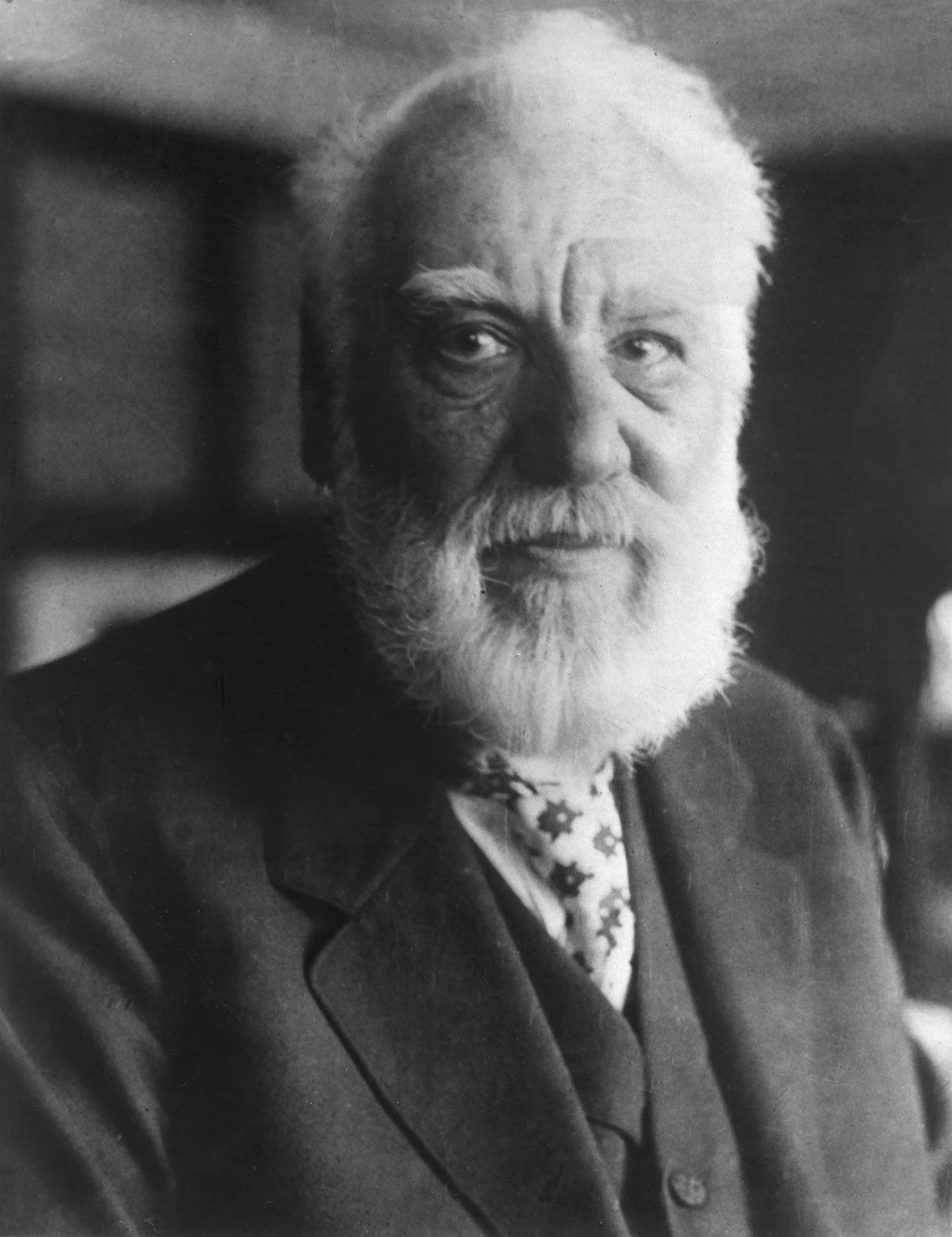
Before the telephone, the telegraph could carry messages over long distances, but it could not carry a human voice. Alexander Graham Bell helped change that. Born in Edinburgh on 3 March 1847, he brought a close interest in speech and hearing to experiments in electrical transmission. The telephone became his best-known achievement, but his work also encompassed sound recording, optical communication, aviation and hydrofoils. His life connects a Scottish beginning and a London family tradition of speech study with an adult career spent largely in North America.
Edinburgh beginnings and the study of speech
Bell grew up in a family whose work centred on speech. His father, Alexander Melville Bell, developed Visible Speech, a system for showing how sounds are formed. His grandfather had worked in elocution in London. Pronunciation, articulation and communication were not remote scientific topics in the Bell household: they were subjects to demonstrate and teach. This gave the young Bell a practical interest in the production of speech before he turned to electrical apparatus.
His mother gradually lost her hearing. Bell’s interest in sound therefore had a personal context as well as a technical one. He was brought up around the question of how speech could be made and understood, and how communication might be affected when hearing changed. He was educated in Edinburgh and later studied in London, though he did not complete a conventional university course. As a young man he served as a pupil-teacher in Elgin and assisted his father with demonstrations. These experiences combined the study of speech with the work of explaining it to others.
In 1870, after Bell’s two brothers died of tuberculosis, the family emigrated to Canada. The move changed the setting of Bell’s adult life: his later experiments and career unfolded mainly in North America. But the family’s interests travelled with him. His exposure to speech science remained a foundation for the problem he would eventually address electrically: how to convey not just a coded message, but the changing sounds of a voice.
From telegraphy to the telephone
Bell entered a world in which the telegraph could send messages quickly, provided they were encoded and interpreted. Inventors were also trying to send more than one signal along a wire. Bell’s experiments with the harmonic telegraph arose from that effort. Working with Thomas Watson, a skilled mechanic, he explored whether an electrical current could vary in response to the vibrations of speech. The central idea was to reproduce the continuous changes in a voice through changing electrical signals. A telephone, on this account, was not simply a louder or faster telegraph; it required a different way of representing sound.
On 7 March 1876, Bell received United States patent 174,465, described as an “improvement in telegraphy”. Three days later in Boston, he called to Watson: “Mr Watson, come here, I want to see you.” The words have become a shorthand for the invention, but the essential demonstration was that articulate speech could travel electrically and be understood at the other end. Bell was working in a crowded field of experimenters, and subsequent patent disputes were fierce. The supplied accounts describe his achievement as securing the first practical telephone patent and demonstrating a working instrument; that does not make him the only person whose experiments formed part of the history of the telephone.
The invention soon left the laboratory. Bell demonstrated it at the 1876 Centennial Exposition in Philadelphia and experimented with longer-distance calls in Ontario. In January 1878 he demonstrated the telephone to Queen Victoria at Osborne House on the Isle of Wight. The royal demonstration did not create the telephone, but it placed the new device before a British audience in a conspicuous setting. A technology that might have seemed an experimental curiosity was becoming something people could picture in use.
The telephone’s significance lay in the change it offered to everyday communication. A conversation no longer had to wait for a letter, and users did not have to translate their words into a telegraph code. The ability to speak at a distance could alter the pace of work for businesses, government offices, newspapers, railways and doctors. It could also give families separated by work or migration another means of staying in touch. Bell did not alone create every later use of the telephone, but his successful transmission of speech helped make these new patterns possible.
Light, recording and the experimental method
The telephone did not exhaust Bell’s interest in sound. In 1880 he and Charles Sumner Tainter developed the photophone, which transmitted sound using a beam of light rather than a wire. Light reflected from a vibrating surface could change in response to the sound, and those changes could be converted back into sound at the receiving end. Bell regarded the photophone as his greatest invention. Its principle is notable because it showed that light could carry speech, anticipating in a broad sense the later use of light in fibre-optic communication. The device was a separate line of enquiry, not simply another version of the telephone.
At the Volta Laboratory, Bell and his collaborators also worked on sound recording. Their work used wax in place of the tinfoil associated with earlier phonographs and refined the way sound could be inscribed. The significance of this work lies partly in improvement rather than a single dramatic first: recording had to become more practical if it was to be useful beyond an initial demonstration. Bell’s interest extended from transmitting sound to preserving it, and his laboratory work addressed the shortcomings of an existing process.
Not every experiment succeeded. After President James A. Garfield was shot in 1881, Bell tried to devise an induction-balance instrument that could locate the bullet. The attempt did not save Garfield. It shows, nonetheless, a characteristic approach in the supplied account: Bell met a practical problem by trying to build a device capable of detecting an object inside the body. The outcome is important to state plainly. An inventive response to an urgent need does not guarantee that the experiment will work.
Baddeck, aviation and speed on water
Bell’s later work in Baddeck, Nova Scotia, shows how far his interests extended beyond communication. At Beinn Bhreagh, his estate overlooking Bras d’Or Lake, he pursued experiments with models, boats and kites, working alongside younger collaborators. The place functioned as an experimental base, not merely as a retreat from public life. The projects varied, but they shared an interest in testing how a system behaved and whether its performance could be changed through design.
Bell helped found the Aerial Experiment Association, bringing together Glenn Curtiss, Frederick “Casey” Baldwin, J. A. D. McCurdy and Thomas Selfridge. The Association’s work contributed to early controlled flight. In February 1909 its Silver Dart made the first powered aeroplane flight in Canada. Bell’s contribution was not that of a solitary pilot or lone inventor. He helped establish a group in which collaborators could pursue ambitious engineering questions, an important form of practical work in its own right.
He also worked with Baldwin on hydrofoils. Their HD-4 used underwater wings to lift much of its hull clear of the water at speed, reducing drag. In 1919 it set a world marine speed record of 70.86 miles per hour. The design addressed a different problem from the telephone, but it reflects the same willingness to investigate how physical forces and forms could be arranged to improve performance. Bell’s later work was not a series of unrelated diversions: across fields, he kept testing what a new design could make possible.
Teaching, deaf education and disputed assumptions
Bell’s study of speech was also part of his work as a teacher. His mother was deaf, as was his wife, Mabel Hubbard. In Boston he taught deaf pupils and ran a school devoted to vocal physiology and the mechanics of speech. In 1886, when Helen Keller’s family sought guidance, Bell helped direct them towards an educational route that led to Anne Sullivan and Perkins. Keller later retained affection for Bell, and correspondence between them survived among his papers. These details show a sustained personal and professional involvement with deaf people, rather than a passing interest attached to his inventions.
That involvement needs to be considered alongside the limitations of Bell’s educational views. He supported oralism: teaching deaf people through speech and lip-reading rather than sign language. He also wrote about heredity in ways that became controversial. Deaf scholars and campaigners have criticised the assimilationist assumptions associated with his position and its undervaluing of Deaf language and culture. This is not a minor qualification to an otherwise uncomplicated story. The history of deaf education concerns choices about language, identity and whose understanding of communication should shape teaching.
Bell’s work with deaf pupils does not cancel that criticism, and the criticism does not remove the historical importance of his inventions. Both belong in an account of his life. His commitment to the study and teaching of speech existed alongside an approach to deaf education that many have challenged. The tension is a reminder that a technical interest in communication cannot, by itself, settle the human questions of how people communicate or which forms of language a society values.
Why Alexander Graham Bell deserves a place in British Legacy
Bell belongs in British Legacy because his British beginnings are specific and consequential, even though his adult career took place mainly in North America. Edinburgh was where he was born and educated; London was part of the family’s history of elocution and speech study. His early formation gave him an unusually practical interest in articulation, hearing and the mechanics of speech. That background helps explain the direction of his work: the telephone grew from an attempt to make the voice itself transmissible, rather than merely to send another kind of coded signal.
The benefit of that achievement can be described without claiming that Bell alone created the communications world that followed. By demonstrating that speech could be carried electrically, he helped make a new kind of conversation at a distance possible. That change affected the conduct of business and public services as well as the private lives of people separated by work or migration. The telephone’s legacy is not only a technical milestone; it is a change in what people could expect communication to do.
His wider record strengthens that case. Bell pursued the photophone’s transmission of sound by light, worked with colleagues to improve sound recording, helped organise experiments that contributed to powered flight in Canada, and developed a high-speed hydrofoil with Baldwin. These projects show a mind willing to move between fields and to work with collaborators, rather than treat one celebrated success as the end of enquiry. They also make his history more than a biography of a single device.
A lasting account must include the controversy around oralism and the criticism that Bell’s views undervalued sign language and Deaf culture. His life brought invention, education and disability into close contact, but technical progress did not guarantee an inclusive understanding of communication. Remembering Bell well means recognising both the practical reach of his inventions and the limits of his assumptions. That combination makes his British connection worth examining: a Scottish-born figure carried a tradition of speech study into work that reshaped communication internationally, while leaving questions about language and human difference that remain important to the history of education.