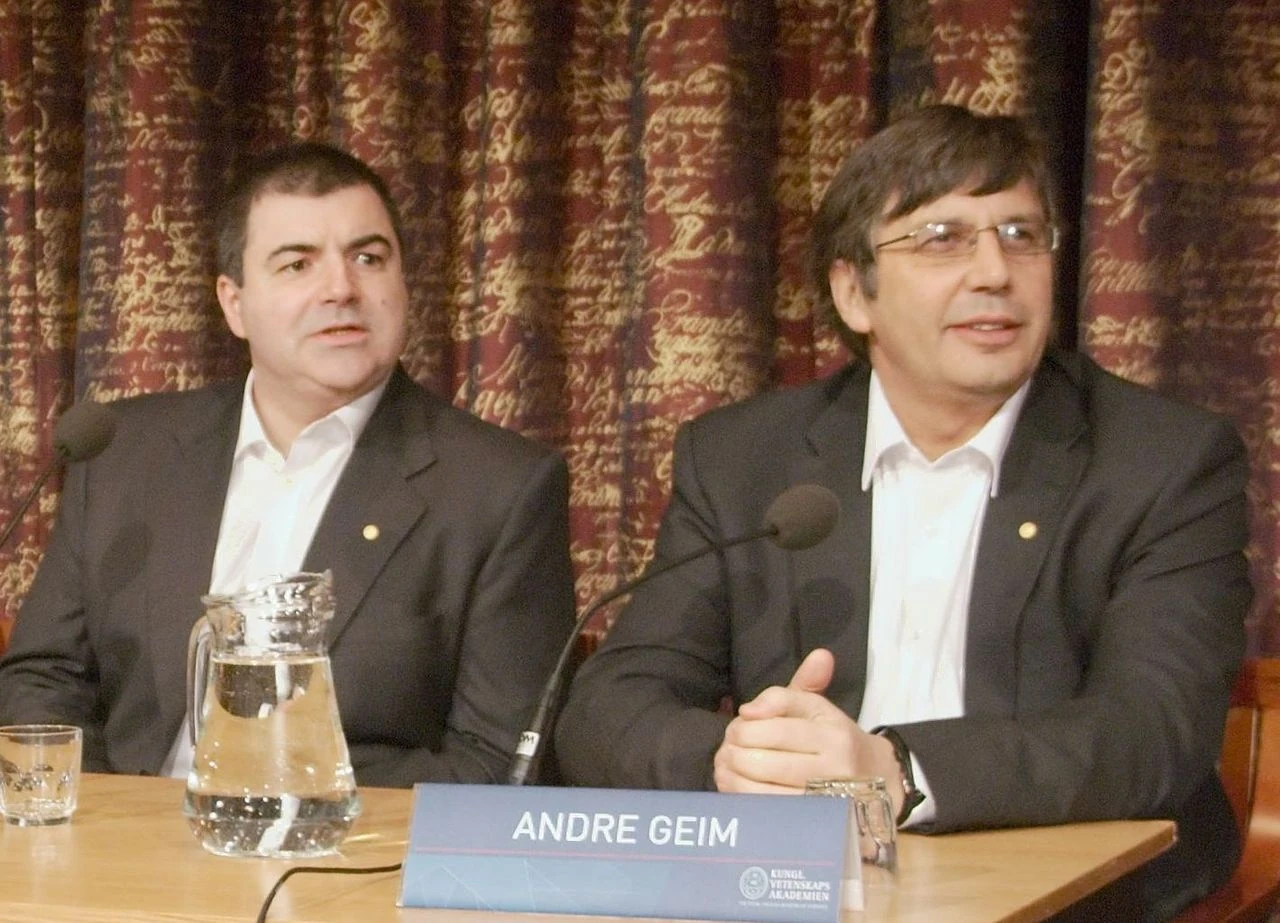
In 2004, Andre Geim and Konstantin Novoselov isolated graphene at the University of Manchester: a single layer of carbon atoms, just one atom thick. Their method involved adhesive tape and graphite, not an elaborate piece of machinery. Yet the result gave researchers a new material to study, with a striking combination of strength, conductivity, transparency and flexibility. The experiment was simple to describe; recognising what it could reveal, and establishing that the material could be isolated and investigated, was the consequential part.
Both scientists were born in Russia and later became British citizens, according to the supplied accounts. Their defining work took place in Manchester, and in 2010 they received the Nobel Prize in Physics for their experiments on graphene. Their story is therefore connected to Britain not by birthplace, but by scientific work carried out at a British university and its effect on research beyond the country.
A partnership in Manchester
Geim was born in Sochi in 1958; Novoselov was born in Nizhny Tagil in 1974. The supplied accounts give few further biographical details, but they establish the partnership’s most significant setting: the University of Manchester, where the two scientists worked together on graphene. Their achievement was not simply the simultaneous interest of two researchers in the same subject. The isolation of the material became a shared breakthrough, one that gave scientists a fresh subject for experiments and opened further questions about the behaviour of materials only a few atoms thick.
Manchester was more than the location attached to the discovery after the fact. It was where the work was done and where the result entered scientific discussion. That distinction matters when considering the British dimension of the story. Geim and Novoselov were born elsewhere, but their best-known achievement belongs to the record of research undertaken in Britain. The supplied accounts also state that both later became British citizens, adding a personal connection alongside their professional one.
The discovery quickly became one of the most notable scientific results associated with the start of the 21st century. Its appeal was partly the material itself, and partly the contrast between the scale of its implications and the plainness of the method. A familiar substance, graphite, could be separated until a single atomic layer remained. That did not make the work a casual accident. It required scientific judgement to see that a modest tool and a careful experimental approach might disclose a material worth investigating.
What graphene is
Graphene is a single layer of carbon atoms arranged in a two-dimensional honeycomb lattice. That description captures both its thinness and its ordered structure. It is not simply a very thin, featureless coating: its atoms form a regular arrangement. The supplied accounts describe graphene as transparent, conductive, flexible and around 200 times stronger than steel. Taken together, those properties help explain why the material attracted attention from several areas of science and engineering.
Materials often require designers to accept a trade-off. A material may be strong but heavy, or thin but fragile; a conductive layer may not be transparent. Graphene seemed to bring together qualities that can be difficult to find in one substance. Its appeal, then, was not only that it was exceptionally thin. It was that the thinness existed alongside useful physical properties, prompting researchers to ask what a single layer of carbon might make possible.
The honeycomb arrangement is part of that scientific interest. It gives a precise account of how the carbon atoms are organised, rather than treating graphene as an unspecified film. Structure and properties are closely linked in materials research; identifying a new material in a defined arrangement creates a basis for studying how it behaves and what uses might follow. The isolation of graphene supplied that basis, turning a theoretical possibility into an object of laboratory investigation.
A simple method, a significant result
Geim and Novoselov used adhesive tape to exfoliate layers from graphite until they obtained a single atomic layer. The basic idea can be understood without specialist equipment: separate an ordinary material into thinner and thinner layers, then identify the one-atom-thick result. Its accessibility makes the episode memorable, but it should not obscure the scientific achievement. A simple method is not automatically an effective experiment. The work depended on recognising what to try, carrying it out and establishing the significance of what had been isolated.
The supplied account describes the technique as ingenious and serendipitous. Those terms need not contradict one another. Chance may play a part in a scientific route, but the value of a result also depends on the researchers’ ability to recognise it and pursue its implications. In this case, tape and graphite became the means of separating a material that could be examined in its own right.
That human scale is one reason the discovery has travelled well beyond specialist accounts. The experiment can be explained plainly, without reducing the work to a trick. It offers an unusually clear illustration of how scientific progress need not always begin with imposing equipment: an everyday object can become useful in the hands of people who know what question to ask and how to interpret the result. The real significance lies not in tape alone, but in the combination of a practical method and a new research opportunity.
Why researchers looked to many fields
The properties attributed to graphene suggested possible uses in electronics, medicine, energy storage and composite materials. These are areas of potential application, not a claim that every proposed use has become an established technology. The distinction is important: a promising material can inspire investigation well before a particular application is demonstrated or widely adopted.
In electronics, graphene’s conductivity and extreme thinness prompted interest in flexible electronic devices, transparent conductive electrodes, and faster, more efficient transistors. A material that conducts electricity while remaining exceptionally thin invites designers to consider components in forms that differ from conventional rigid parts. Its transparency also makes it relevant to the idea of conductive surfaces that allow light through. These characteristics explain the research interest; the supplied accounts do not establish that every suggested electronic use has reached practical deployment.
In medicine, the imported account points to biocompatibility as a possible reason to investigate graphene for drug-delivery systems, biosensors and regenerative medicine. Such proposals depend on more than a material’s strength or conductivity: researchers must consider how it performs in biological settings. The examples indicate the breadth of the questions raised by graphene, rather than proving that the listed medical uses are established treatments or routine tools.
Energy storage offers another area of interest. Graphene-enhanced batteries and supercapacitors are described as potentially offering faster charging and greater storage capacity. That prospect addresses a practical challenge: storing energy as well as generating it. Here, too, the significance in the supplied account is the possibility under investigation, not a guarantee that the material will deliver each anticipated benefit in a finished product.
As an additive in composite materials, graphene could help make materials stronger and lighter. The supplied text identifies aerospace, automotive and consumer goods as possible contexts. Reducing weight while maintaining strength is an attractive aim for designers, but the potential application should not be mistaken for proof of a particular commercial outcome. The range of examples demonstrates why a material combining strength, low thickness and conductivity could interest researchers across different disciplines.
From one material to a wider research field
The significance of the Manchester experiment did not end with the isolation of graphene. The supplied accounts connect the scientists’ work with the wider study of two-dimensional materials and nanotechnology. Graphene was a new platform for investigation: once a single atomic layer could be studied as a material, researchers had reason to examine its properties and ask what other structures might be explored.
The 2010 Nobel Prize in Physics recognised Geim and Novoselov’s experiments on graphene. The award marked the scale of their contribution, but the lasting scientific value of the work lies also in what it made possible for other researchers. A discovery can be influential not only because it answers a question, but because it gives a field new questions to pursue. Graphene’s combination of defined atomic structure and unusual properties offered that kind of starting point.
It is easy for a celebrated discovery to be reduced to a single dramatic scene: tape, graphite and a Nobel Prize. The fuller account links those elements. The method made isolation possible; the material’s properties made it worth studying; and the result established a new subject for scientific work. The promise of applications across electronics, medicine, energy and composites grew from that research opportunity, while the broader study of two-dimensional materials extended the story beyond one experiment.
Why Andre Geim and Konstantin Novoselov deserve a place in British Legacy
Andre Geim and Konstantin Novoselov deserve a place in British Legacy because they made a defining scientific breakthrough at the University of Manchester. Their work brought graphene into laboratory study as a distinct material and gave researchers a new platform for investigation. The achievement combined a clear practical method with scientific judgement: they used adhesive tape to separate layers of graphite, but the importance of the result lay in identifying and pursuing the one-atom-thick layer. The 2010 Nobel Prize in Physics recognised the significance of those experiments.
Their legacy also rests on the questions their discovery enabled. Graphene’s described strength, conductivity, transparency and flexibility prompted research into possible uses in electronics, medicine, energy storage and composites. These remain possibilities in the supplied accounts, rather than a list of applications that can all be claimed as established outcomes. Even with that distinction, the breadth of the interest shows how one material can connect fundamental research to practical problems that engineers and scientists want to address.
The British connection is specific and substantial. Geim and Novoselov were born in Russia, and the supplied material says they later became British citizens; their celebrated work was done in Manchester. Their story illustrates how a British university can be the setting for research of international consequence, and how the country’s scientific record includes achievements by people born elsewhere who carried out defining work here. What began with a carefully judged experiment became part of a wider research field. That combination of work in Britain, international recognition and opportunities created for subsequent researchers is the reason their achievement belongs in British Legacy.