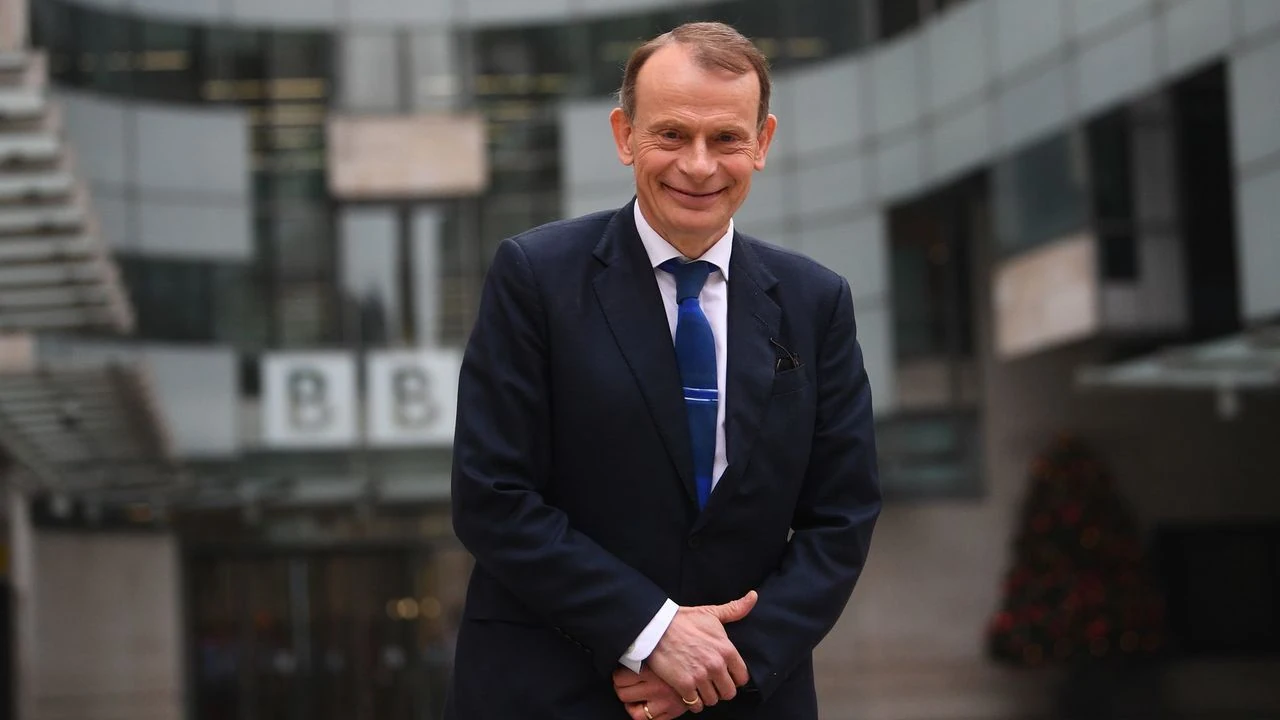
Andrew Marr’s career has moved between newspaper editing, political reporting, television interviews and historical documentary. He began as a trainee at The Scotsman, edited The Independent during a turbulent period for the paper, and became the BBC’s political editor in 2000. His Sunday morning programme brought politicians before a broad television audience; later, his documentaries examined British history from the twentieth century onwards. After leaving the BBC in 2021, he returned to regular broadcasting with LBC and Classic FM.
From Scottish newspapers to The Independent
Born in Glasgow on 31 July 1959, Marr studied English at Trinity Hall, Cambridge, where he graduated with first-class honours. He joined The Scotsman as a trainee and junior business reporter in 1981. After moving to London in 1984, he reported on Parliament and then became the paper’s political correspondent.
In 1986, Marr joined the launch staff of The Independent. He left shortly afterwards for The Economist, where he wrote the political column “Bagehot” and became political editor in 1988. He later said that his time there had made him question some of his assumptions. In 1992, he returned to The Independent as political editor and became its editor in 1996.
The paper was facing falling sales and price competition. Marr tried bold poster-style front pages before overseeing a substantial redesign, grouping stories by subject and adopting a different visual approach. The relaunch struggled to attract attention and was mocked for its alteration of the paper’s slogan. Marr left in 1998, after a short return as co-editor with Rosie Boycott and then a brief period as sole editor. He subsequently wrote columns for the Daily Express and The Observer. The episode is a reminder that editorial ambition does not guarantee commercial success: the redesign was a conspicuous intervention, but it did not reverse the paper’s difficulties.
Reporting and presenting at the BBC
The BBC appointed Marr political editor in May 2000. He held the post through the 2001 general election and the period following the September 2001 attacks in the United States, and stepped down after the 2005 general election. In 2002, he also took over as presenter of BBC Radio 4’s Start the Week, a discussion programme he continued to host until leaving the BBC.
In September 2005, Marr began presenting Sunday AM, the BBC’s Sunday morning political programme. It became The Andrew Marr Show in 2007. Its regular interviews placed politicians and public affairs at the centre of a weekend broadcast, while giving Marr a different role from that of a political editor: he was now the programme’s principal interviewer and host. In 2009, an interview with Prime Minister Gordon Brown drew criticism after Marr asked about the use of prescription medication, relying on a claim whose source later said he could not substantiate it. The episode illustrates the scrutiny that accompanies high-profile political questioning, as well as the importance of testing a claim before putting it to an interviewee.
Marr’s BBC work also ranged well beyond weekly interviews. He presented Andrew Marr’s History of Modern Britain, a five-part series covering the period from 1945 to 2007, and followed it with Andrew Marr’s The Making of Modern Britain, about the first half of the twentieth century. Other projects included Britain From Above, Darwin’s Dangerous Idea, Megacities, The Diamond Queen and Andrew Marr’s History of the World. The range matters: his broadcasting connected political reporting with documentaries about the institutions, events and ideas that have shaped public life.
Books, illness and a return to broadcasting
Marr developed a parallel career as an author. The Day Britain Died accompanied a television series in 2000. My Trade: A Short History of British Journalism considered the profession behind his own work, while his books on modern Britain and its making complemented the BBC history series. He also wrote about the monarchy and world history, and published the novels Head of State and Children of the Master.
In January 2013, Marr suffered a stroke and spent two months in hospital. He returned to The Andrew Marr Show in September that year. His return restored a familiar presence to the programme, but the stroke also marked a significant interruption to a working life built around live broadcasting and regular deadlines.
Marr left the BBC in December 2021. He had said he wanted greater freedom to use his own voice, and moved to Global in 2022. His work there included the LBC programme Tonight with Andrew Marr, a new arts and interview programme for Classic FM, and a weekly podcast. He also became political editor of the New Statesman, having joined the magazine as chief political commentator in 2021. These roles continued his engagement with politics while taking it beyond the BBC’s broadcast framework.
Recognition and the responsibilities of journalism
Marr’s work has been recognised with awards across print and broadcasting. He was named Columnist of the Year at both the What the Papers Say Awards and the British Press Awards in 1995, and received the Journalist Award at the Channel 4 Political Awards in 2001. The Royal Television Society gave him the Richard Dimbleby Award in 2004; in 2008, he received a BAFTA for Best Specialist Factual Programme for History of Modern Britain. Staffordshire University awarded him an honorary doctorate in 2009.
His career also includes cases in which the accuracy and impartiality of his broadcasting were challenged. The BBC’s Editorial Complaints Unit found that a statement in a 2018 broadcast about Palestinian children killed by Israeli forces lacked evidence and risked misleading audiences. In 2019, it found that Marr had misled viewers in an interview with Prime Minister Boris Johnson about sentencing and the early release of a terrorist offender. These findings belong in an account of a prominent political journalist: public trust depends not only on asking difficult questions, but on getting the factual framing right. They do not erase the scale of Marr’s work, but they make clear that journalistic influence carries obligations as well as reach.
Why Andrew Marr deserves a place in British Legacy
Andrew Marr’s place in British Legacy rests on the breadth of his contribution to British public discussion. As political editor of the BBC, he reported on national politics at a time when television news remained a central way for many people to follow elections and government. As presenter of The Andrew Marr Show, he made Sunday morning interviews a regular point of contact between political leaders and viewers. His career in print, meanwhile, included both political reporting and the demanding responsibility of editing a national newspaper. Those roles show how political journalism is made across institutions, not just in front of a camera.
His documentaries and books extended that work beyond the immediate news cycle. By examining modern Britain, its twentieth-century political history and wider world history, Marr brought long-term context into mainstream broadcasting. His return to work after a serious stroke, followed by a move to LBC, Classic FM and the New Statesman, also shows how a journalist can adapt across formats and organisations. A balanced legacy includes the BBC’s findings that some of his broadcasts failed standards of accuracy: those cases underline why scrutiny and impartiality matter. Taken together, Marr’s reporting, interviewing, historical programmes and writing form a sustained record of explaining politics and history to British audiences—and of the responsibilities that come with that influence.
Sources
Andrew Marr — Wikipedia revision 1368922884
Adapted in part from Andrew Marr by Wikipedia contributors, under CC BY-SA 4.0. Text has been edited and combined with the existing article; this adapted text is shared under the same licence. Contributor history.