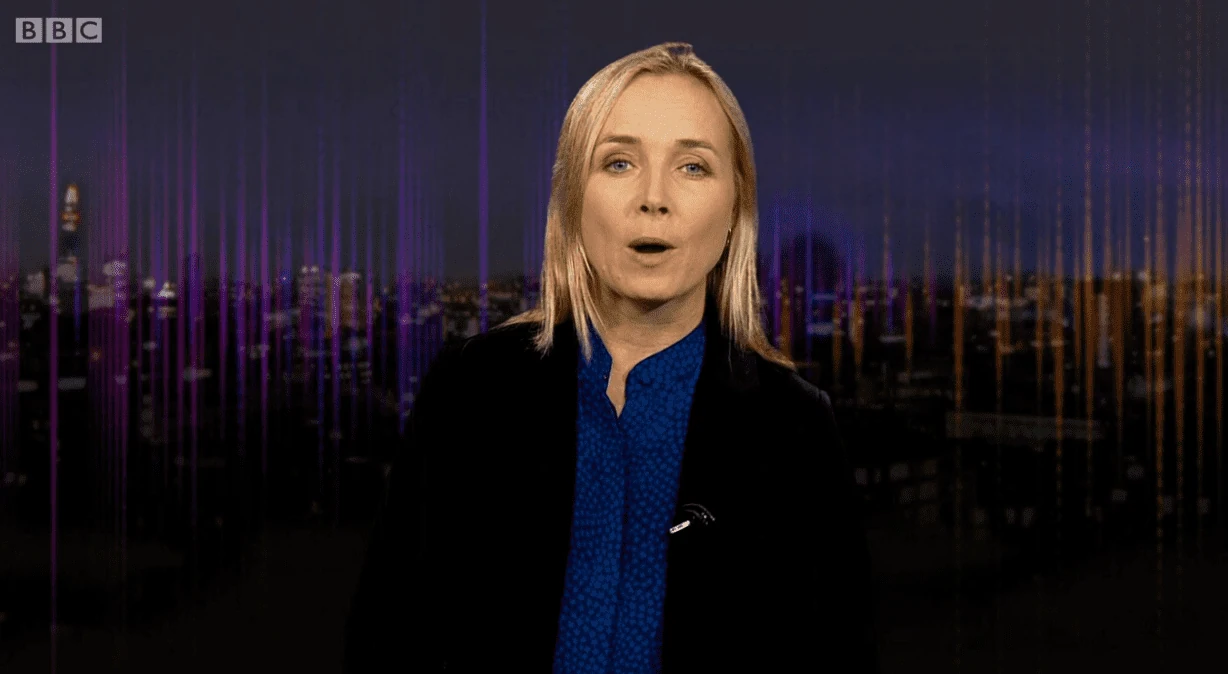
Katie Razzall’s career, as described in the supplied account, connects two British newsrooms: Channel 4 News and the BBC’s Newsnight. The account associates her reporting with Grenfell Tower, Brexit, the COVID-19 pandemic and a range of social questions. It offers a broad outline rather than a dated record of assignments, but its central thread is clear: work on public affairs and issues affecting people’s lives.
From Channel 4 News to Newsnight
The account says Razzall worked at Channel 4 News as a reporter and later as a news correspondent, before becoming a correspondent on Newsnight. It gives no dates for these roles or examples of her Channel 4 assignments, so the sequence is more useful as an outline than as a full chronology. Even so, it places her work across two prominent UK broadcasters and provides the framework for the career described here.
At Newsnight, the supplied text links her reporting to Brexit and the COVID-19 pandemic. These subjects span political change and a public-health crisis; the source, however, names no individual reports or broadcasts. The topics therefore indicate the range of coverage attributed to her, rather than establishing particular findings or effects. The account’s broader praise of her contribution to the programme is not supported there by specific examples.
Reporting on Grenfell and social issues
The source identifies Razzall’s reporting on survivors of the Grenfell Tower fire as a notable example of her work. It describes coverage that gave survivors a platform and connected their experiences with questions of housing policy and government accountability. No report title, date or further particulars are supplied. The example is worth retaining as part of the source’s account of her journalism, while its claims about the coverage’s wider public impact cannot be assessed from the material provided.
The same account associates her work with child exploitation, mental health and systemic inequality. These are subjects with social and ethical dimensions, and their inclusion helps convey the kind of issues the source says she has covered. It does not provide case studies or identify specific investigations, however. It would therefore be misleading to describe particular methods, conclusions or resulting changes that the source does not document.
What the account establishes—and what it does not
The supplied article also refers to awards, documentaries and investigative pieces, but names no accolade, programme or investigation. Its claims that her work has catalysed policy discussion and reform are similarly unsupported by examples. Those assertions are not presented here as established outcomes. Nor does the source offer dates or details sufficient to measure Razzall’s wider influence on public understanding or media standards.
One biographical claim in the original account concerns her father, described there as the Labour politician Baron Razzall. The accompanying research warning says that no unique, context-supported Wikipedia match was established. With no other corroborating material supplied, that family relationship remains unresolved and is not stated as fact here. The source’s career outline and its list of reporting subjects can still be retained without relying on that claim.
Read with these limits in mind, the account provides a starting point rather than a comprehensive assessment. It places Razzall at Channel 4 News and Newsnight, and points to reporting on prominent public questions and social issues. A fuller record would need named reports, dates and particulars of any awards or documented consequences. Those details are absent from the supplied material, so no more specific account is warranted.
Why Katie Razzall deserves a place in British Legacy
The supplied account gives a specific British context for Razzall’s career: it attributes roles at Channel 4 News and the BBC’s Newsnight to her, and associates her reporting with Grenfell, Brexit and social questions including child exploitation, mental health and inequality. These are matters of public concern, and the account’s outline offers a reason to consider how journalism brings such questions before audiences. Its value lies in the subjects and professional settings it identifies, not in unsupported claims of exceptional influence.
A responsible place in British Legacy need not depend on overstating the evidence. The source provides a useful outline of a journalist’s work across two UK newsrooms, but it does not name the reports or demonstrate their effects. Preserving that distinction makes the account more trustworthy: it recognises the public-facing work described while leaving room for a better-documented assessment of its findings and consequences. Razzall’s reported coverage of consequential British issues is the basis for inclusion; the scale of its impact remains unestablished in the material supplied.