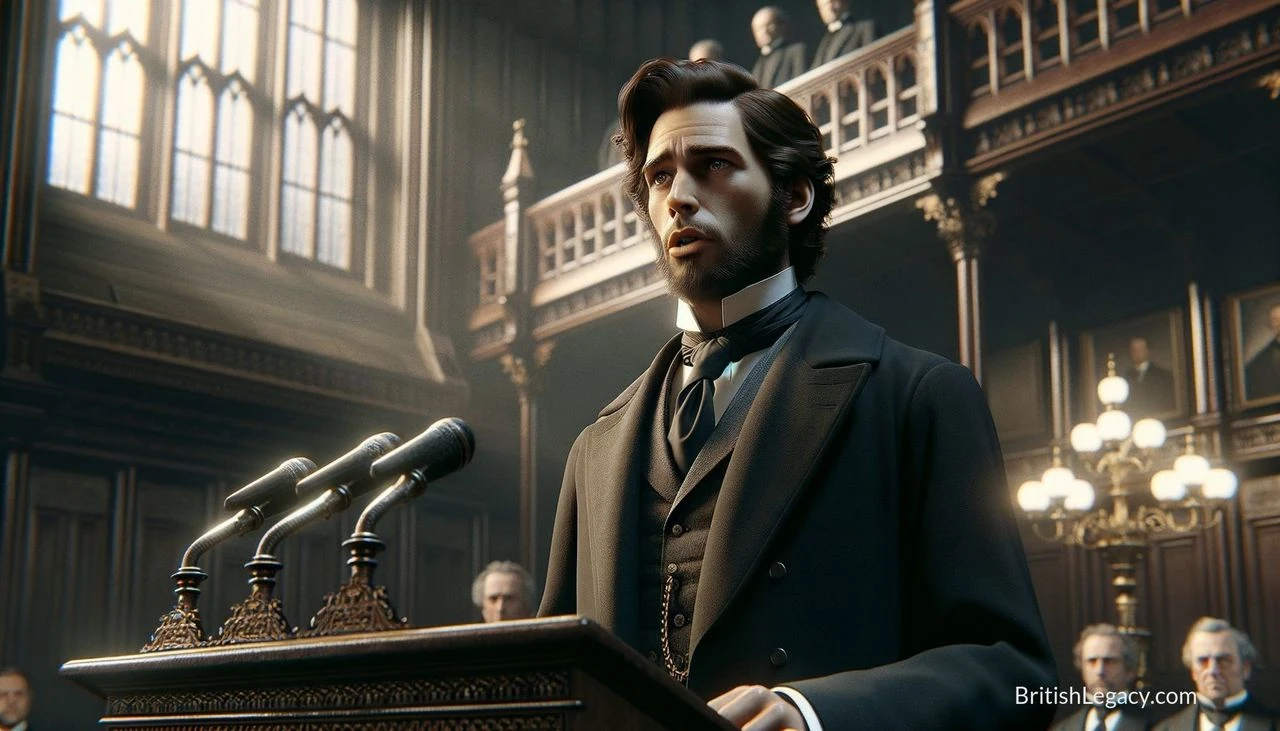
William Wilberforce spent two decades pressing Parliament to abolish Britain’s slave trade. The Slave Trade Act of 1807 ended British participation in that trade, but not slavery itself. Wilberforce continued to campaign for emancipation, handing leadership in the Commons to Thomas Fowell Buxton as his health declined. He lived to hear that the Slavery Abolition Act 1833 was assured of passage, three days before he died. His achievement was substantial, but it belonged to a much wider movement: activists gathered evidence, organised public pressure and sustained a campaign that Parliament repeatedly resisted.
Hull, Cambridge and a seat in Parliament
Wilberforce was born in Kingston upon Hull on 24 August 1759, the only son of merchant Robert Wilberforce and Elizabeth Bird. His family’s wealth came from maritime trade with the Baltic. After his father died in 1768, he spent time with an aunt and uncle in London and Wimbledon, where he encountered evangelical Christianity. He later returned to Hull and attended Pocklington School before entering St John’s College, Cambridge, in 1776.
At Cambridge he became friends with William Pitt, who would later be prime minister. Wilberforce enjoyed student society more than serious study, but graduated with a BA in 1781 and an MA in 1788. In 1780, aged 21, he was elected MP for Kingston upon Hull. He sat as an independent and did not bind himself to a party, although he often supported Pitt. In 1784 he was returned for Yorkshire, a constituency he represented until 1812, before moving to the seat of Bramber.
In 1785, during a European tour, Wilberforce underwent an evangelical conversion. He considered leaving public life, but the clergyman John Newton encouraged him to remain in politics. His faith brought a new focus on religion and social reform, but it did not make him a political radical. He remained wary of revolution and favoured moral improvement within the existing order—an outlook that would shape both his campaigning and its limitations.
Building the case against the slave trade
Wilberforce’s conversion did not begin the British campaign against the slave trade. Quakers had organised against it, and abolitionists including Granville Sharp were already at work. In 1787, Thomas Clarkson met Wilberforce and brought him evidence gathered from people involved in the trade. Clarkson and other campaigners helped make the treatment of enslaved Africans a matter for public and parliamentary debate; Wilberforce could bring that case into the Commons.
On 12 May 1789, he made his first major parliamentary speech on abolition, arguing that the trade was morally wrong and contrary to natural justice. He described evidence of the appalling conditions of the Middle Passage. The work was neither a single speech nor a straightforward contest between conviction and vested interests. Parliamentary opponents delayed scrutiny, the first abolition bill was defeated in 1791, and war with France and shifting political conditions repeatedly obstructed the campaign.
Wilberforce and his allies kept up the pressure. He brought forward further measures, while Clarkson and other organisers assembled evidence and built public support. In the 1790s, Wilberforce also backed the Sierra Leone Company, which sought to establish a free colony with Black settlers from Britain, Nova Scotia and Jamaica, alongside Africans and some white settlers. The project reflected abolitionists’ efforts to argue for the capacity of free Black communities, though it did not replace the political struggle over the trade.
A change in parliamentary tactics helped bring success. In 1806, Wilberforce and Clarkson gathered and published evidence against the trade, and the government passed a measure restricting British subjects’ involvement in the slave trade to foreign colonies. The following year, Lord Grenville introduced an abolition bill in the Lords and Charles Grey moved it in the Commons. It passed by 283 votes to 16 and received royal assent as the Slave Trade Act 1807. The law ended the British slave trade; it did not emancipate people already enslaved. Wilberforce did not present the two aims as interchangeable.
From ending the trade to challenging slavery
In 1816, Wilberforce began introducing bills for the compulsory registration of enslaved people, which could help expose illegal imports. He later spoke against slavery itself, while arguing for gradual rather than immediate emancipation. In 1823, he published an appeal for the abolition of slavery in the West Indies and supported a campaign that Thomas Fowell Buxton led in the Commons. Wilberforce’s health and eyesight worsened, and in 1825 he resigned his seat. He nevertheless continued to attend anti-slavery meetings and support the cause.
In 1833, the government introduced the Slavery Abolition Bill. On 26 July, Wilberforce heard that concessions had been secured that guaranteed its passage. He died three days later, on 29 July, at his cousin’s house in London. The Act abolished slavery in most of the British Empire. His funeral took place at Westminster Abbey on 3 August, where he was buried close to his friend Pitt.
The distinction between ending the trade and ending slavery matters. The 1807 law did not free enslaved people, and emancipation followed only after further campaigning and legislation. Wilberforce’s contribution was a prominent parliamentary one, sustained over many years and joined to the work of campaigners outside Parliament. Later accounts that place him at the centre of abolition have sometimes obscured the importance of Clarkson and others. The achievement is better understood as a partnership between political leadership, research, organising and public pressure.
Reform, faith and political limits
Abolition was not Wilberforce’s only concern. He supported prison reform, education, restrictions on capital punishment and improved working conditions for chimney-sweeps and textile workers. He helped found the Society for the Prevention of Cruelty to Animals, later the RSPCA, and supported Hannah More’s Sunday schools for poor children. His 1797 book, A Practical View of the Prevailing Religious System, set out his evangelical beliefs and became widely read.
Yet his reforming activity coexisted with a strong conservatism. He opposed workers’ right to organise and supported measures restricting public meetings and political dissent. He opposed an inquiry into the Peterloo Massacre and backed the government’s Six Acts. His criticism of women who organised anti-slavery campaigns also exposed limits in his assumptions about public life. These positions complicate any simple portrait of Wilberforce as a consistent champion of liberty: his opposition to the slave trade did not lead him to support political freedom or equality in every sphere.
His religious and charitable commitments were extensive. He supported missionary organisations, including the Church Missionary Society, and campaigned for the British East India Company’s charter to include provision for teachers and chaplains. He gave money to charitable causes and helped individuals seeking education or assistance. These efforts formed part of a wider programme to shape society through Christian teaching and moral reform, a programme that could be generous in purpose while also prescriptive in its view of how people should live.
Commemoration and historical reassessment
Wilberforce’s sons published a five-volume biography after his death, giving their father a dominant place in the history of abolition. The account played down Clarkson’s work; Clarkson objected, and passages were later revised. Historians have since examined how the parliamentary campaign depended on both Wilberforce’s political role and the research and mobilisation of abolitionists beyond Parliament. They have also debated the motives behind abolition, including the economic arguments associated with historian Eric Williams and later reassessments of the prosperity of the sugar industry.
His memory has a strong presence in Hull. A public subscription funded the Wilberforce Monument, and his birthplace became Wilberforce House, now a museum devoted to slavery. The University of Hull established the Wilberforce Institute for the study of Slavery and Emancipation. In Westminster Abbey, a statue commemorates him. These memorials make his name visible, but the history they represent is larger than one politician: it concerns enslaved people, campaigners, legislation and the arguments over how Britain remembers its role in slavery.
Why William Wilberforce deserves a place in British Legacy
Wilberforce deserves a place in British Legacy because his parliamentary work helped turn the abolition of the British slave trade into law. He used his position in the Commons to bring evidence and arguments before Parliament, returned to the question after repeated defeats, and worked alongside campaigners who built the case beyond Westminster. The 1807 Act was a decisive legal change, but the distinction between ending the trade and ending slavery must remain clear. The later Slavery Abolition Act followed another sustained campaign, in which Wilberforce continued to support abolition as his health failed. His story demonstrates how legislation can emerge from the combined efforts of political advocates, researchers and organisers rather than from an isolated act of individual resolve.
His wider record also makes his legacy more instructive than a simple celebration. Wilberforce supported education, animal welfare and prison reform, but he also backed restrictions on dissent and opposed workers’ organising. Acknowledging those contradictions does not diminish the importance of his anti-slavery work; it places it in the context of his time and politics. Hull’s Wilberforce House and the University of Hull’s institute for the study of slavery and emancipation offer British institutions through which the history can be examined. Remembering Wilberforce responsibly means recognising both the legislative achievement and the movement around it, while keeping the experiences of enslaved people at the centre of the history.
Sources
William Wilberforce — Wikipedia revision 1377558647
Adapted in part from William Wilberforce by Wikipedia contributors, under CC BY-SA 4.0. Text has been edited and combined with the existing article; this adapted text is shared under the same licence. Contributor history.