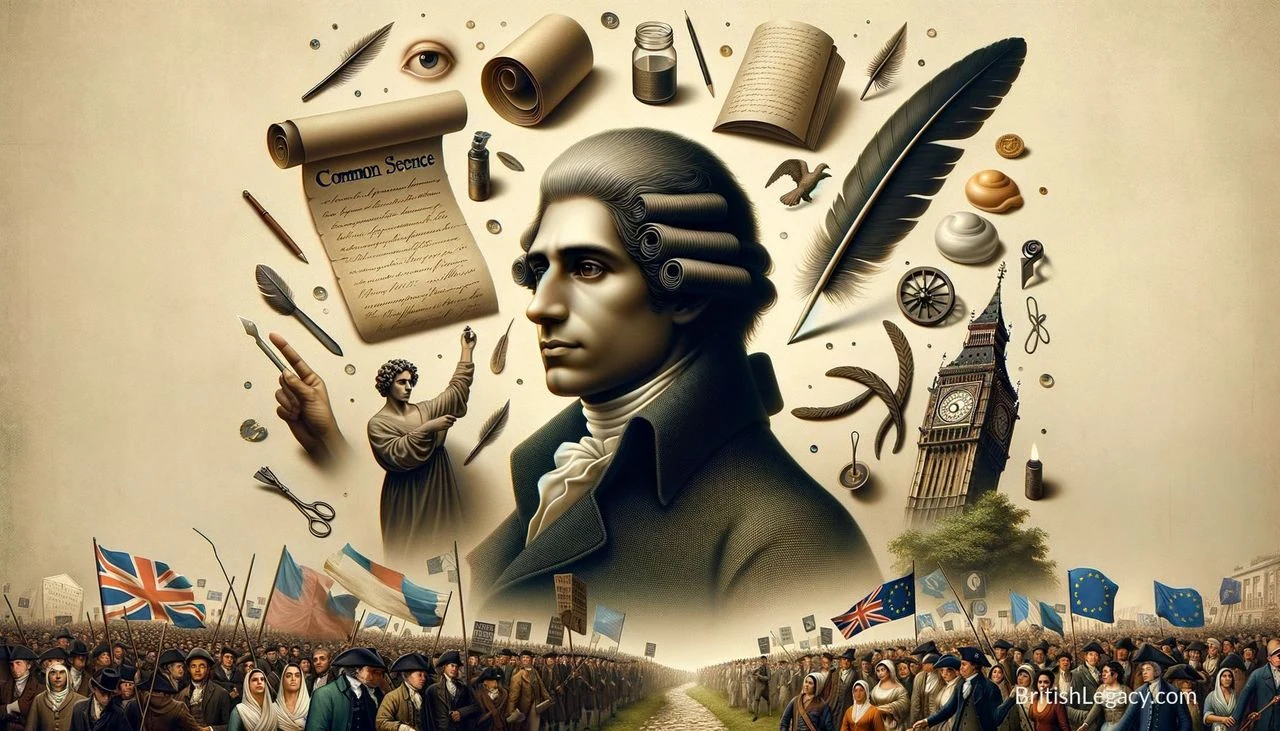
Thomas Paine was born in Thetford, Norfolk, in 1737 and died in New York in 1809. Between those two places, he wrote pamphlets that helped make political argument accessible to broad audiences, challenged hereditary monarchy and advanced proposals for social support. His life crossed the American and French revolutions, but his British beginnings—and his return to Britain before publishing Rights of Man—belong at the centre of his story.
A working life before politics
Paine was born Thomas Pain, the son of Joseph, a tenant farmer and stay-maker, and Frances Cocke. His father was a Quaker and his mother an Anglican. He attended Thetford Grammar School from 1744 to 1749 and then worked as an apprentice to his father. At 19, he served as a privateer aboard the King of Prussia. After returning to Britain, he worked as a master staymaker, first establishing a business in Sandwich.
His early adulthood was unsettled. He married Mary Lambert in 1759; she and their child died after she went into early labour. Paine later entered the excise service, working in Lincolnshire, Cornwall and Sussex. He was dismissed in 1765 for claiming to have inspected goods he had not inspected, reinstated the following year, and dismissed again in 1774 after being absent from his post without permission. In the intervening years, he also worked as a schoolteacher and staymaker.
In Lewes, where he lived above the Bull House tobacco shop, Paine became involved in local civic life. He joined the town's Court Leet and parish vestry, and in 1771 married Elizabeth Ollive, the daughter of his former landlord. He entered the Ollive family's grocery and tobacconist business. Paine also took up the cause of excise officers seeking better pay and conditions. His 1772 pamphlet, The Case of the Officers of Excise, was his first political work. The shop later failed; in 1774 he sold his possessions to pay debts and separated from Elizabeth.
Across the Atlantic: Common Sense
In London, the mathematician and excise commissioner George Lewis Scott introduced Paine to Benjamin Franklin. Franklin provided a letter of recommendation, and Paine emigrated to the American colonies in October 1774, arriving in Philadelphia at the end of November. After recovering from illness contracted on the voyage, he became editor of the Pennsylvania Magazine in 1775. Under his editorship, the magazine developed a strong political voice, addressing liberty and the participation of ordinary people in public life.
Published anonymously in Philadelphia in January 1776, Common Sense argued for a complete break with Britain and attacked hereditary monarchy. Its direct language carried political arguments to readers beyond the small circle of political leaders. Paine estimated that 100,000 copies sold in three months; a biographer later estimated total sales, including unauthorised editions, at about 500,000 over the course of the Revolution. Those figures are estimates, and the higher total has been disputed.
Paine followed the pamphlet with the American Crisis series, written to sustain support for the revolutionary cause. The first essay opened with the words “These are the times that try men's souls”. George Washington had that pamphlet read to his troops. Paine also served as secretary to the Congressional Committee on Foreign Affairs from 1777 to 1779. After controversy over his public criticism of diplomatic dealings, he left the post. In 1781, he accompanied John Laurens to France on a mission to obtain funds for the American war effort.
Rights of Man and the French Revolution
Paine returned to Britain in 1787. As the French Revolution began, he wrote Rights of Man in answer to Edmund Burke's attack on the revolution. Its two parts, published in 1791 and 1792, defended popular sovereignty and representative government. Paine also argued for public measures to address poverty, including pensions and progressive taxation. The work was read by reformers and working people as well as political intellectuals.
The British authorities treated the book as a threat. Paine was indicted for seditious libel and tried in absentia; he left for France in 1792, beyond the reach of the British proceedings. He was elected to the French National Convention as a representative for Pas-de-Calais, despite not speaking French. Paine supported the French Republic but opposed executing Louis XVI, arguing instead for exile. As the revolution grew more dangerous, Paine was arrested in December 1793 and imprisoned in Paris. He was released in November 1794 after the American ambassador James Monroe intervened.
His writing ranged beyond the immediate revolutionary struggles. In The Age of Reason, written in the 1790s, he advocated Deism and challenged organised religion. In Agrarian Justice (1797), he argued that land ownership had deprived people of a natural inheritance and proposed payments to young adults and pensions for older people, funded by a tax on inherited land. These arguments connected political equality to material conditions, rather than treating liberty as solely a matter of constitutional form.
Return to America and final years
Paine returned to the United States in 1802, following an invitation from President Thomas Jefferson. His attacks on Christianity and criticism of American political leaders made him an unpopular figure. He died in Greenwich Village, New York, on 8 June 1809, aged 72. Only six mourners attended his funeral. He was first buried on his farm in New Rochelle. In 1819, the English radical journalist William Cobbett exhumed his bones and brought them to England, intending to arrange a public reburial. That plan was never realised; the bones were later lost, and their whereabouts are unknown.
Why Thomas Paine deserves a place in British Legacy
Paine's British legacy begins with more than his birthplace. His working life in Thetford, Sandwich, Lincolnshire and Lewes shaped the experience from which he entered public argument. Before he wrote the works that made him internationally known, he challenged the conditions of excise officers and participated in civic life in Sussex. He then returned to Britain and wrote Rights of Man, a direct intervention in arguments about the French Revolution, political authority and the rights of ordinary people. The resulting prosecution and his departure for France show how sharply those ideas confronted the British establishment of his time.
His contribution also lies in the connection he drew between political rights and social provision. In Rights of Man he proposed measures including pensions and progressive taxation; in Agrarian Justice he developed a scheme of payments based on the claim that land ownership had separated people from a shared natural inheritance. These proposals made questions of poverty and economic security part of a debate about freedom. Paine's influence crossed borders, but his British story is not incidental to that reach: it was shaped by his Norfolk origins, his work and political activity in Britain, and the controversy that followed publication of his reforming arguments there.
Sources
Adapted in part from Thomas Paine by Wikipedia contributors, under CC BY-SA 4.0. Text has been edited and combined with the existing article; this adapted text is shared under the same licence. Contributor history.