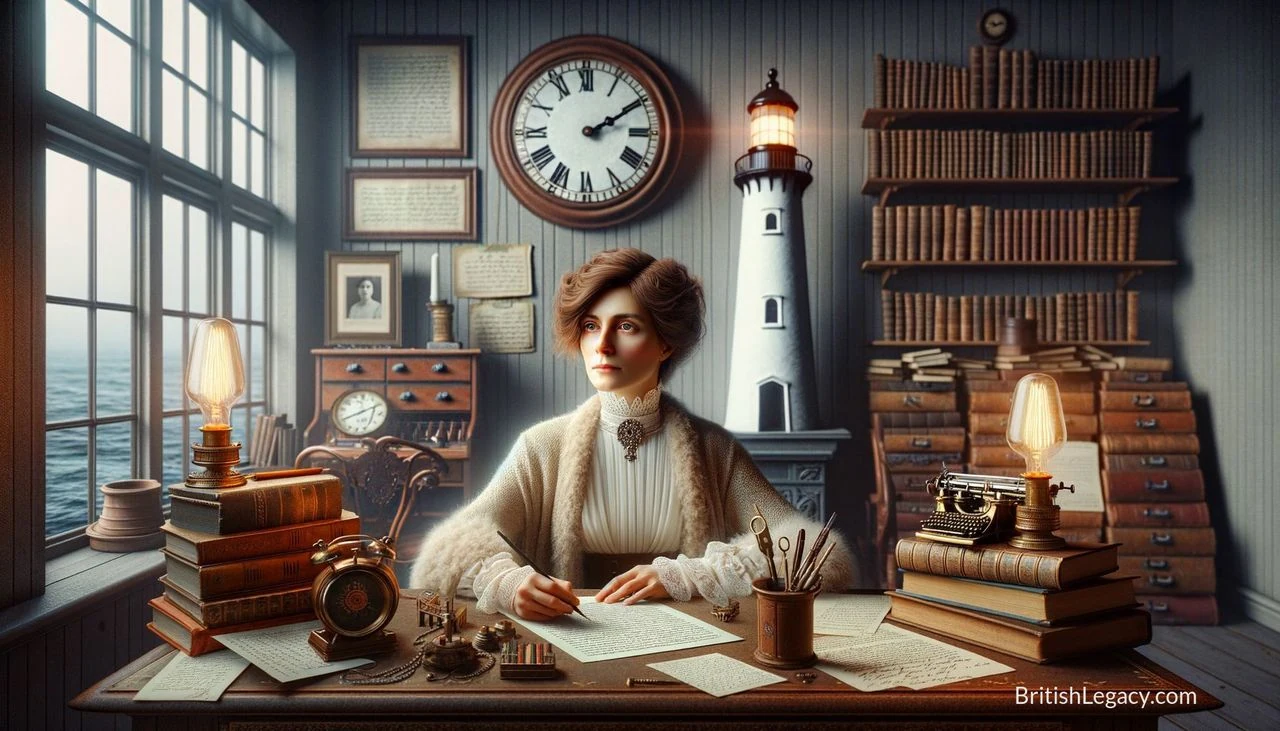
Virginia Woolf made the ordinary events of a day, a family visit or a passing impression carry the weight of a life. In novels such as Mrs Dalloway and To the Lighthouse, she moved between characters’ thoughts and memories, loosening the conventional boundaries of plot. Her experiments helped make her one of the central English modernist writers of the twentieth century. Through essays including A Room of One’s Own, she also asked who had the money, education and space to write. Her achievement was literary and practical: she helped widen both the possibilities of fiction and the conversation about women’s place in it.
A childhood shaped by books and loss
Born Adeline Virginia Stephen on 25 January 1882, Woolf grew up in South Kensington in a large, blended family. Her parents, Julia and Leslie Stephen, brought together children from earlier marriages as well as their own. Her sister Vanessa became the painter Vanessa Bell. Woolf was educated largely at home, with access to her father’s extensive library, and later attended classes at King’s College London, where she studied classics and history. She began writing early: as a child she made a family newspaper, the Hyde Park Gate News, and kept a diary from 1897.
The family spent summers at Talland House in St Ives, Cornwall, where Woolf encountered the sea and its changing light. Those visits stayed with her and informed later fiction, including To the Lighthouse. The deaths of her mother in 1895, her half-sister Stella in 1897 and her father in 1904 marked successive upheavals in her young life. Following her father’s death, Woolf and some of her siblings left the family home for Bloomsbury, then a more affordable part of London.
There, gatherings with her brother Thoby’s Cambridge friends formed the core of the circle that became known as the Bloomsbury Group. Its members included writers and artists such as E. M. Forster, Lytton Strachey, Roger Fry and John Maynard Keynes. Their discussions and friendships offered Woolf a lively intellectual setting, although her own writing remained the centre of her working life. She began earning money through reviews and journalism, and in 1905 started contributing to The Times Literary Supplement.
Building a life as a writer and publisher
Woolf married Leonard Woolf in 1912. Their partnership became both a marriage and a working collaboration. They established the Hogarth Press in 1917, beginning with a small hand-printing press set up at home. Its first book, Two Stories, contained work by both Virginia and Leonard. The press gave Woolf a way to publish her own writing, while also bringing work by other modern writers to readers. Its list included authors such as Katherine Mansfield, T. S. Eliot and E. M. Forster, alongside translations and political writing.
Woolf’s first novel, The Voyage Out, appeared in 1915. She continued to develop her approach across books including Jacob’s Room (1922), Mrs Dalloway (1925), To the Lighthouse (1927), Orlando (1928) and The Waves (1931). Her fiction often gives less weight to external action than to the shifting perceptions through which characters experience it. In Mrs Dalloway, a single day in London opens into a much broader account of memory, social expectation and the aftermath of the First World War. In To the Lighthouse, the Ramsay family’s visits to a summer house frame a three-part structure concerned with relationships, change and time.
These novels do not treat consciousness as a tidy sequence. A sight, sound or remembered phrase can redirect a character’s thoughts, allowing past and present to press on one another. Woolf’s use of stream-of-consciousness narration became one of her most recognised contributions to modernist fiction. Her writing also made room for the small details of domestic and social life, using them to examine class, gender, artistic work and the ways people understand one another.
Making the case for women’s independence
In 1928 Woolf gave lectures on women and fiction at Cambridge. They became the basis of A Room of One’s Own, published the following year. The essay considers the material conditions that shape a writer’s chances: access to education, income, privacy and time. Its most famous formulation—that a woman needs money and a room of her own to write fiction—distils an argument about power as well as space. Woolf insists that talent alone cannot undo barriers that keep women from the resources and traditions available to men.
Three Guineas (1938) extended her examination of women’s position in society and the relationship between gender and public life. Across her essays, Woolf wrote as a critic as well as a novelist, questioning inherited assumptions about literary value and who was entitled to speak. Her feminist arguments have remained influential, while her writing has also prompted continuing debate about its treatment of class and race. The breadth of that debate is part of her continuing importance: her work is read not only for its formal innovations but also for the ideas and exclusions readers continue to examine.
Woolf’s writing was produced alongside recurring periods of serious mental ill health. She wrote about experience and consciousness with unusual intensity, but it would be reductive to treat illness as either a simple explanation for her art or its source. Her life and work reflect both the effect of illness on her capacity to work and her determination to keep writing. In her later years, the Second World War and the destruction of the Woolfs’ London homes added to the pressures she faced. She died in 1941, aged 59, at Rodmell in East Sussex. Her final novel, Between the Acts, was published posthumously.
Why Virginia Woolf deserves a place in British Legacy
Woolf belongs in British Legacy because her work changed how English-language fiction could represent a mind at work. Rather than relying on a sequence of outward events, novels such as Mrs Dalloway and To the Lighthouse let memory, perception and passing impressions shape the reader’s sense of time and character. The result is a body of fiction in which the textures of everyday life can carry historical and emotional significance. Her innovations were not isolated experiments: they became part of the modernist inheritance and helped establish new possibilities for later writers.
Her legacy also rests on the connection she made between creative freedom and material independence. A Room of One’s Own remains a clear, memorable argument that women need more than ability to write: they need money, education and a space in which to work. Through the Hogarth Press, Woolf and Leonard helped create a route to publication for their own work and for other writers, making publishing part of her practical contribution as well as her literary one. Woolf’s British connection is grounded in a life and career formed in London and Sussex, in her engagement with British literary and social institutions, and in writing that continues to shape discussion of literature and women’s independence. Her novels, essays and publishing work together make a specific and enduring contribution to the country’s cultural history.
Sources
Virginia Woolf — Wikipedia revision 1379643445
Adapted in part from Virginia Woolf by Wikipedia contributors, under CC BY-SA 4.0. Text has been edited and combined with the existing article; this adapted text is shared under the same licence. Contributor history.