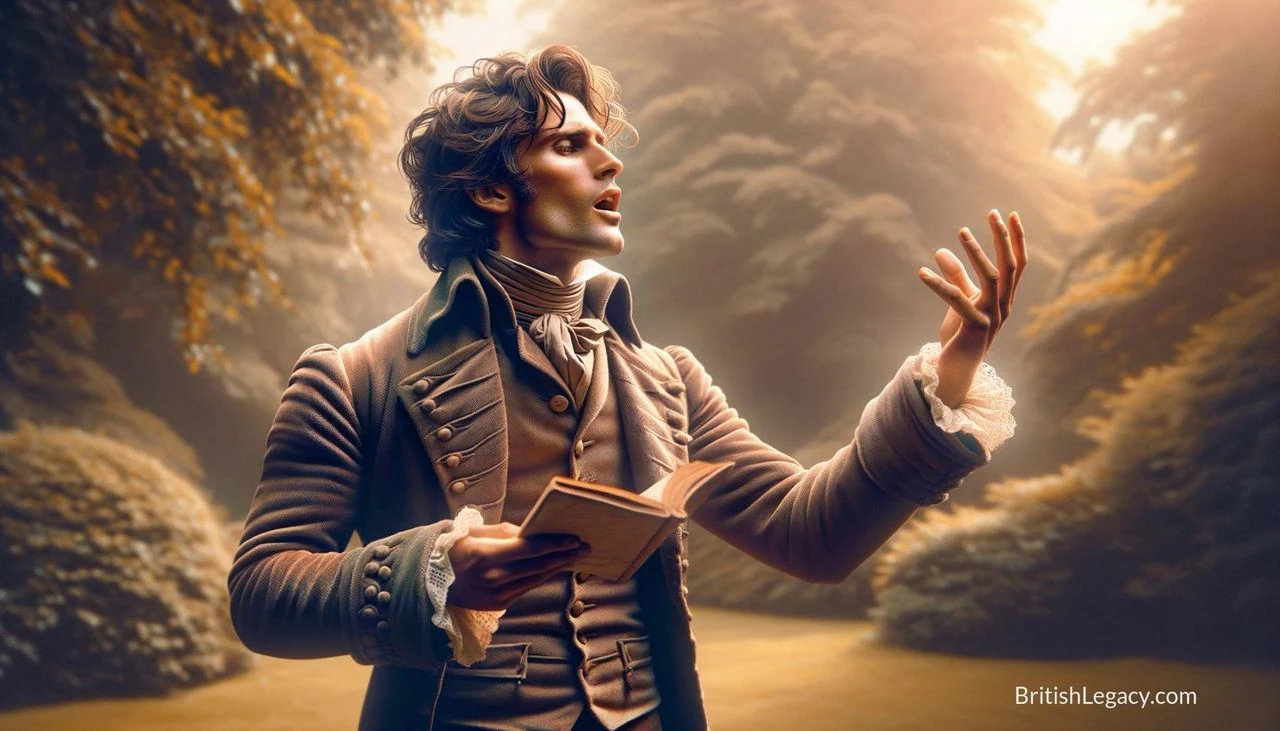
John Keats wrote with an unusual intensity about beauty, sensation and the knowledge that life passes. His career as a published poet lasted less than four years; he died in Rome of tuberculosis, aged 25. Yet poems such as “Ode to a Nightingale”, “Ode on a Grecian Urn” and “To Autumn” became central to English literature. Their achievement lies not simply in memorable lines, but in the way they hold pleasure and loss, imagination and uncertainty, together without forcing an easy resolution.
A London childhood and a change of direction
Keats was born in Moorgate, London, on 31 October 1795, the eldest of four surviving children of Thomas and Frances Keats. His father died after a fall from a horse when John was eight. His mother died of tuberculosis in 1810, when he was 14, and the children went into the care of their grandmother and appointed guardians. The family’s finances were a persistent concern, though Keats had inheritances held in trust that he apparently did not know about.
At John Clarke’s school in Enfield, Keats developed an interest in classical literature and history. The headmaster’s son, Charles Cowden Clarke, encouraged his reading, introducing him to writers including Edmund Spenser and to George Chapman’s translation of Homer. In 1810 Keats left school to apprentice with Thomas Hammond, a surgeon and apothecary. He later registered as a medical student at Guy’s Hospital and qualified for a licence to practise as an apothecary, physician and surgeon.
Medicine offered a practical career, but poetry increasingly claimed his attention. Keats had begun writing verse as a young man and was drawn into the literary circle around Leigh Hunt, who published Keats’s sonnet “O Solitude” in The Examiner in 1816. That year Keats decided to give up medicine and pursue poetry, despite the cost of his training and the financial insecurity that followed. His first collection, Poems, appeared in 1817 and attracted little attention. His early years as a poet were years of work and experiment, not instant acclaim.
Odes, letters and the work of uncertainty
Keats’s writing is often associated with its vivid sensory language, but that richness serves a more searching purpose. His poems return to beauty and transience, asking what art, imagination and feeling can offer in the face of change. In “Ode to a Nightingale”, the bird’s song seems to pass beyond individual human life, while the speaker remains aware of mortality. “Ode on a Grecian Urn” turns to the figures preserved on an artwork, setting their unchanging scenes against the movement and limits of lived experience. Its closing lines, “Beauty is truth, truth beauty”, have remained open to debate rather than providing a simple answer.
Keats’s letters are an essential part of this intellectual story. Writing to his brothers and friends, he developed ideas about poetry and the mind, including “Negative Capability”: the capacity to remain with uncertainties and mysteries without urgently reaching for a settled explanation. The letters also show a writer thinking through his craft in ordinary correspondence, not merely setting out a finished theory. His reflections on imagination, beauty and the poet’s ability to inhabit different perspectives give a valuable companion to the poems.
The poems of 1819 mark an extraordinary period of concentrated work. Among them are “The Eve of St Agnes”, “La Belle Dame sans Merci”, “Lamia”, “Hyperion” and the major odes. “To Autumn”, written in September, attends closely to ripeness, harvest and the approaching end of the season. In July 1820, Keats’s final collection published during his lifetime, Lamia, Isabella, The Eve of St Agnes, and Other Poems, appeared to a more favourable reception than his earlier books. The gap between that response and the hostile treatment of some earlier work is one reason his later reputation can obscure how unevenly he was received while alive.
Love, illness and the journey to Rome
Keats’s relationship with Fanny Brawne began while he was living at Wentworth Place in Hampstead. Brawne and her widowed mother moved into the other half of the house in 1819, bringing the couple into daily proximity. Their attachment developed while Keats had little money and increasingly poor health. His sonnet “Bright Star” became associated with Brawne, and his letters to her convey the intensity of his feelings as well as his awareness that illness might separate them.
Keats had nursed his brother Tom, who died of tuberculosis in 1818, and the poet himself became seriously ill. After suffering lung haemorrhages in 1820, he was advised to seek a warmer climate. He left England for Italy with the artist Joseph Severn in September. The journey was difficult, and Keats reached Rome in November. His health continued to decline despite Severn’s care. He died there on 23 February 1821, aged 25, and was buried in the city’s Protestant Cemetery.
Keats had asked for a gravestone without his name or dates, bearing the words “Here lies One whose Name was writ in Water”. The inscription expressed his bleak sense that he had made no lasting mark. His posthumous reputation would prove otherwise. Percy Bysshe Shelley memorialised him in Adonais, and Keats’s work gained readers and advocates over the following decades. That later esteem should not erase the small audience and mixed reviews he faced in life; it makes the distance between his own expectations and his eventual standing all the more striking.
From posthumous reputation to literary inheritance
By the Victorian period, Keats had become an important presence in English poetry. His poems influenced members of the Pre-Raphaelite Brotherhood, including Dante Gabriel Rossetti and William Morris, and writers such as Algernon Charles Swinburne. The attraction was not limited to the odes: medievalist works including “The Eve of St Agnes” and “La Belle Dame sans Merci” also offered artists and poets material to reinterpret. Later writers, among them W. B. Yeats and Wilfred Owen, continued to engage with his work.
His letters, first published in the nineteenth century, acquired their own standing as literary writing and as a record of a poet thinking through what poetry might do. Together, poems and correspondence show that Keats’s importance does not depend on a large body of work. His achievement was concentrated into a brief period, but it ranges from the formal control of the odes to the unfinished questions of the letters. His reputation grew because successive readers found in both an exacting attention to experience and a willingness to leave its contradictions unresolved.
Why John Keats deserves a place in British Legacy
Keats belongs in British Legacy because his work became a lasting part of the country’s literary inheritance, while remaining rooted in a particular and difficult life. Born in London, educated at Enfield and trained at Guy’s Hospital, he turned from a prospective medical career towards poetry despite financial insecurity. In a few years he produced poems that later generations of British writers and artists repeatedly took up: the Pre-Raphaelites drew on his medievalist poems, while poets including Tennyson, Swinburne, Yeats and Owen belong to the longer history of his reception. That influence is specific and traceable, not a vague claim that he represents a national character.
His legacy also rests on the quality of the questions his writing preserves. “Ode to a Nightingale”, “Ode on a Grecian Urn” and “To Autumn” make beauty inseparable from time, change and loss; the letters give readers a vivid account of a poet testing ideas about uncertainty and imagination. These works have supported generations of readers, teachers and writers in thinking closely about language and experience. Keats’s brief career is not merely a story of early death: it is a record of sustained artistic development, from apprentice poet to author of some of the most studied poems in English. His place in British literary history is secured by both the work he made and the creative attention it continues to inspire.
Sources
John Keats — Wikipedia, revision 1375415322
Adapted in part from John Keats by Wikipedia contributors, under CC BY-SA 4.0. Text has been edited and combined with the existing article; this adapted text is shared under the same licence. Contributor history.