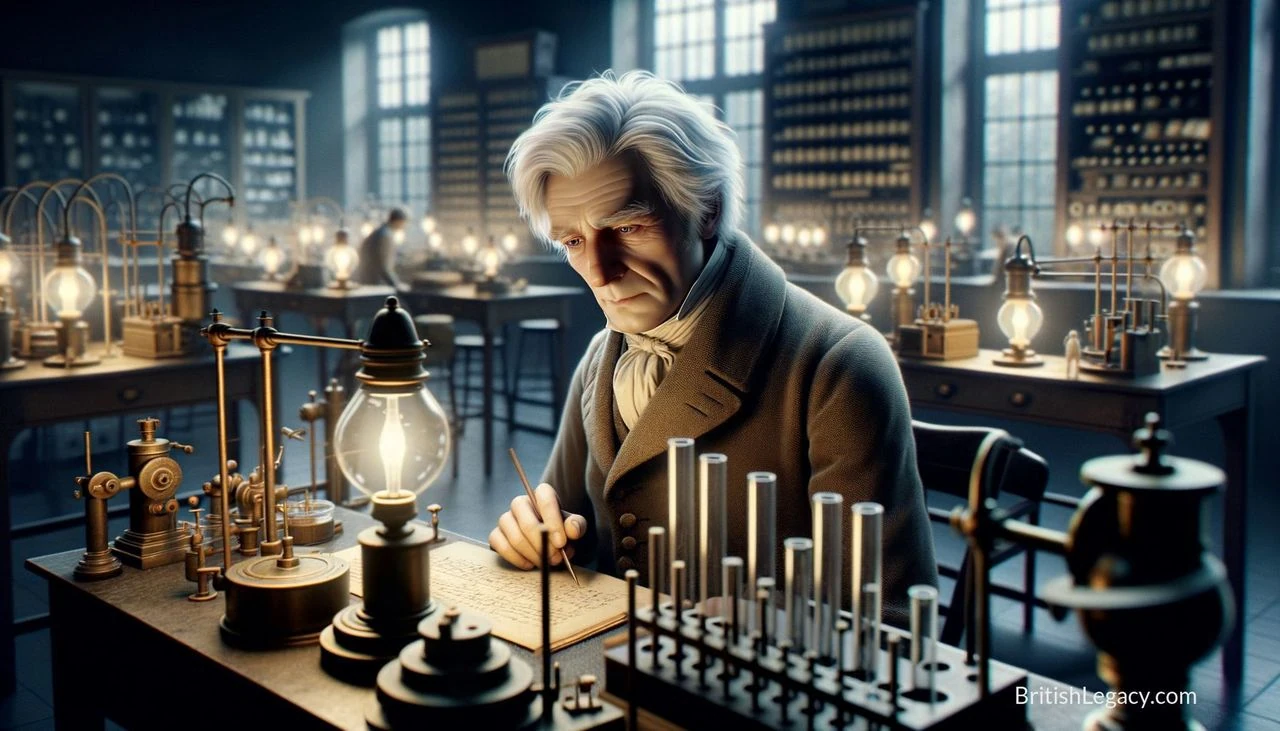
Michael Faraday’s experiments helped turn electricity and magnetism from subjects of scientific investigation into foundations of practical technology. In 1831, he showed that a changing magnetic field could produce an electric current. The principle underpins generators and transformers, while his earlier work on electromagnetic rotation helped establish the basis of electric motors. Faraday reached these discoveries with little formal education, building a career through self-directed study, patient experiment and a gift for explaining what he observed.
A bookseller’s apprentice finds a route into science
Faraday was born on 22 September 1791 in Newington Butts, then in Surrey and now part of the London Borough of Southwark. His family had moved to London from Westmorland, and money was limited. He received only basic schooling. At 14, he became an apprentice to George Riebau, a bookbinder and bookseller in Blandford Street, where reading gave him an education beyond the classroom. Among the works he encountered was Jane Marcet’s Conversations on Chemistry, which helped kindle his interest in science.
Faraday also attended lectures and joined discussions at the City Philosophical Society. In 1812, aged 20 and nearing the end of his apprenticeship, he heard Humphry Davy lecture at the Royal Institution. He made a book of notes from the lectures and sent it to Davy. The gesture led to a position as a chemical assistant at the Royal Institution, which Faraday took up on 1 March 1813. He began there at the lowest level of the institution’s scientific staff, but the laboratory became the setting for the work that would define his life.
Faraday’s early career was not without danger or difficulty. While assisting Davy with experiments involving nitrogen trichloride, both men were injured in an explosion. Faraday continued to develop his practical skills, learning through close observation and experiment. In 1821, he married Sarah Barnard; they had no children. His Christian faith was important to him, and he served as a deacon and elder in the Sandemanian congregation.
Experiments in motion, current and magnetism
In 1821, Faraday investigated the connection between electricity and magnetism. After Hans Christian Ørsted had shown that an electric current affects a magnetic needle, Faraday constructed devices that produced continuous electromagnetic rotation. One, now known as a homopolar motor, made a wire rotate around a magnet when a current passed through it. These experiments were an early demonstration that electrical and magnetic forces could produce motion, and they helped lay the foundations of electric-motor technology.
Faraday’s work on electromagnetic induction followed a decade later. In 1831, he wrapped two insulated coils around an iron ring. When he switched on a current in one coil, a momentary current appeared in the other. Further experiments showed that moving a magnet through a wire loop, or moving the loop over a stationary magnet, also generated a current. The essential condition was change: a changing magnetic field could induce an electric current. The iron ring and coils used in the first experiment remain on display at the Royal Institution.
Faraday went on to use the principles of induction in an early electric dynamo, a predecessor of modern power generators. The later mathematical formulation of his findings became Faraday’s law of induction, incorporated into James Clerk Maxwell’s equations. Faraday did not express his findings in advanced mathematics; his strength lay in careful experiment and in visualising physical forces. His idea that electromagnetic forces extended through the space around a conductor helped shape the later understanding of the electromagnetic field.
His contributions were not confined to electricity and magnetism. In 1833, he became the first Fullerian Professor of Chemistry at the Royal Institution, a position he held for life. His work on electrolysis established quantitative laws relating the amount of electricity used to the amount of substance produced at an electrode. He also helped make terms including anode, cathode, electrode and ion familiar in scientific use.
A chemist with a wider experimental range
Faraday’s chemical investigations ranged from gases and compounds to materials with unusual optical properties. He liquefied several gases, investigated chlorine compounds and discovered benzene, which he called bicarburet of hydrogen. He also studied chlorine clathrate hydrate and produced glass for optical experiments. In 1845, he found that a magnetic field could rotate the plane of polarisation of light, an effect now known as the Faraday effect. The finding demonstrated a connection between magnetism and light.
In 1857, Faraday reported that gold in colloidal form had optical properties different from those of bulk gold. His work also included experiments with charged conductors. In 1836, he demonstrated electrical shielding by entering a room-sized wooden structure covered with paper and wire mesh and electrifying its exterior. The experiment showed that the charge remained on the outside and that the interior was shielded. This effect is now associated with the Faraday cage.
Faraday’s practical investigations often served purposes beyond the laboratory. He worked on lighthouse lighting and the protection of ships from corrosion, and advised on optical glass for lighthouse use. In 1846, he and the geologist Charles Lyell examined an explosion at the Haswell colliery in County Durham, in which 95 miners died. Their report identified coal dust as a contributor to the severity of the explosion and demonstrated how ventilation could help prevent such disasters. Faraday also investigated industrial pollution at Swansea, air pollution at the Royal Mint and the polluted state of the River Thames.
His public service included work for the Great Exhibition of 1851 and advice to the National Gallery on cleaning and protecting its collection. During the Crimean War, he declined a request to advise on chemical weapons, citing ethical objections. His decisions show a scientist engaged with the consequences of his work as well as its technical challenges.
Making science visible to the public
Faraday’s public lectures were another important part of his career. From 1827 to 1860, he gave 19 Christmas lecture series at the Royal Institution, presenting science to young people and general audiences. He also founded the institution’s Friday Evening Discourses in 1825, where researchers presented new work. His demonstrations made abstract forces tangible: rather than asking an audience simply to accept an explanation, he invited them to consider what an experiment showed.
One of his best-known lecture subjects was the chemistry of a candle. In these talks, ordinary materials and familiar effects became a route into scientific reasoning. Faraday valued experiment as a form of shared discovery and was reluctant to publish his lectures without the demonstrations that gave them life. The Christmas Lectures continued after his death, preserving a format he had helped establish.
Faraday’s standing grew during his lifetime. He was elected a Fellow of the Royal Society in 1824 and received an honorary degree from the University of Oxford in 1832. He declined a knighthood and twice refused the presidency of the Royal Society. In 1848, he was granted a house at Hampton Court, where he retired in 1858. He died there on 25 August 1867, aged 75, and was buried at Highgate Cemetery.
Why Michael Faraday deserves a place in British Legacy
Faraday deserves a place in British Legacy because his work connected scientific discovery with technologies that became central to modern life. His experiments on electromagnetic rotation helped establish the principles behind electric motors; his discovery of induction provided a basis for generators and transformers. These were not isolated observations. Faraday tested how currents, magnets and motion interacted, then developed his findings into a practical understanding of electromagnetic forces. His research also reached into chemistry, electrolysis, optics and the behaviour of charged conductors. The breadth of that work matters: it shows how patient experimental investigation can build knowledge that later researchers and engineers develop into useful systems.
His British legacy also lies in the institutions and public responsibilities through which he worked. At the Royal Institution, he rose from chemical assistant to its first Fullerian Professor of Chemistry, while his lectures helped bring experimental science to audiences beyond specialist laboratories. His work for lighthouses, shipping and mine safety applied scientific reasoning to concrete risks and public needs. At Haswell, his investigation with Charles Lyell connected coal dust to the severity of a fatal explosion and demonstrated the value of ventilation. Faraday’s refusal to assist with chemical weapons further shows that his public service had ethical limits. Together, these achievements make his legacy more than a list of discoveries: they link British scientific practice with education, engineering and a sense of responsibility for how knowledge is used.
Sources
Adapted in part from Michael Faraday by Wikipedia contributors, under CC BY-SA 4.0. Text has been edited and combined with the existing article; this adapted text is shared under the same licence. Contributor history.