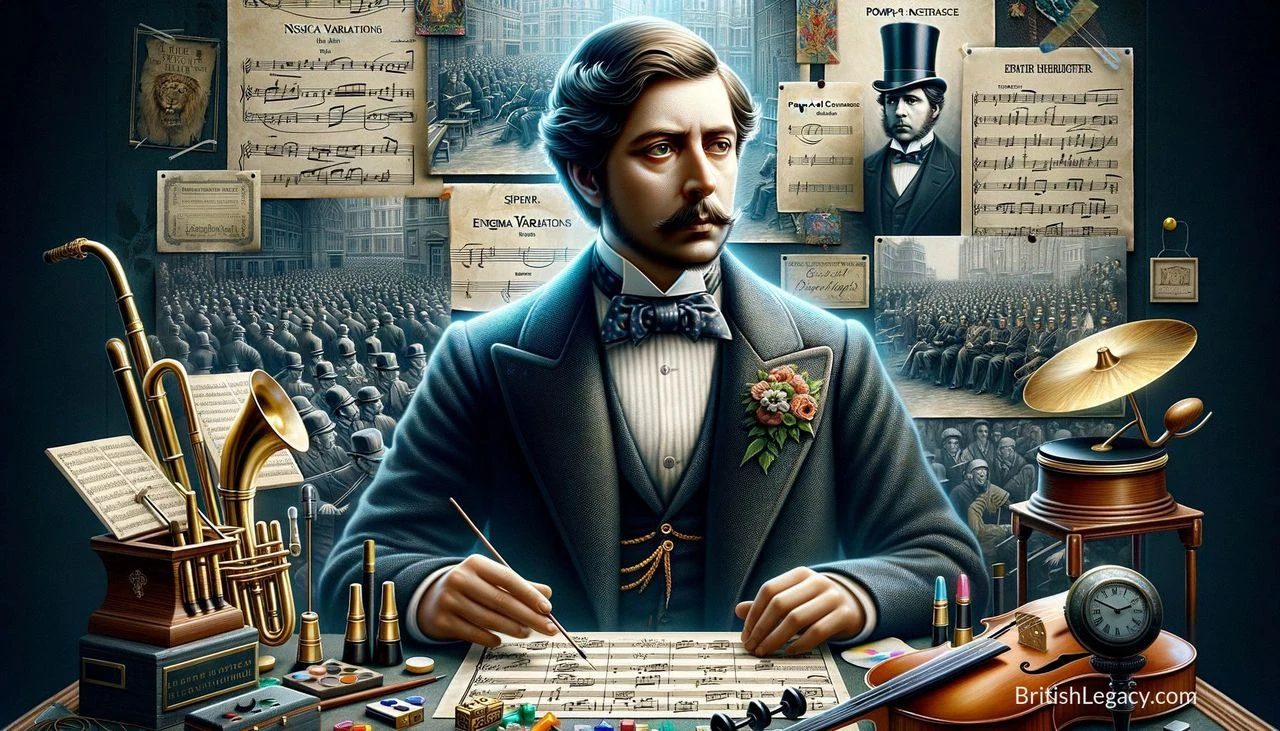
Edward Elgar’s music became closely bound to British public life, but its route there was neither effortless nor straightforward. A largely self-taught composer from Worcestershire, he spent years earning a living as a teacher and musician before the Enigma Variations brought him national and international recognition in 1899. He went on to write orchestral and choral works that entered the concert repertoire, while his own recordings helped preserve how he wanted that music to sound.
A musical education in Worcestershire
Edward William Elgar was born on 2 June 1857 in Lower Broadheath, near Worcester. His father, William, tuned pianos and ran a shop selling sheet music and musical instruments; he was also a violinist and organist. Music was part of family life, and Elgar began piano and violin lessons as a child. He composed from an early age, drawing on ideas that he later revisited in works including the Wand of Youth suites.
Elgar received a general education but little formal instruction in composition. He read books on musical theory and learnt by playing, arranging and conducting. After leaving school at 15, he worked briefly in a solicitor’s office, then turned to music: teaching, playing the violin and working in his father’s shop. At 22, he became conductor of the band at Powick asylum, writing and arranging music for its unusual combination of instruments. The practical work deepened his knowledge of orchestral colour and the capabilities of individual instruments.
He also played in local orchestras, including William Stockley’s Orchestra in Birmingham, and heard major works by European composers. These experiences broadened his musical outlook. Although later associated with an English sound, Elgar drew significantly on continental traditions, including the music of Handel, Dvořák, Brahms, Wagner and French composers such as Berlioz and Delibes.
In 1889 he married Caroline Alice Roberts, a writer and the daughter of a senior army officer. Alice supported his career and helped him move in influential social circles. The couple settled in Worcestershire after a period in London, where Elgar had struggled to establish himself. During the 1890s he built a reputation through works for choral festivals in the English Midlands, including The Black Knight, King Olaf and Caractacus. His progress was gradual: he was respected locally, but financial security and broad recognition remained uncertain.
The work that brought recognition
That changed in 1899 with the first performance of the Enigma Variations. Its 14 variations portray, through musical character sketches, people in Elgar’s circle. The work’s formal title is Variations on an Original Theme; the familiar word “Enigma” comes from an inscription over the opening bars. Elgar also said that another theme ran through the work without being heard. He never identified it, leaving a genuine puzzle alongside the variations’ more personal portraits.
The piece established Elgar as a leading British composer and travelled beyond Britain. Its success was followed by The Dream of Gerontius (1900), a choral work based on a poem by the Catholic theologian John Henry Newman. A poorly prepared first performance obscured the work’s strengths, but performances in Germany helped secure its reputation. Its religious text also brought resistance from some Anglican church authorities in Britain.
Elgar’s first Pomp and Circumstance March, composed in 1901, became famous for its broad central melody. He later incorporated that melody, with words by A. C. Benson, into the Coronation Ode for Edward VII and Alexandra in 1902. Published separately as “Land of Hope and Glory”, it became an unofficial British national anthem. The march is now strongly associated with the Last Night of the Proms, while the tune also found a different public role in American graduation ceremonies.
Elgar’s standing grew quickly. In 1904, a three-day festival of his music was held at Covent Garden, an honour without precedent for an English composer. He was knighted that year. His First Symphony, premiered in 1908, won immediate success in Britain and abroad. The Violin Concerto, written for Fritz Kreisler and first performed in 1910, was another major achievement. The Second Symphony, by contrast, did not meet the same public enthusiasm at its premiere.
War, reflection and later work
Elgar’s music did not remain fixed in the grand public manner associated with “Land of Hope and Glory”. During the First World War, he composed patriotic works, but also wrote for the stage and set poems by Laurence Binyon in The Spirit of England. In 1919 he completed three chamber works and the Cello Concerto in E minor. The concerto’s first performance was badly affected by inadequate rehearsal. Its restrained, reflective character differed markedly from the public confidence of his earlier successes; it took time to find its place in the repertoire.
Alice died in 1920. Elgar was devastated, and his output of large-scale original works diminished. He returned to Worcestershire and, in 1924, was appointed Master of the King’s Musick. He also took the gramophone seriously. From 1914 onwards he conducted recordings of his work; later advances in recording technology allowed him to make a substantial series of electrical recordings. These documents preserve not only compositions but the composer’s own interpretations.
Elgar’s final years brought renewed attention to his music, including a BBC festival for his 75th birthday in 1932. He began work on an opera and a Third Symphony, but illness prevented their completion. He died on 23 February 1934, aged 76, and was buried beside Alice at St Wulstan’s Roman Catholic Church in Little Malvern.
Why Edward Elgar deserves a place in British Legacy
Elgar deserves a place in British Legacy for the scale and range of his contribution to British musical life. The Enigma Variations brought a composer working outside the academic establishment to national prominence, while The Dream of Gerontius helped shape the country’s choral tradition. His symphonies and concertos extended the ambitions of British orchestral music. These were not isolated successes: Elgar built his command of composition through years of teaching, performing, arranging and conducting, and his works drew on a broad European musical inheritance rather than a narrow idea of national style.
His legacy also lives in the different settings in which his music continues to be heard. “Land of Hope and Glory”, first part of a coronation commission, became familiar at the Proms and took on a separate association with graduations in the United States. The Cello Concerto offers a very different inheritance: a work whose quiet, inward character speaks beyond public ceremony. Elgar’s recordings add another lasting contribution, preserving his own approaches to performance for later musicians and listeners. Taken together, his achievements show how one composer could write for national occasions while also making music that resists simple patriotic labels. That combination—public resonance, artistic breadth and a continuing presence in performance—makes his place in British musical history enduring and specific.
Sources
Edward Elgar — Wikipedia, revision 1377657276
Adapted in part from Edward Elgar by Wikipedia contributors, under CC BY-SA 4.0. Text has been edited and combined with the existing article; this adapted text is shared under the same licence. Contributor history.