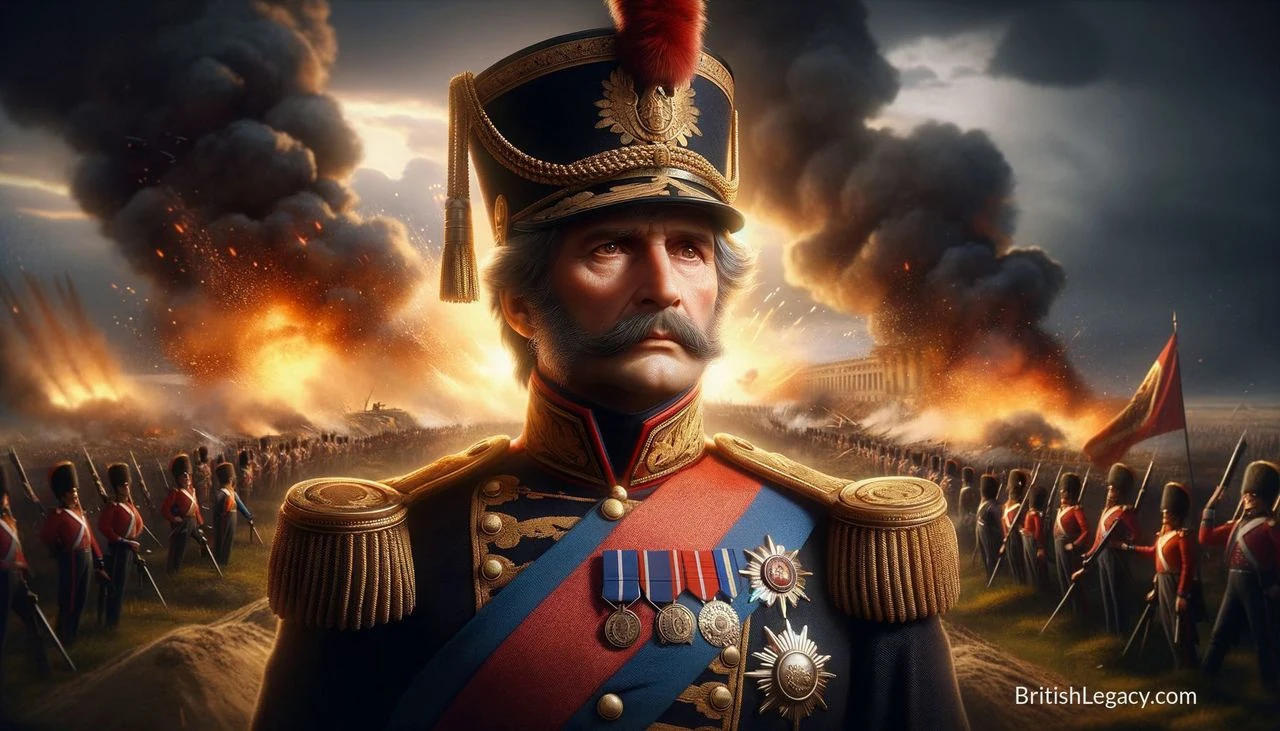
Arthur Wellesley, the 1st Duke of Wellington, is remembered for commanding the allied army at Waterloo, where Napoleon was defeated in 1815. His public life also extended into politics: Wellington served twice as British Prime Minister and played a central part in the passage of Catholic relief in 1829. His story links a military career shaped by campaigns in Europe with political leadership at a time of change in Britain.
From Ireland to the army
Wellesley was born in Ireland on 1 May 1769 and belonged to the Anglo-Irish aristocracy. He was educated at Eton and at the Royal Academy of Equitation in France, then entered military service in 1787. His early career was described as unremarkable, but his reputation grew during the Peninsular War. He led forces at Vimeiro, Talavera and Salamanca, campaigns that established him as a prominent commander.
Those campaigns preceded the confrontation for which he became most famous. On 18 June 1815, at Waterloo, Wellesley commanded a coalition army against Napoleon’s forces. The allied victory ended Napoleon’s return to power and helped reshape Europe’s political landscape. Wellington later recalled the battle as “a damned nice thing — the nearest run thing you ever saw in your life”. The remark conveys the uncertainty of the fighting, rather than presenting the outcome as inevitable.
Waterloo and its aftermath
Waterloo made Wellington a defining figure in the closing phase of the Napoleonic Wars. His role was not simply a matter of being present at the decisive battle: the account of his career also rests on the earlier campaigns in the Iberian Peninsula, where Vimeiro, Talavera and Salamanca had brought him recognition. Together, these episodes made his military reputation one of the foundations of his later public standing.
His name remained associated with Waterloo, but his career did not end with the battlefield. Returning to Britain, he entered political life and became Prime Minister in 1828. He held office until 1830, then served again briefly in 1834. The transition from commander to head of government placed him at the centre of British public affairs in a period when religious and political questions demanded decisions as well as military leadership.
Government and Catholic relief
Wellington’s most substantial political achievement in the existing account is his part in the passage of the Catholic Relief Act of 1829. The Act enabled Roman Catholics to sit in Parliament, removing a significant restriction on their participation in political life. Wellington’s support for the measure sits alongside the conservative views for which he was also criticised, including opposition to electoral reform.
That combination makes his political record more complex than a simple story of reform. He helped secure a major change in Catholic political rights while remaining a conservative figure in other disputes. His two periods as Prime Minister, one lasting from 1828 to 1830 and a second brief return in 1834, place him among the military leaders who also took a direct role in governing Britain.
A London home and public memory
Wellington’s London residence was Apsley House, known as “Number One, London”. The original account describes it as a museum containing art and objects associated with his life. The house provides a tangible link between the public figure and the capital in which he served as a politician. His memory has also endured through accounts of Waterloo and his political career, although the more sweeping claims that he shaped military thinking worldwide are not necessary to explain his place in British history.
Descriptions of Wellington as stern, dutiful or personally warm belong to the portrait offered in the earlier account, rather than to a documented incident. His public record gives a firmer basis for understanding his character as a historical figure: military command, high political office, and involvement in a contested measure that widened access to Parliament.
Why Arthur Wellesley deserves a place in British Legacy
Wellington merits a place in British Legacy because his life joined two forms of public authority. His command at Waterloo made him a central figure in the defeat of Napoleon, while his earlier campaigns at Vimeiro, Talavera and Salamanca show that his military reputation was built over time. The importance of Waterloo lies not only in its place in European history, but also in the way the battle became inseparable from Wellington’s name and subsequent public standing.
His political record adds a distinct British dimension to that legacy. As Prime Minister, he was involved in the passage of the Catholic Relief Act of 1829, which allowed Roman Catholics to sit in Parliament. That achievement can be considered alongside his opposition to electoral reform, without flattening his record into either unqualified praise or a single political label. Apsley House, remembered as “Number One, London”, also connects his public career to the capital. Together, military service, government and Catholic relief explain why Wellington belongs in a history of people whose decisions left a mark on Britain’s institutions and its place in Europe.