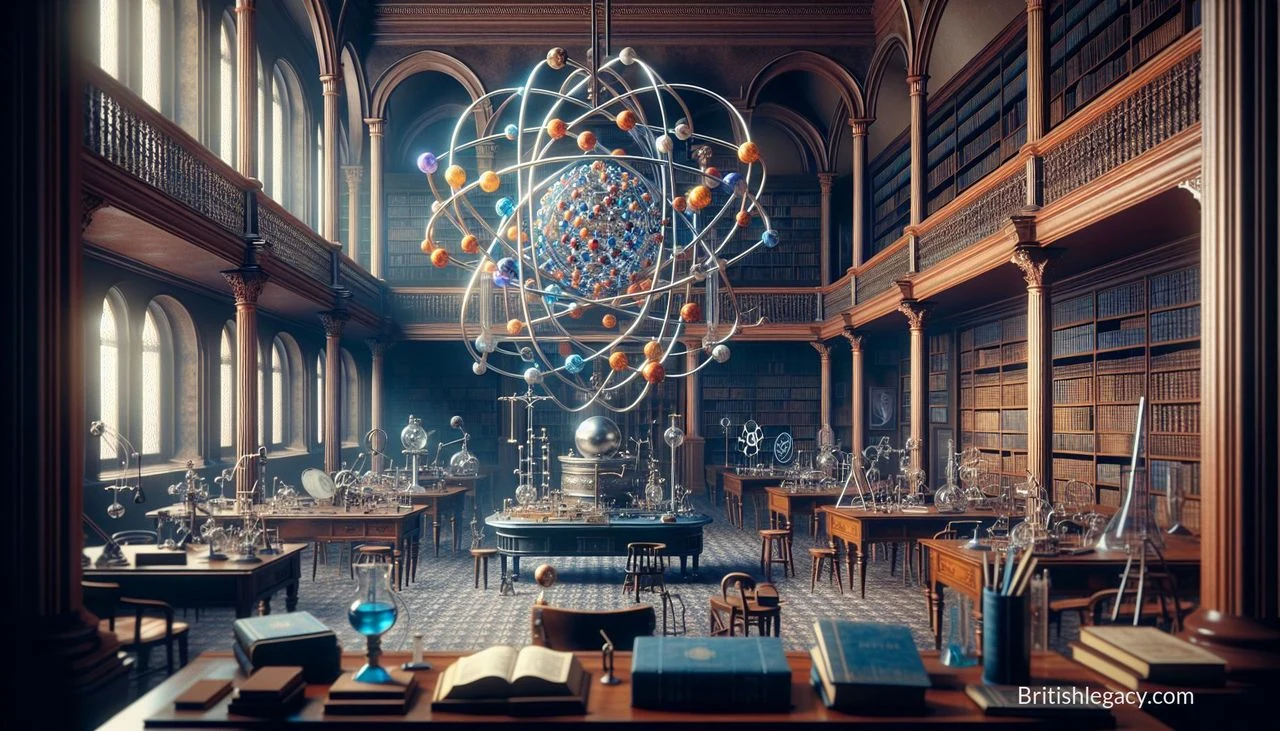
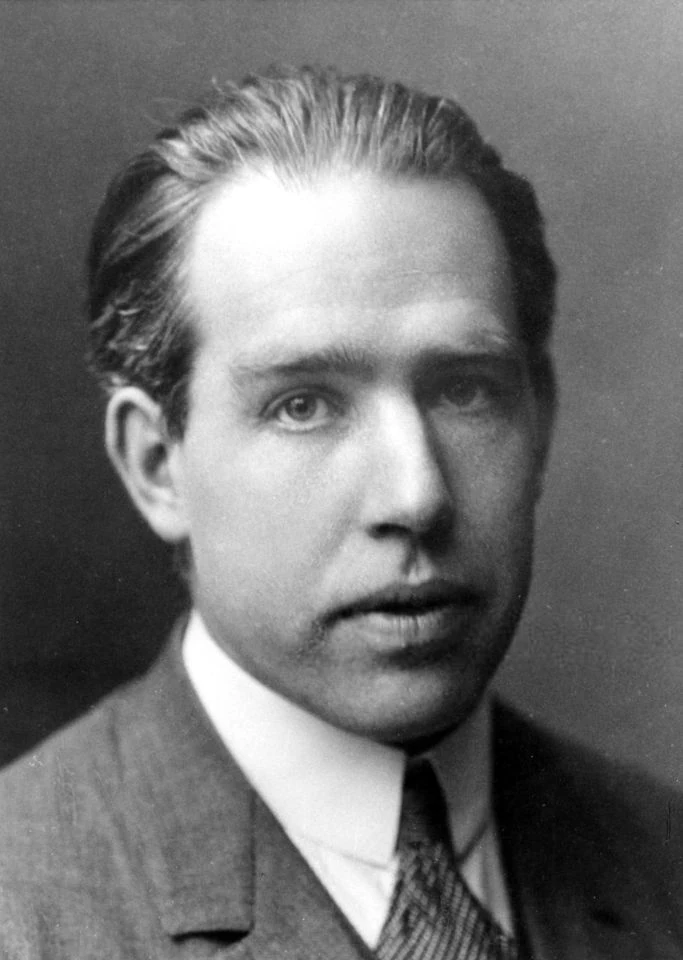
When Niels Bohr arrived in Manchester in 1912, Ernest Rutherford’s work had revealed a tiny, massive nucleus at the centre of the atom. Yet the new picture created a serious problem: according to classical physics, an orbiting electron should lose energy, spiral inwards and bring the atom to ruin. Matter plainly did not behave that way. Bohr’s response, developed in the years around his time in Manchester, was to bring quantum theory into the description of atomic structure. His 1913 model did not have the last word, but it changed the questions physicists could ask—and helped make the invisible atom answerable to measurement.
Bohr was Danish, not British. His place in British scientific history rests on something more substantial than nationality: Rutherford’s Manchester laboratory helped shape his most influential early work, British institutions later recognised him, and Britain became a place of refuge and scientific work during the Second World War.
A young theorist finds the right problem
Niels Henrik David Bohr was born in Copenhagen on 7 October 1885. He studied physics at the University of Copenhagen, where his work on the electron theory of metals led to a doctorate in 1911. Football was another important interest: Bohr played for Akademisk Boldklub, as did his brother Harald. His early scientific work already involved a practical streak. For a university prize investigation into the surface tension of liquids, he carried out experiments using his father’s laboratory and made the glassware he needed himself.
In 1911 Bohr travelled to England, where much of the theoretical discussion of atoms and molecules was taking place. He went first to Cambridge, hoping to work with J. J. Thomson at the Cavendish Laboratory. The visit did not produce the collaboration he wanted. A more consequential connection was forming with Ernest Rutherford, whose account of the atom placed a small nucleus at its centre.
Rutherford invited Bohr to Manchester in 1912. The department there was investigating radioactivity, the scattering of particles and the nucleus. Bohr’s first paper from Manchester concerned the absorption of alpha rays, but he soon focused on the conceptual problem presented by Rutherford’s atom. If electrons behaved according to established electrodynamics, their motion should make them radiate energy continuously. They would then lose energy and fall into the nucleus. The stability of matter, which was evident all around them, demanded a different explanation.
Bohr concluded that classical mechanics alone could not account for atomic structure. Max Planck’s quantum theory offered a way to rethink the problem: rather than allowing electrons to have any energy, Bohr proposed that they could occupy only certain allowed states. That was a bold step, not a minor adjustment to Rutherford’s picture. It brought a new kind of rule into the heart of the atom.
The model that connected atoms with light
Bohr published his account in three papers in 1913, later known as the atomic trilogy. He proposed that electrons could remain in particular stable states without radiating energy continuously. An electron could move between those states, but only by absorbing or emitting a discrete amount of energy. This idea gave the atom a means of remaining stable while linking its internal structure to the radiation it produced.
The connection was especially important for hydrogen. Its spectrum consists of distinct lines rather than a continuous spread of colours. Before Bohr’s work, the pattern could be described mathematically, but its origin was not understood. If an electron could occupy only certain energy levels, a transition between two levels would release or absorb a particular amount of energy. The model therefore connected the observed lines in hydrogen’s spectrum to changes inside the atom. Spectral measurements became evidence about atomic structure.
The familiar schoolbook image of electrons circling a central nucleus captures part of Bohr’s proposal, but it is a simplified picture. Later quantum mechanics replaced the model’s neat orbits with a more complex account. Bohr’s theory also had limits: it worked particularly well for hydrogen and certain single-electron systems, not for every atom. Its importance lies not in being the final description, but in explaining evidence that earlier models could not handle and giving physicists a productive starting point for further work.
Bohr returned to Denmark after his first Manchester period. In 1914 he took up a position in Manchester again, remaining until 1916; by then he had been appointed to the chair of theoretical physics at the University of Copenhagen. His work continued to attract attention. In 1922 he received the Nobel Prize in Physics for his investigation of atomic structure and the radiation associated with it.
Building a home for theoretical physics
Bohr’s influence was not confined to his own papers. He helped establish the Institute of Theoretical Physics in Copenhagen, which opened in 1921 with him as director and later became the Niels Bohr Institute. The institute brought physicists from several countries into sustained contact. Among those who worked there were Hans Kramers, George de Hevesy and Werner Heisenberg; the British physicist Paul Dirac also visited. Bohr helped create a setting in which researchers could test ideas through discussion as well as individual work.
That environment supported investigations beyond the original atomic model. Bohr developed the correspondence principle, which held that quantum theory should recover the results of classical physics in the appropriate limit. The principle offered a bridge between older and newer descriptions rather than treating them as wholly disconnected. He also used ideas about atomic structure to address the ordering of the elements.
One notable prediction concerned the then-undiscovered element 72. Bohr argued that its properties should be more like those of zirconium than those of the rare-earth elements. At the Copenhagen institute, Dirk Coster and George de Hevesy searched for a substance with the predicted properties and identified the element, which they named hafnium, after the Latin name for Copenhagen. The episode showed how theoretical reasoning could guide a search in the laboratory and help distinguish between competing classifications.
In 1927 Bohr introduced the principle of complementarity. In his account, some aspects of atomic phenomena call for descriptions that appear incompatible, such as wave and particle pictures, depending on the experimental arrangement. The aim was not to claim that any explanation would do, but to address what experiments permit physicists to say about quantum events. Complementarity became associated with the Copenhagen interpretation of quantum mechanics and with the continuing debates between Bohr and Albert Einstein about how the theory should be understood.
Bohr’s ideas reached beyond Denmark. In 1926 the Royal Society elected him a Foreign Member, recognising his standing in a scientific community in which he had already worked and collaborated. The distinction also made clear that international exchange was integral to the development of modern physics: Manchester had helped shape his early atomic work, while his later ideas and the researchers associated with his institute became part of scientific life across national boundaries.
War brings a renewed British connection
Bohr’s work during the 1930s included helping scholars endangered by Nazism. After Germany occupied Denmark in 1940, his institute lost its foreign researchers as they departed, though Bohr kept it operating. In 1943, with the danger of arrest increasing, he escaped Denmark with help from the Danish resistance and reached Sweden. He was then flown to Britain, arriving in Scotland on 6 October.
Bohr came to Britain during a period when the practical and political consequences of nuclear physics were becoming urgent. He joined the British Tube Alloys project and later became part of the British mission to the Manhattan Project. He travelled to the United States as a Tube Alloys consultant and visited the project’s facilities, including Los Alamos, where nuclear weapons were being designed. His wartime work was conducted under security restrictions; in the United States he used the name Nicholas Baker.
Bohr understood that nuclear weapons would transform international relations as well as military power. He argued for international cooperation and openness in nuclear affairs after the war. On 9 June 1950 he addressed an open letter to the United Nations, making the case that secrecy and rivalry between states could not alone provide a stable basis for the atomic age. This political concern grew from the same scientific developments that had made the atom newly intelligible, though the discovery of nuclear power and weapons involved many people and institutions, not Bohr alone.
His post-war work also included support for international scientific cooperation. Bohr backed the formation of CERN, whose early theoretical study group was based in Copenhagen before moving to Geneva. He was involved in discussions about the organisation’s beginnings and supported its development. Such collaboration reflected a conviction that demanding scientific problems could require shared effort across borders, an outlook also present in the institute he had built in Copenhagen.
Why Niels Bohr deserves a place in British Legacy
Niels Bohr deserves a place in British Legacy because Manchester was not an incidental stop in his career. Rutherford’s work on the nucleus confronted him with a precise difficulty: the established physics of electron motion could not explain the atom’s stability. Bohr’s answer, developed through his engagement with that problem, brought quantum ideas into atomic structure. The model connected discrete electron energies with the measured lines of hydrogen’s spectrum and supplied physicists with a workable route into questions that had resisted earlier explanations. Its later replacement does not erase that achievement; it shows how a successful scientific model can open the way to better ones.
His British legacy also includes the continuing value of scientific exchange. Bohr worked in Manchester, returned there for a second period, and was elected a Foreign Member of the Royal Society. During the Second World War Britain became a place where he could continue scientific work after escaping occupied Denmark, including through Tube Alloys and the British mission to the Manhattan Project. After the war, he called for international cooperation on nuclear affairs and supported the development of CERN. These are specific connections, not a claim that Bohr was British or that one person created modern physics. They show how British institutions and colleagues formed part of a wider scientific community—and how that community benefited from Bohr’s ideas, collaboration and willingness to confront the political consequences of scientific discovery.
Sources
Adapted in part from Niels Bohr by Wikipedia contributors, under CC BY-SA 4.0. Text has been edited and combined with the existing article; this adapted text is shared under the same licence. Contributor history.