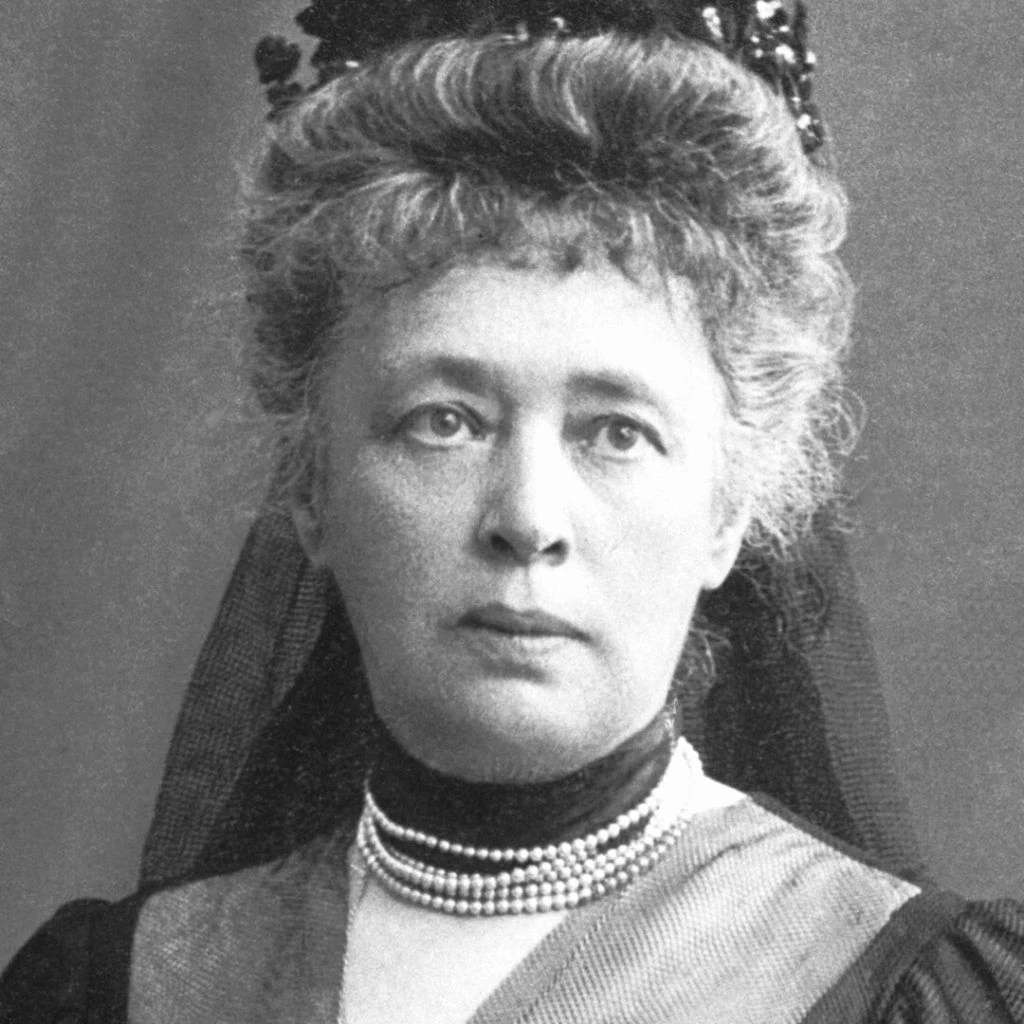
Bertha von Suttner turned opposition to war into a public campaign. Her 1889 novel Die Waffen nieder! (Lay Down Your Arms!) reached readers in many languages; her work as a journalist and organiser carried the argument into peace societies and international meetings. In 1905 she became the first woman to receive the Nobel Peace Prize. Her connection to Britain is specific rather than national: in 1908 she attended an International Peace Congress in London, where she met the English anti-war activist Caroline Playne, who would later write her first biography.
From Prague to a life of her own
Bertha Sophie Felicitas Kinsky was born in Prague on 9 June 1843, in the Austrian Empire. Her father, an Austrian lieutenant general, died before she was born. Her mother came from a family of lower noble status, and Bertha’s mixed ancestry excluded her from parts of aristocratic society. The family also had limited financial resources. These circumstances help explain why her adult life involved a search for paid work and independence, despite her aristocratic connections.
She received private tuition and became proficient in French, Italian and English, as well as an accomplished amateur pianist and singer. Her cousin Elvira introduced her to literature and philosophy. Bertha tried to establish herself as an opera singer, taking lessons in Paris and Baden-Baden, but stage fright and difficulty projecting her voice prevented her from securing a professional engagement. She also wrote early fiction, including a novella published in 1859.
In 1873 she took a position as tutor to the daughters of Karl and Karola von Suttner. She fell in love with their younger son, Arthur, but his parents opposed the match. In 1876 Bertha briefly became Alfred Nobel’s secretary and housekeeper in Paris after answering a newspaper advertisement. She and Nobel formed a friendship, but she returned to Vienna and married Arthur in secret. His family disinherited him, and the couple left for Mingrelia, in what was then the Russian Empire.
They earned a living teaching languages and music to the children of local aristocrats. Their circumstances were difficult, and both turned to writing. Bertha contributed to the Austrian press; in 1883 she published Inventarium einer Seele (Inventory of the Soul), a political work that argued for disarmament and suggested that technological change might make world peace possible. In 1885, after reconciling with Arthur’s family, the couple returned to Austria.
A novel becomes a campaign
Back in Austria, Suttner concentrated increasingly on war and peace. Her novel Die Waffen nieder!, published in 1889, follows the effects of war through the life of its protagonist, Martha. Rather than treating conflict as an abstraction, the book presents its human consequences and challenges the values that sustain militarism. It became her best-known work, appearing in 37 editions and being translated into 15 languages.
The novel’s reach was one part of a broader effort. Suttner wrote about the peace movement, corresponded with activists and helped build organisations to support its work. In 1891 she called for an Austrian pacifist organisation in an editorial for the Neue Freie Presse; she became chairwoman of the Austrian Peace Society and founded the German Peace Society the following year. From 1892 to 1899 she edited the international pacifist journal also called Die Waffen nieder!
Her organising brought her into international forums. In 1897 she presented Emperor Franz Joseph I with a petition calling for an international court of justice. She attended the First Hague Convention in 1899 and, in 1907, was the only woman at the Second Hague Peace Conference. She criticised the latter for concentrating on rules governing warfare rather than addressing the political system that accepted war. Her campaign was not limited to writing: it also involved petitions, journalism and sustained participation in peace organisations.
The Nobel Prize and the British connection
Suttner’s relationship with Alfred Nobel was brief in person but continued through correspondence until his death in 1896. Her influence on his decision to include a peace prize in his will is widely believed to have been significant, though the supplied account does not establish it as the sole cause. She received the Nobel Peace Prize in 1905, becoming the first woman to win that award. The prize recognised a campaign built through writing and organisation, not a single book alone.
Her British connection is best understood through identifiable encounters and exchanges. In 1908 she attended the International Peace Congress in London, where she first met Caroline Playne, an English anti-war activist who later wrote Suttner’s first biography. The supplied account also records English-language editions of her memoirs published in Boston and London in 1910. These details place her work in contact with British readers and campaigners without turning her into a British activist or claiming that she directed Britain’s peace movement.
Suttner also travelled in the United States in 1904, attending a universal peace congress in Boston and meeting President Theodore Roosevelt. The following year she received the Nobel Peace Prize; its presentation took place in Kristiania, now Oslo, in April 1906. In 1911 she joined the advisory council of the Carnegie Peace Foundation. These international engagements show the scale of her campaigning, while the London congress gives the British connection its clearest documented point.
Arguments beyond disarmament
Suttner’s writing addressed the ideas that could make war seem acceptable. In Lay Down Your Arms!, she challenged the use of religious language to justify conflict and questioned the spectacle of public piety when it concealed violence. She also objected to the division of people by nationality or faith. Her husband, Arthur, founded the League Against Anti-Semitism in response to pogroms in Eastern Europe and growing antisemitism; Suttner’s own stated ideal was acceptance across religious and national boundaries.
She also wrote about gender. Though she did not take part in the campaign for women’s suffrage, she maintained contact with that movement and attended the 1904 International Women’s Conference in Berlin. Her argument was that lasting peace required cooperation between women and men on equal terms. In her fiction, she used the character of Martha to challenge expectations about women’s roles and the ways boys were taught to admire military life. These arguments sit alongside her anti-war work, rather than being a claim that she led every aspect of the women’s movement.
Her public career continued as Europe moved towards another conflict. In the last months of her life, while suffering from cancer, she helped organise a peace conference planned for September 1914. It never took place. Suttner died in Vienna on 21 June 1914, seven days before the assassination of Archduke Franz Ferdinand, an event that helped trigger the First World War. In her will she had requested cremation in Gotha, Germany, where her ashes were placed in a local columbarium.
Why Bertha von Suttner deserves a place in British Legacy
Bertha von Suttner deserves a place in British Legacy not because she was British, but because her documented work crossed into British public life. At the 1908 International Peace Congress in London, she met Caroline Playne, an English anti-war activist who went on to write her first biography. Her memoirs were also published in an English edition in London. These connections give British readers a concrete route into her story: a writer and organiser from Austria whose ideas reached British campaigners and readers through meetings and publication.
Her wider achievement gives those encounters their significance. Die Waffen nieder! made the consequences of war legible to readers across languages; Suttner then worked to build the organisations, journals and international forums through which opposition to war could be sustained. She petitioned for an international court, took part in peace conferences and challenged the assumption that war could be made acceptable simply by regulating its conduct. The Nobel Peace Prize recognised this combination of literature and activism. Remembering her in a British context can therefore do more than claim her as an honorary national figure: it can show how British readers and campaigners formed part of a wider exchange of anti-war ideas, and how a writer based abroad could help bring that debate into shared public view.
Sources
Bertha von Suttner (revision 1379421767) · Bertha von Suttner
Adapted in part from Bertha von Suttner by Wikipedia contributors, under CC BY-SA 4.0. Text has been edited and combined with the existing article; this adapted text is shared under the same licence. Contributor history.