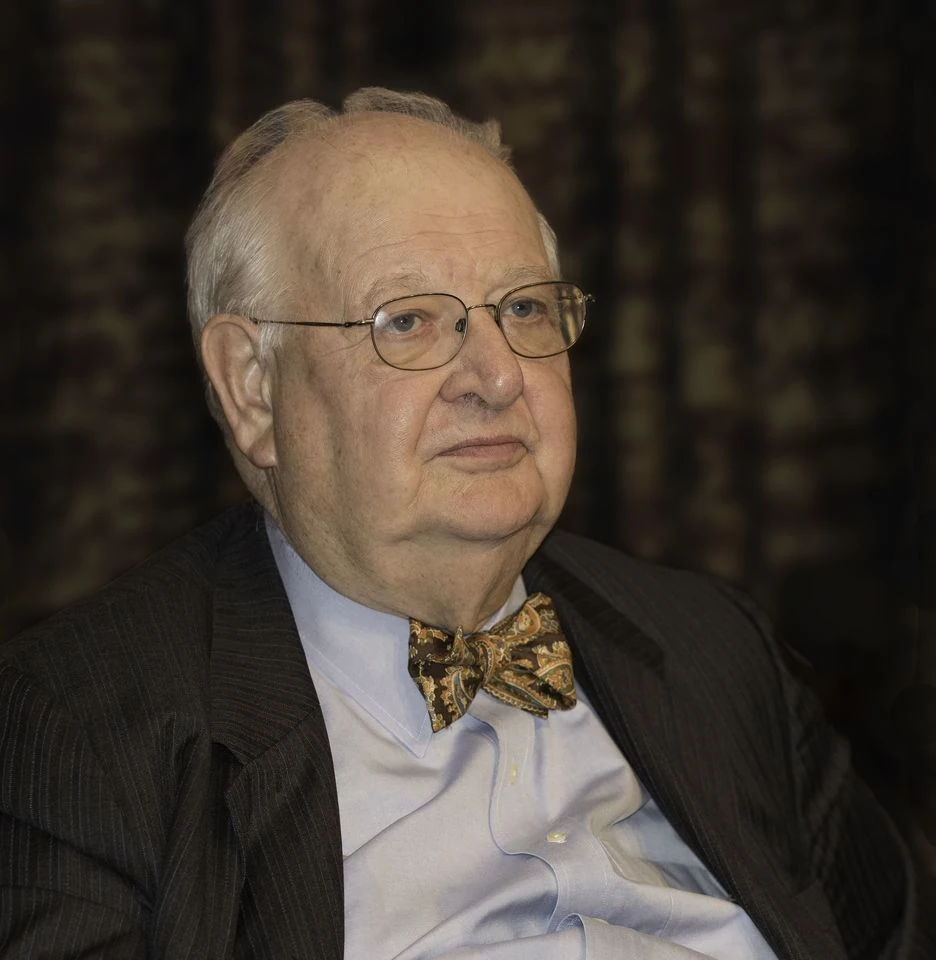
Angus Deaton’s economics starts with a close look at household choices: what people consume, how spending responds to prices and income, and what those patterns can tell us about welfare. That focus on detailed evidence has shaped work ranging from consumer-demand models to the measurement of poverty. Born in Edinburgh and educated at Cambridge, Deaton built much of his career in Britain before moving to Princeton. In 2015, he received the Nobel Memorial Prize in Economic Sciences for his analysis of consumption, poverty and welfare.
From Edinburgh to Cambridge
Angus Stewart Deaton was born in Edinburgh on 19 October 1945. He attended Hawick High School and then Fettes College, where he was a foundation scholar. In the summer of 1964, he worked at the Portmeirion Hotel. He went on to Fitzwilliam College, Cambridge, where he earned his BA, MA and PhD.
His doctoral thesis, supervised by Richard Stone, was titled Models of Consumer Demand and Their Application to the United Kingdom and dated 1975. At Cambridge, Deaton was a student and later a fellow at Fitzwilliam College. He also worked as a research officer in the university’s Department of Applied Economics with Stone and Terry Barker. The thesis title points to a question that would remain central to his career: how can economists represent the decisions consumers make, and use them to understand economic conditions?
Demand, measurement and the years at Bristol
In 1976, Deaton became Professor of Econometrics at the University of Bristol. He completed a significant portion of his influential work there. Two years later, he became the first recipient of the Econometric Society’s Frisch Medal, awarded for an applied paper published in Econometrica during the preceding five years.
In 1980, the American Economic Review published a paper by Deaton and John Muellbauer introducing the Almost Ideal Demand System, generally known by its initials, AIDS. It offered a practical model for examining how demand for different goods changes with prices and income. The system was designed to satisfy economic constraints while allowing researchers to analyse consumer demand and assess the welfare effects of policies that affect consumers. The journal later ranked the paper among the 20 most influential articles published in its first hundred years.
Their work also appeared in the 1980 book Economics and Consumer Behavior. Deaton’s subsequent publications developed related questions. Understanding Consumption, published in 1992, examined the subject in depth; The Analysis of Household Surveys: A Microeconometric Approach to Development Policy followed in 1997. The latter addressed the use of household survey evidence in development policy. Rather than relying only on national totals, this kind of analysis asks what data about individual households can show about living conditions.
From household evidence to welfare
Deaton’s research made consumption a route into the study of poverty and welfare. Household spending can provide important evidence about living standards, but the figures need careful interpretation. Researchers must consider how surveys are designed and how prices, income and household choices relate to one another. Deaton’s work on demand modelling and measurement helped develop the tools for asking those questions.
The Nobel award recognised his analysis of consumption, poverty and welfare. The Royal Swedish Academy of Sciences’ account, reproduced in the supplied biographical text, explained that policies intended to reduce poverty require an understanding of individuals’ consumption choices. Deaton’s research connected those detailed choices with broader economic outcomes, linking microeconomic evidence to questions in development economics and public policy.
His 2013 book, The Great Escape: Health, Wealth, and the Origins of Inequality, considered the relationship between economic development, health, wealth and human welfare. His other work included guidelines co-authored with Salman Zaidi on constructing consumption aggregates for welfare analysis, published in 2002, and the volume The Great Indian Poverty Debate, which he co-edited with Valerie Kozel in 2005. Taken together, these works show the range of his interest: from models of consumer choice to the evidence used to assess poverty and living standards.
Princeton and wider questions of welfare
Deaton left Bristol for Princeton University in 1983. He became the Dwight D. Eisenhower Professor of International Affairs and Professor of Economics and International Affairs, with appointments in Princeton’s School of Public and International Affairs and Department of Economics. Since 2016, he has been a Senior Scholar and professor emeritus there. From 2017, he also held a joint appointment at the University of Southern California as Presidential Professor of Economics. He holds British and American citizenship.
His research with Anne Case brought questions of health and economic circumstance together. In a 2015 paper, Case and Deaton reported rising morbidity and mortality among middle-aged white non-Hispanic Americans. They identified increases in deaths associated with drug and alcohol poisoning, suicide, and liver disease, alongside worsening self-reported health and chronic pain. In later work, they examined how patterns differed by educational attainment and considered the role of deteriorating labour-market opportunities for less-educated people. Their analysis connected health outcomes with the conditions in which people live and work.
Deaton has also written for readers beyond academic journals. His semi-annual “Letters from America” feature in the Royal Economic Society Newsletter offers a public-facing account of economic questions. In 2023, he published Economics in America: An Immigrant Economist Explores the Land of Inequality. The following year, he wrote that he had changed his mind about a substantial part of the mainstream economics he had previously supported, and argued that economists could benefit from greater engagement with philosophy, history and sociology.
Honours and public scholarship
Alongside the 1978 Frisch Medal and the 2015 Nobel Memorial Prize, Deaton received the BBVA Foundation Frontiers of Knowledge Award in Economics, Finance and Management in 2011. He was elected president of the American Economic Association in 2007 and a member of the National Academy of Sciences in 2015. He is a fellow of the Econometric Society, the British Academy and the American Academy of Arts and Sciences. In 2016, he was knighted for services to research in economics and international affairs.
These distinctions recognise different parts of a career: technical work on consumer demand, research into the evidence available about household conditions, and scholarship that connects economic measurement with questions about welfare. His books and newsletter writing have also carried those subjects beyond specialist research. The through-line is not a claim that one model answers every policy question, but an insistence that analysis of large-scale outcomes should take account of individual choices and the quality of the evidence behind them.
Why Sir Angus Deaton deserves a place in British Legacy
Sir Angus Deaton deserves a place in British Legacy because his contribution to economics is closely connected to a British education and research career, as well as to questions with worldwide significance. Born in Edinburgh, he attended schools in Scotland and studied at Cambridge, where his doctoral thesis addressed consumer demand in the United Kingdom. At Bristol, he developed important work on how prices and income relate to what households buy. His career therefore connects British institutions not just to his biography, but to the formation of ideas that became influential in the wider discipline.
The practical value of Deaton’s scholarship lies in its attention to what economic measures can, and cannot, tell us about people’s lives. The Almost Ideal Demand System gave researchers a usable framework for analysing consumer demand, while his work on household surveys and consumption measurement addressed the evidence needed to study poverty and welfare. The Nobel recognition drew attention to the importance of connecting individual consumption choices with broader outcomes. His later research with Anne Case extended that interest to health and the economic circumstances associated with changing patterns of mortality and distress. Across models, books and public writing, Deaton has kept household evidence at the heart of economic debate. That sustained contribution, rooted in Scottish and English academic experience and carried into international research, gives his place in British Legacy a specific foundation.
Sources
Angus Deaton (revision 1377025104)
Adapted in part from Angus Deaton by Wikipedia contributors, under CC BY-SA 4.0. Text has been edited and combined with the existing article; this adapted text is shared under the same licence. Contributor history.