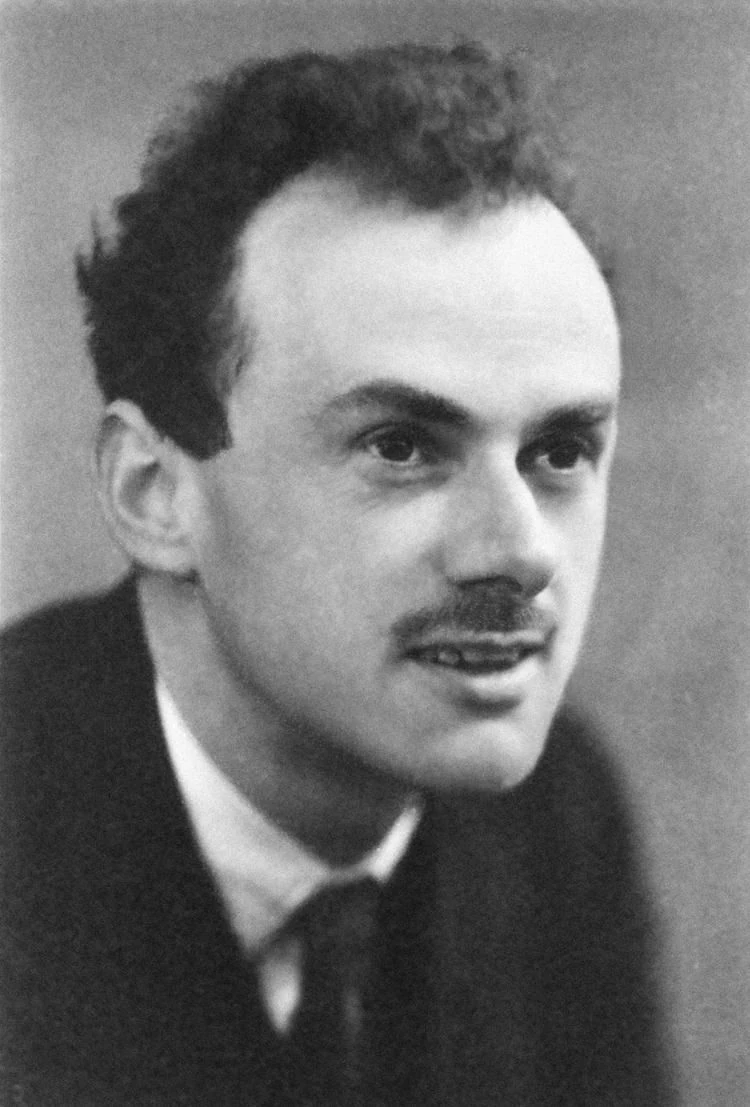
In 1928, Paul Dirac formulated an equation for the electron that brought quantum mechanics and special relativity together. It also pointed to something not then observed: the existence of antimatter. The positron was detected four years later, turning a mathematical prediction into a landmark in physics. Dirac’s path to that work began with a technical education in Bristol and led to a long research career at the University of Cambridge.
A technical education in Bristol
Paul Adrien Maurice Dirac was born in Bristol on 8 August 1902 and grew up in the Bishopston area. His father, Charles, had emigrated from Switzerland and worked as a French teacher. His mother, Florence, came from a Cornish Methodist family. Dirac attended Bishop Road Primary School and then the Merchant Venturers’ Technical College, an institution associated with the University of Bristol. Its curriculum included technical subjects and modern languages, rather than the classical studies that dominated much British secondary education. Dirac later expressed gratitude for that schooling.
He studied electrical engineering at Bristol on a scholarship, graduating with first-class honours in 1921. Although he passed the entrance examination for St John’s College, Cambridge, the scholarship he was offered did not cover the cost of living there. The post-war depression also made it difficult to find engineering work. He remained at Bristol to study mathematics, graduating with first-class honours in 1923. Projective geometry and the geometrical formulation of special relativity became important interests.
A scholarship and research award then enabled him to move to Cambridge. There he studied quantum physics and general relativity under the supervision of Ralph Fowler. Dirac completed his doctorate in 1926 with a thesis on quantum mechanics—the first thesis on the subject to be submitted, according to the biographical account. He continued his research in Copenhagen and Göttingen, working during a period when physicists were developing new ways to describe the behaviour of matter.
An equation with consequences
Dirac proposed his relativistic equation for the electron in 1928. It joined quantum mechanics with special relativity and helped explain the electron’s spin. Its mathematical structure also implied that an electron should have a counterpart with the same mass and an opposite charge. Carl Anderson observed the positron in 1932, providing evidence for the existence of antimatter.
The prediction was one part of a broader contribution. Dirac helped establish quantum field theory and quantum electrodynamics, which describes interactions between light and charged particles. He was the first to use the term “quantum electrodynamics”. His work on the creation and absorption of radiation contributed to the development of the theory, while Fermi–Dirac statistics describes the behaviour of fermions, a class of particles that includes electrons.
Dirac also investigated magnetic monopoles: hypothetical particles with a single magnetic pole. He proposed that the existence of even one monopole could explain why electric charge occurs in discrete amounts. No magnetic monopole has been detected. His work ranged further, including mathematical tools and ideas used in quantum mechanics and the study of gravity.
In 1930 he published The Principles of Quantum Mechanics, a book that brought different approaches to quantum theory into a unified mathematical framework. It introduced the Dirac delta function; later editions also helped establish bra–ket notation, now widely used to express quantum states. The book became a standard text. Dirac’s influence thus travelled not only through research papers and discoveries, but through the methods and language with which generations of physicists learned the subject.
Cambridge, recognition and wartime work
In 1932 Dirac became Lucasian Professor of Mathematics at Cambridge, holding the chair until 1969. The following year he shared the Nobel Prize in Physics with Erwin Schrödinger. The award was made “for the discovery of new productive forms of atomic theory”. The recognition was followed by the Royal Medal in 1939 and the Royal Society’s Copley Medal in 1952.
His Cambridge career also brought him into contact with students who later became prominent physicists. They included Homi J. Bhabha, Fred Hoyle, John Polkinghorne and Freeman Dyson. Dirac’s impact was not limited to formal teaching: the concepts and mathematical approaches he developed became working tools for research in quantum mechanics and particle physics.
During the Second World War, Dirac contributed to Tube Alloys, Britain’s programme of research into atomic weapons. His theoretical work concerned uranium enrichment by gas centrifuge, and he introduced the separative work unit, a measure used in uranium-isotope separation. This work connected his mathematical expertise with a British research effort of urgent practical importance.
A reserved manner and a later career in Florida
Dirac was known among colleagues for precision and reticence. A Cambridge joke described a “dirac” as one word per hour. He also treated mathematical beauty as an important guide in physics: a theory’s mathematical form could help a physicist judge whether it offered a promising account of nature. His reserve became part of his reputation, but it sat alongside a sustained and varied research career.
In 1937 he married Margit Wigner, the sister of physicist Eugene Wigner. Margit had two children, Judith and Gabriel, whom Dirac raised; the couple also had two daughters, Mary Elizabeth and Florence. When Dirac’s Cambridge chair ended in 1969, he took a visiting position at the University of Miami. In September 1970 he accepted a visiting professorship at Florida State University in Tallahassee, and became a full professor there in 1972.
Dirac continued to publish and pursue theoretical problems in Florida. He produced more than 60 papers during his final twelve years, including work on general relativity and quantum field theory. He died in Tallahassee on 20 October 1984, aged 82. His British commemorations include a blue plaque on his childhood home in Bristol and a marker bearing his equation in Westminster Abbey. The Institute of Physics awards a medal in his name for outstanding contributions to theoretical physics.
Why Paul Dirac deserves a place in British Legacy
Dirac’s place in British Legacy rests on achievements closely tied to British education and research. Bristol gave him a technical education that began in electrical engineering and led, through mathematics, to theoretical physics. Cambridge became the setting for his doctoral research and much of his working life. As Lucasian Professor, he held one of Britain’s most prominent academic chairs for nearly four decades. His career illustrates how engineering, mathematics and physics could meet in a single research programme.
The consequences of his ideas reached far beyond Britain. His equation predicted antimatter before the positron was observed; his work helped establish quantum electrodynamics and quantum field theory; and his textbook gave generations of physicists a rigorous framework for quantum mechanics. During the Second World War, his contribution to Tube Alloys brought theoretical expertise to a British research programme. These are specific achievements, not simply a claim to national prestige: they changed how scientists describe matter and its interactions.
Dirac’s legacy is also visible in the institutions that trained and remember him. Bristol marks his childhood connection to the city, Westminster Abbey commemorates his equation, and the Institute of Physics recognises theoretical work through a medal bearing his name. His story belongs in British Legacy because it joins an identifiable British educational and academic path to ideas that became part of international science. The benefits of that work endure in the concepts, mathematical language and teaching that physicists continue to use.
Sources
Paul Dirac — Wikipedia, revision 1372471093
Adapted in part from Paul Dirac by Wikipedia contributors, under CC BY-SA 4.0. Text has been edited and combined with the existing article; this adapted text is shared under the same licence. Contributor history.