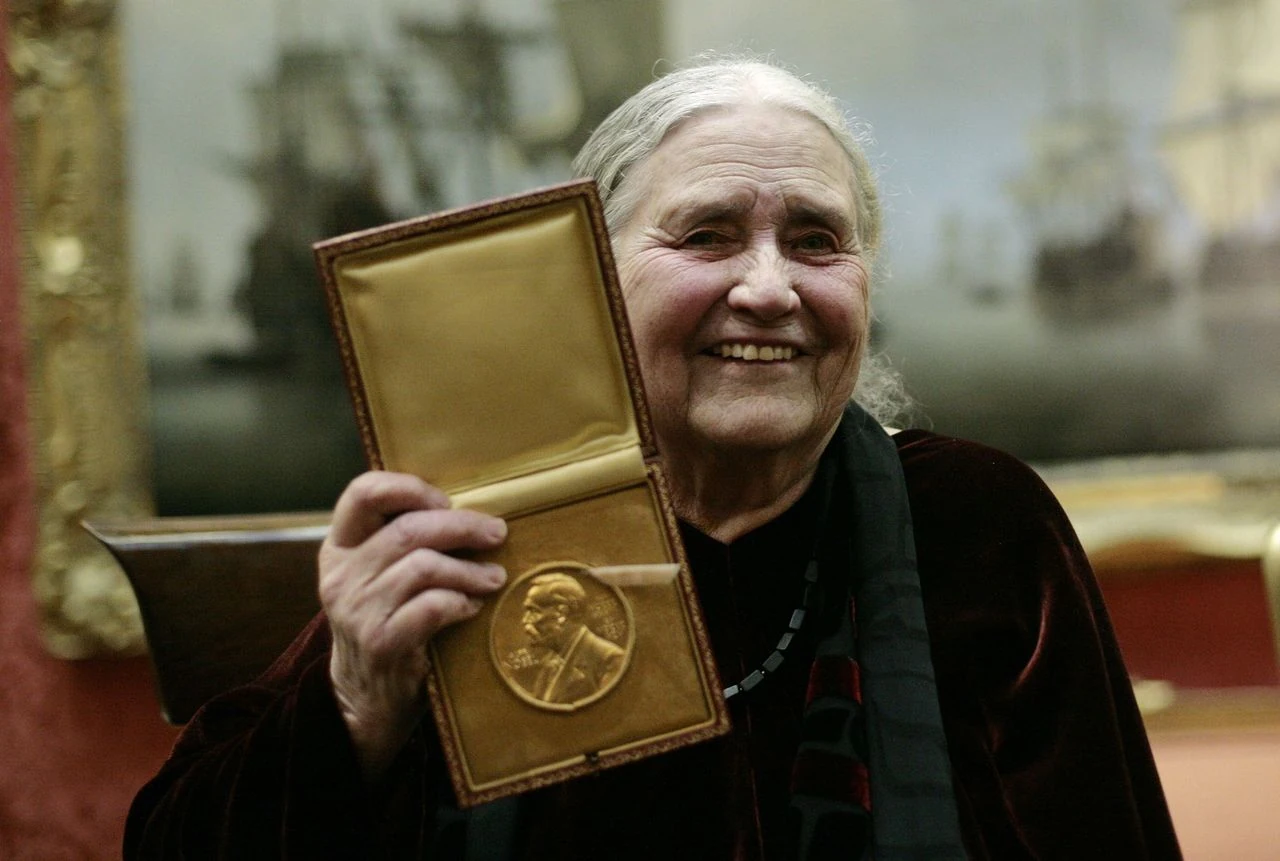
Doris Lessing built a body of fiction that moved between intimate psychological experience and the pressures of social systems. Born in Persia and raised in Southern Rhodesia, she drew on the divisions and conflicts of colonial life in her early writing, then ranged across feminist fiction, speculative writing and autobiography. The Nobel Prize in Literature, awarded in 2007, recognised a career whose subjects included race, gender, politics and the fragility of social order.
Early life and the African setting
Lessing was born in Kermanshah, Persia, on 22 October 1919. When she was six, her family moved to Southern Rhodesia, now Zimbabwe. Africa became an important setting and point of reference in her early work. Her writing examined colonial society and its racial tensions, alongside questions of injustice and human behaviour. Rather than treating these as separate concerns, her fiction connected social structures with the pressures they place on individual lives.
That combination of public conflict and private experience would remain central to her literary reputation. The supplied account identifies psychological insight and an interest in political and social change as recurring qualities of her work. Lessing did not confine herself to one genre or one mode of storytelling: her career encompassed novels, speculative fiction and memoir, with a readiness to approach difficult subjects.
Novels, feminism and speculative worlds
Her first novel, The Grass Is Singing, appeared in 1950. Set in colonial Africa, it addressed racial and gender relations, establishing subjects that would recur in her work. The book began a literary career characterised by attention to power and social division, as well as the effects of those forces on personal lives.
The Golden Notebook, published in 1962, became one of her best-known novels and an important work in feminist literature. Its fragmented structure reflects the fragmentation of its protagonist’s life. The novel’s form is part of its argument: it challenges conventional ways of arranging a story while making room for the complexity of women’s experience. Lessing’s work is associated with feminist writing, though her wider achievement also rests on her range beyond that category.
That range is evident in the Canopus in Argos: Archives series, which uses speculative fiction to consider humanity and the possible breakdown of civilisation. Across very different forms, Lessing returned to the relationship between individuals and the systems around them. Her novels could be read as psychological studies, accounts of social change, or both at once.
Recognition and later writing
In 2007, Lessing received the Nobel Prize in Literature. The Swedish Academy praised her ability to “make the epic collapse of a whole social system visible”. The award recognised not simply her command of narrative but the scale of the questions her fiction pursued: how systems shape lives, and how people experience political and social upheaval.
Lessing continued writing into her later years. Her memoirs Under My Skin (1994) and Walking in the Shade (1997) offered accounts of her life alongside her fiction. She died on 17 November 2013. Her writing’s concern with racial, gender-based and ideological divisions gives readers a record of how social conflicts can be examined through both public events and private experience.
Why Doris Lessing deserves a place in British Legacy
Lessing’s place in British Legacy rests on the scale and variety of her contribution to literature as represented in the supplied account. Her work brought psychological experience into sustained contact with questions of race, gender and political power. The Grass Is Singing confronted colonial divisions; The Golden Notebook made fragmentation part of its exploration of women’s lives; and the Canopus series carried her interest in society into speculative fiction. Together, these works show a writer unwilling to let genre or a single political theme contain her concerns.
The Nobel Prize in Literature gave international recognition to that achievement, while the Academy’s citation captured her ability to make the collapse of a social order visible. Her memoirs extended her writing into autobiography, adding another form to an already varied career. Lessing’s British literary significance is not a matter of birthplace: she was born in Persia and grew up in Southern Rhodesia. It lies in her standing as a major figure in British literature and in work that continues to invite scrutiny of the divisions shaping societies and individual lives.