Malala Yousafzai was 11 when she began describing life under Taliban rule in Pakistan’s Swat Valley. Writing anonymously for the BBC Urdu website, she recorded how restrictions on girls’ education reached into ordinary school days. Years later, after surviving a shooting, she carried that argument to audiences around the world. Her story also belongs to Britain’s recent history: Birmingham provided specialist hospital treatment after the attack, and later became the place where she continued her schooling before studying at Oxford.
A schoolgirl’s account of Swat
Yousafzai was born on 12 July 1997 in Swat District, in Pakistan’s north-west. Her father, Ziauddin Yousafzai, was an education activist who ran schools. In 2008, she spoke publicly about the right to education. The following year, at her father’s suggestion, she began writing a BBC Urdu blog under the pseudonym Gul Makai. Its entries described the effects of the Pakistani Taliban’s restrictions, including the closure of girls’ schools and the fear and disruption affecting families in the area.
The blog ended in March 2009, but the events it described continued to shape her life. That year, a Pakistani military operation in Swat displaced Yousafzai and her family. Her father went to Peshawar to protest and seek support; she was sent to live with relatives in the countryside. The family later returned home. In the years that followed, she continued to speak publicly about girls’ education, including in interviews and on television. In 2011, she received Pakistan’s National Youth Peace Prize.
Her early work began with a particular place and a particular loss: the ability of girls in Swat to attend school safely. The blog brought an account of that experience to readers beyond the region. It also established the subject that would remain central to her advocacy: whether girls can learn without intimidation, and what happens when that right is denied.
The attack and treatment in Birmingham
On 9 October 2012, a Taliban gunman shot Yousafzai as she travelled home on a bus after taking an examination in Swat. Two other girls were also wounded. Following initial treatment in Pakistan, Yousafzai was transferred to the Queen Elizabeth Hospital in Birmingham. She received further medical care there, later undergoing surgery to repair facial nerve damage and reconstruct her skull. After leaving hospital, she continued rehabilitation in the West Midlands.
The shooting prompted an international outpouring of support and condemnation. In Pakistan, more than two million people signed a petition associated with the campaign for education; it helped lead to ratification of the country’s first Right to Education Bill. The attack also brought Yousafzai’s experience to a much larger audience. Her recovery became part of her public story, but her cause remained the right to education rather than survival alone.
Based in Birmingham, Yousafzai and Shiza Shahid co-founded the Malala Fund, a non-profit organisation working to advance girls’ education. The work connected the experience described in her blog to a broader campaign, while keeping girls’ access to schooling at its centre.
School, university and the Nobel Prize
From 2013 to 2017, Yousafzai attended Edgbaston High School in Birmingham. She then studied Philosophy, Politics and Economics at Lady Margaret Hall, Oxford, graduating in 2020. These stages of her education followed the treatment and rehabilitation she received in Britain. They also gave her a direct connection to the schools and universities that feature in her British story, alongside her work advocating for girls whose opportunities are more restricted.
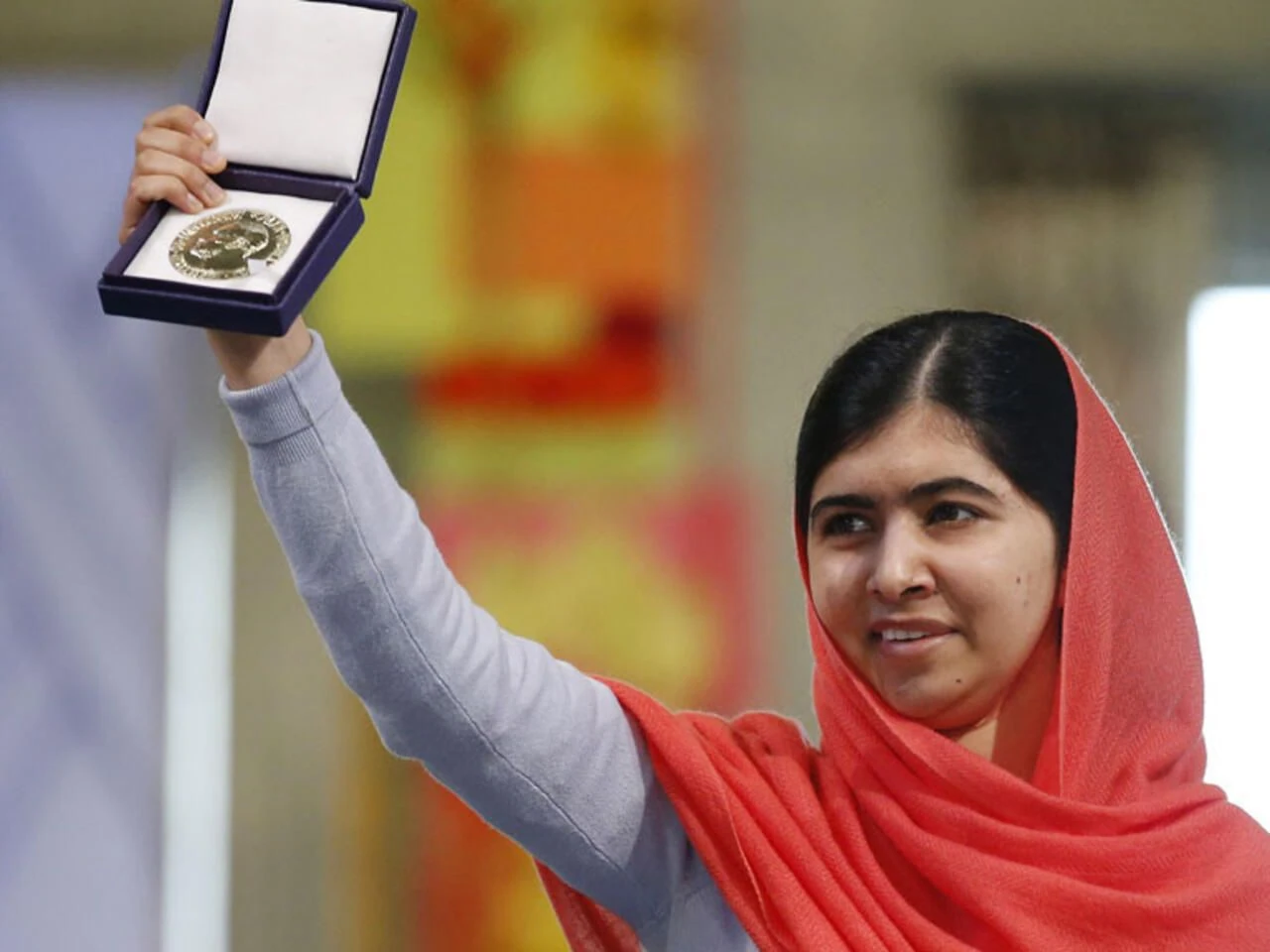
On her 16th birthday in July 2013, she addressed a United Nations youth event that became known as Malala Day. She called for access to education and presented the cause as one shared by children beyond her own experience. In 2014, aged 17, she shared the Nobel Peace Prize with Indian child-rights activist Kailash Satyarthi. The award recognised their struggle against the suppression of children and young people and for the right of all children to education. Yousafzai was the youngest Nobel laureate.
Her writing has carried the campaign to readers as well as audiences at public events. I Am Malala, published in 2013 and co-written with British journalist Christina Lamb, recounts her life and advocacy. A children’s edition followed in 2014. In 2017, Yousafzai published the picture book Malala’s Magic Pencil. Her book We Are Displaced, published in 2019, brings together refugee stories and her own experience. These works take different forms, but each keeps personal testimony and the experiences of other people close to the argument for education.
Advocacy beyond one school or one country
The Malala Fund’s stated aim is to help every girl access 12 years of free, safe and quality education. Yousafzai’s public work has continued to address the barriers that prevent girls from learning. In 2015, on her 18th birthday, she opened a school in Lebanon’s Bekaa Valley for Syrian refugee girls aged 14 to 18. The school was funded by the Malala Fund. The project extended the campaign into a setting shaped by displacement, linking the organisation’s purpose to a specific educational opportunity.
Her later work has also included projects in film and television. A multi-year partnership announced in 2021 with Apple covered programming for its streaming service across drama, comedy, documentary, animation and children’s series. In 2023, Yousafzai became an honorary fellow of Linacre College, Oxford. These roles and honours add to a public career that began with reporting what was happening to girls’ schools in Swat. They do not displace its central concern: the ability of girls to learn and to determine their own futures.
Why Malala Yousafzai deserves a place in British Legacy
Yousafzai’s British connection is grounded in a decisive part of her life. After the shooting in Pakistan, the Queen Elizabeth Hospital in Birmingham treated her. The West Midlands then became the setting for her rehabilitation and schooling: she attended Edgbaston High School before going on to Lady Margaret Hall, Oxford, where she completed her degree in 2020. These are more than addresses in a biography. They mark British medical and educational institutions as part of the story of her recovery and continued education after an attempt to silence her.
Her legacy in Britain is not separate from the international campaign she leads. While based in Birmingham, she co-founded the Malala Fund with Shiza Shahid; its stated aim is to advance free, safe and quality education for girls. Her writing, speeches and work with the Fund have kept public attention on the consequences of denying girls access to school. The Nobel Peace Prize she shared with Kailash Satyarthi in 2014 recognised their work for children and education, rather than treating her survival as an achievement in itself. Remembering Yousafzai in British Legacy means recognising both the part Britain played in her treatment and education and the reach of her subsequent work. Her story links a schoolgirl’s account of restrictions in Swat with a campaign that asks governments and communities to make education possible for girls everywhere.
Sources
Malala Yousafzai — Wikipedia revision 1379474877
Adapted in part from Malala Yousafzai by Wikipedia contributors, under CC BY-SA 4.0. Text has been edited and combined with the existing article; this adapted text is shared under the same licence. Contributor history.