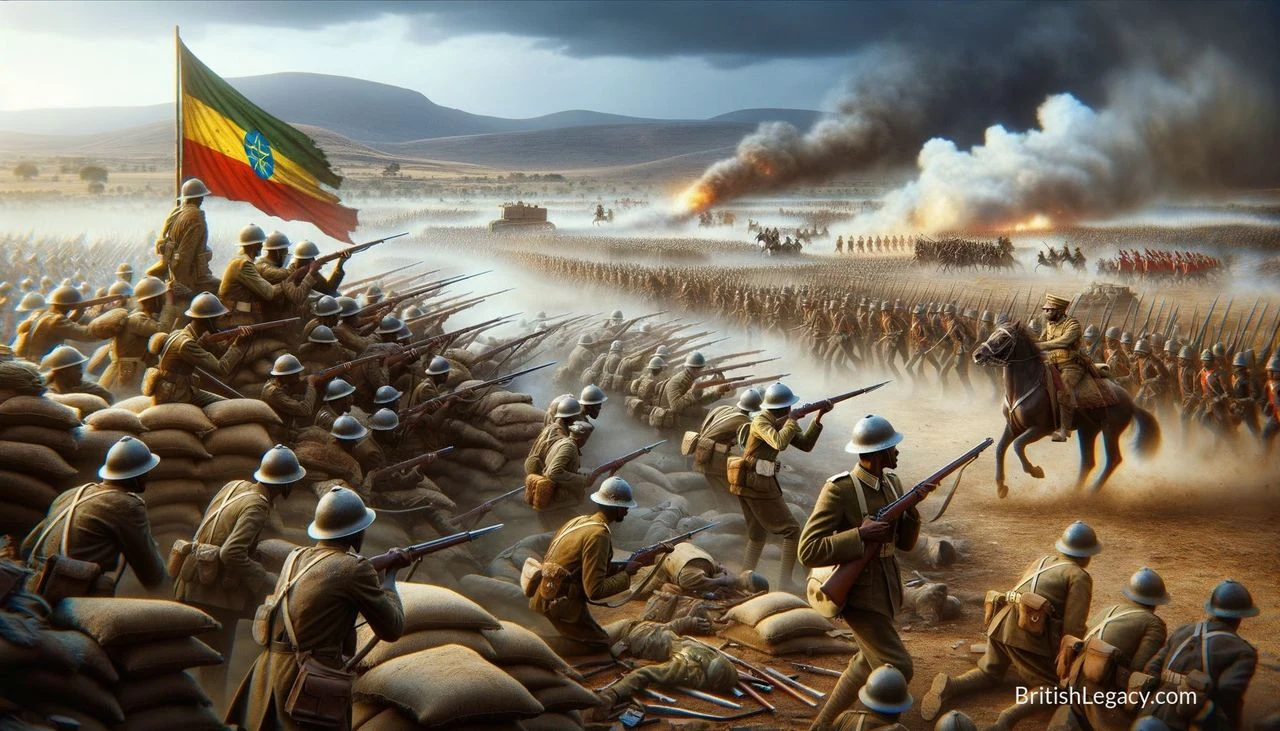
On 1 March 1896, Ethiopian forces defeated an Italian army at Adwa, preserving Ethiopia’s sovereignty. The victory became a symbol of resistance to colonial expansion. Emperor Menelik II led the Ethiopian side, with Empress Taytu also present. A British connection has been claimed in accounts of the battle: military advice and weapons were said to have reached Ethiopia. But the victory was Ethiopian, and claims about the extent or effect of British involvement should not eclipse that fact.
War and resistance
The First Italo-Ethiopian War began in 1895, amid European competition for territory in Africa. Italy sought to extend its power into Ethiopia, one of the independent African kingdoms of the period. Under Menelik II, Ethiopia resisted subjugation. The conflict culminated at Adwa, in northern Ethiopia, where the emperor and Empress Taytu were associated with a coalition of Ethiopian forces confronting the Italian army.
One account gives the Ethiopian force as nearly 200,000 and the Italian force as about 17,000. Those are approximate figures, not precise counts. The same account describes difficult terrain and logistical problems for the Italians. The battle ended in a severe Italian defeat, with thousands of soldiers killed, wounded or taken prisoner. Its immediate consequence was the preservation of Ethiopian sovereignty; its wider resonance came from the example of an African state resisting European imperial expansion.
The British connection in perspective
Britain’s role has been described as indirect. The account credits British advisers with sharing military knowledge with Menelik and says modern weapons reached Ethiopian forces through intermediaries. It also connects British policy in the region with strategic interests around the Suez Canal and Red Sea trade routes. These claims describe a possible overlap between British interests and Ethiopian resistance, rather than a straightforward story of British support for Ethiopian independence.
The account does not identify the advisers or weapons, or establish how much either affected the campaign. It therefore cannot substantiate claims that British guidance shaped the tactics at Adwa or that British-sourced arms proved decisive. The distinction is important: the battle’s outcome should not be credited to outside assistance when the principal achievement was the Ethiopian victory under Ethiopian leadership.
Aftermath and historical significance
Adwa’s significance extended beyond the battlefield. The defeat of Italy preserved Ethiopia’s sovereignty and came to represent resistance to colonial domination across Africa and beyond. For Britain, the episode belongs to a wider history of imperial geopolitics in the Red Sea region. The suggested British involvement sits alongside strategic calculation: the account presents British interest in regional balance in connection with routes near the Suez Canal and Red Sea, not as purely altruistic action.
That context makes the British connection worth examining, but it does not make the two sides’ roles equivalent. The Ethiopian forces confronted the Italian army and secured the victory. Claims of British advice or arms remain claims whose scale and consequences are not established here. A careful account can recognise the possibility of indirect involvement without turning Adwa into a joint British-Ethiopian achievement.
Why the Battle of Adwa deserves a place in British Legacy
Adwa deserves a place in British Legacy because the battle offers a specific way to examine Britain’s relationship with power and resistance beyond its own borders. The account links British strategic interests around the Suez Canal and Red Sea with alleged indirect assistance to Menelik II’s forces. That combination points to a complicated imperial setting: any British support described here was associated with strategic interests, and its extent is not established. Acknowledging those limits keeps the British connection in proportion.
The central achievement belongs to Ethiopia. Under Menelik II, Ethiopian forces defeated the Italian army and preserved their country’s sovereignty; the victory became a wider symbol of resistance to colonial rule. Keeping that agency at the centre gives the article its historical value. It also allows British Legacy to consider British foreign policy without claiming credit for another nation’s success. Adwa is therefore not a British triumph, but a meaningful episode in the history of Britain’s regional interests and the resistance those interests intersected with.