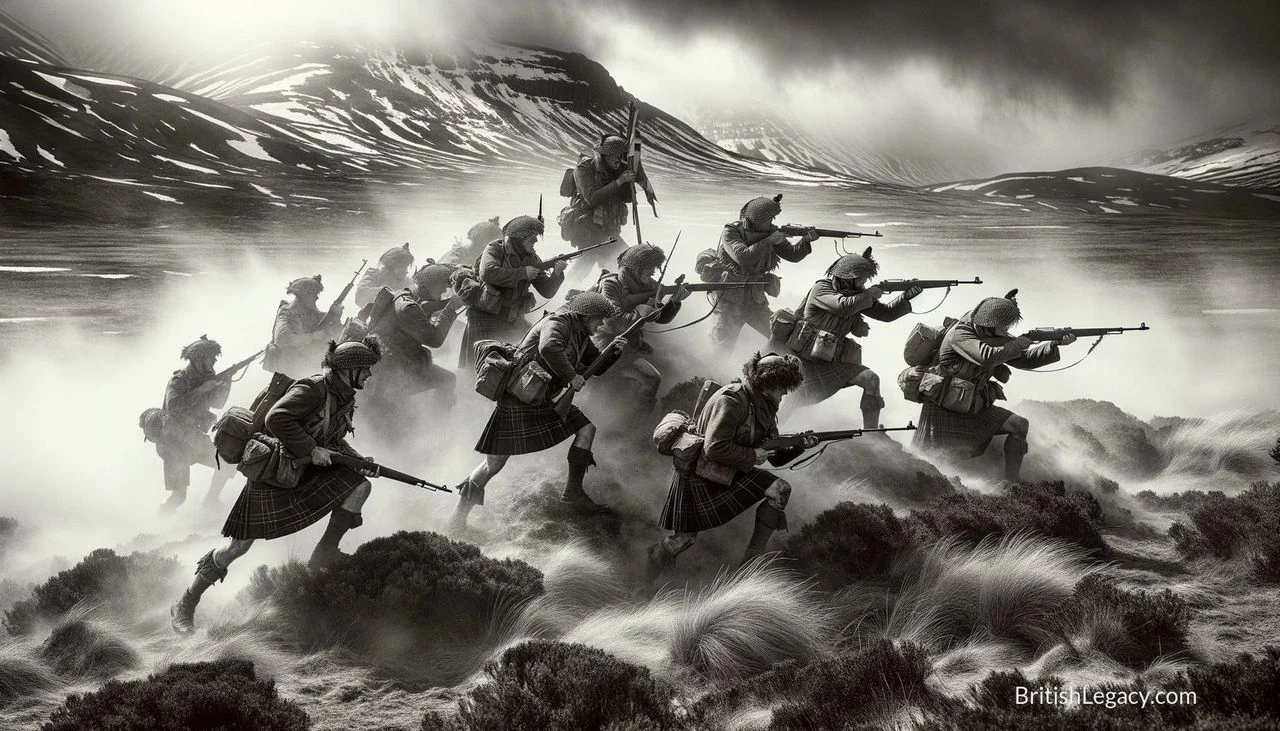
During the night of 13–14 June 1982, the 2nd Battalion, Scots Guards, fought to take Tumbledown Mountain, an Argentine-held position near Stanley in the Falkland Islands. The attack met entrenched defenders and continued into the morning, amid freezing conditions and rugged ground. Its capture formed part of the final British advance on Stanley during the Falklands War.
The campaign reaches Stanley
The Falklands War began on 2 April 1982, when Argentine forces invaded and occupied the Falkland Islands, a British overseas territory in the South Atlantic. The United Kingdom assembled a task force to retake the islands. The ten-week conflict put considerable logistical demands on the British military, operating far from home.
Tumbledown Mountain stood near Stanley, the islands’ capital and the last major stronghold of Argentine forces. Its height offered a view over the surrounding terrain, including routes available to advancing British troops. Taking the position was part of the approach to Stanley, rather than a separate objective from the wider campaign.
Fighting on the mountain
The main British assault was carried out by the 2nd Battalion, Scots Guards. The Argentine defenders included soldiers of the 5th Marine Infantry Battalion, reinforced by elements of the 4th Infantry Regiment. They held entrenched positions, making the Guards’ advance a difficult attack against prepared opposition.
The assault began under cover of darkness on the night of 13 June. As the Scots Guards moved forward, they met strong resistance. The fighting took place across rugged, difficult terrain in the cold of the South Atlantic winter; the account of the battle also describes hand-to-hand combat. Artillery and mortar fire supported the British advance as the troops worked to dislodge the defenders.
The battle continued into the morning of 14 June. Both sides suffered casualties. The Scots Guards eventually took the mountain, securing the position near Stanley and enabling the wider advance to continue. The account places the capture of Stanley the following day, bringing the conflict to a close.
A battle within the final advance
Tumbledown’s immediate significance lay in its position near the capital and in the fighting required to take it. Argentine forces defended prepared ground; British troops had to advance against resistance through harsh conditions. The Scots Guards were the principal British battalion in the assault, while the Argentine defence included both marine infantry and elements of an infantry regiment.
That sequence matters to an understanding of the battle: the night assault, the capture of the mountain and the subsequent move on Stanley were connected stages in the closing part of the campaign. The fighting was not cost-free; casualties were reported on both sides. A concise account of Tumbledown should keep both the military outcome and that human cost in view.
Why the Battle of Tumbledown deserves a place in British Legacy
The Battle of Tumbledown deserves a place in British Legacy because it was part of the United Kingdom’s campaign to retake the Falkland Islands after the Argentine invasion of April 1982. The 2nd Battalion, Scots Guards, led the British assault on an Argentine-held height near Stanley. The position was taken after a night of fighting, helping clear the way for the final advance on the capital. Those specific events explain the battle’s connection to British history more clearly than broad claims about national character or military tradition.
Remembering Tumbledown also means recognising what the account says about the fighting: defenders in prepared positions, difficult terrain, freezing conditions, hand-to-hand combat and casualties on both sides. Its place in the story is not only the fact of a British capture, but the cost and circumstances of achieving it. Keeping the battle in that campaign context offers readers a grounded account of a consequential episode in the Falklands War, without turning a complex night of combat into uncomplicated celebration.