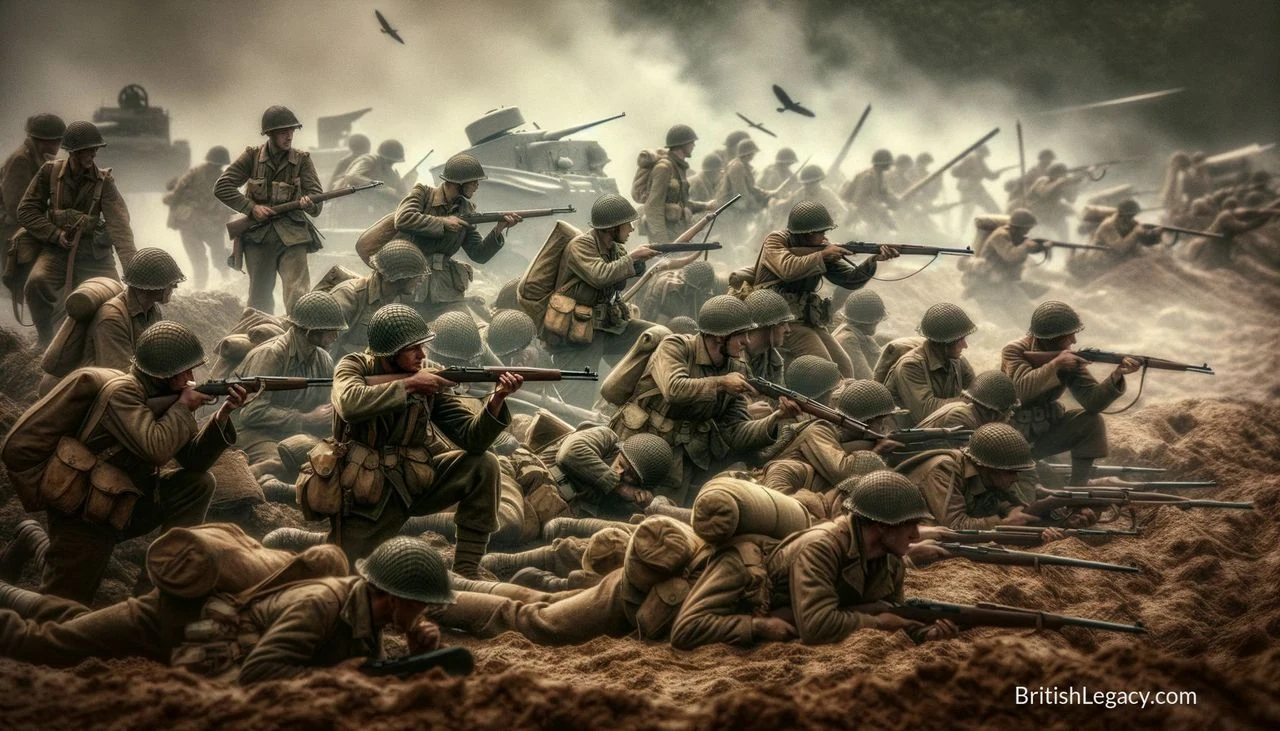
In September 1944, British airborne troops landed near Arnhem as part of Operation Market Garden, an Allied plan to capture bridges in the Netherlands and open a route towards Germany. The British 1st Airborne Division was assigned the most distant bridge in the operation. Its troops were expected to hold their positions until the ground force could reach them. Instead, resistance, communication breakdowns and logistical problems left the airborne force isolated. The operation was abandoned after days of fighting, and survivors were evacuated across the Rhine.
A plan dependent on time and distance
Operation Market Garden, conceived by British Field Marshal Bernard Montgomery, combined an airborne assault with a ground offensive. ‘Market’ was the airborne operation; ‘Garden’ was the advance by ground forces. The plan called for airborne troops to seize key bridges over rivers in the Netherlands, including the crossing at Arnhem, while the ground force moved along the route they were intended to secure. The proposed advance across the Rhine would enable an armoured thrust towards northern Germany.
Arnhem was the final and most distant bridge in the planned sequence. Capturing it would have completed the route envisaged by the operation, but the task depended on the airborne troops holding out until the ground force arrived. British paratroopers landed near Arnhem on 17 September 1944. Their mission was to secure the bridge and keep it against German counter-attacks while awaiting relief.
Fighting at the bridge and Oosterbeek
Resistance proved fiercer than anticipated. German forces regrouped and counter-attacked, while communication failures and logistical difficulties hampered the airborne troops. As the operation faltered, British units became isolated and came under pressure without the relief on which the plan depended.
Lieutenant Colonel John Frost and the men with him defended the northern end of Arnhem Bridge. Their stand became one of the battle’s best-known episodes. Elsewhere, the remaining elements of the 1st Airborne Division resisted at Oosterbeek while encircled. The ground forces did not reach them in time to achieve the objective at Arnhem.
By 25 September, the operation had been abandoned and survivors were evacuated across the Rhine. The existing account estimates that about 10,000 British troops were involved and about 2,000 made it back; these are approximate figures. The battle was a failure for the Allied plan at Arnhem and involved significant casualties. The fighting also exposed the risks of an operation that relied on distant forces meeting on schedule when communications, logistics and the pace of the ground advance did not align.
A phrase and a place in public memory
The phrase ‘a bridge too far’, popularised by Cornelius Ryan’s book and the film based on it, has become associated with the danger of overreaching ambition. It is also linked in public memory with the determination of the troops who fought at Arnhem. The battle’s story is not one of a successful capture: the bridge was not secured for the operation, and the survivors withdrew across the Rhine.
Arnhem Oosterbeek War Cemetery and annual events including the Airborne March commemorate those who fought and died. The battle is also discussed in military study for the operational questions raised by its failure, including coordination, communications and logistics. These commemorations keep the human cost in view alongside the outcome of the plan.
Why the Battle of Arnhem deserves a place in British Legacy
The Battle of Arnhem belongs in British Legacy because British forces were assigned a central and exceptionally exposed role in Operation Market Garden. The 1st Airborne Division was sent to hold the farthest bridge in the planned route, depending on the ground advance to bring relief. At the bridge and in Oosterbeek, British troops continued to resist amid isolation, counter-attacks and mounting difficulties. Remembering their service does not require disguising the result: the operation failed to secure its objective at Arnhem, and the survivors were evacuated.
The battle also offers a specific account of the costs and limits of military ambition. Its outcome draws attention to the strain created when distance, communications, logistics and timing undermine a plan dependent on close coordination. The defence associated with John Frost and the resistance at Oosterbeek remain prominent parts of the battle’s public memory. The cemetery and commemorative events connect that memory to those who fought and died. Arnhem therefore belongs in a British account of the Second World War both as a story of resistance under pressure and as a reminder that courage cannot by itself deliver an operational objective.