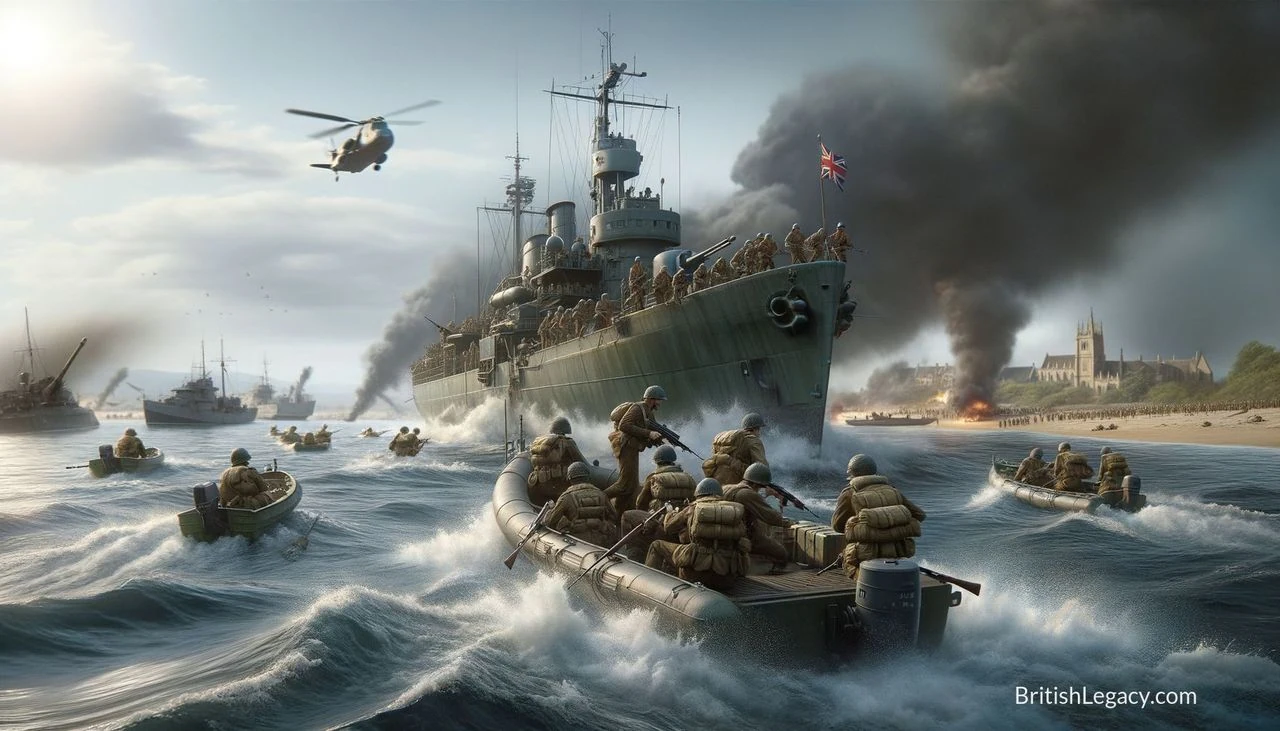
The landing at San Carlos Water on 21 May 1982 gave British forces a foothold on East Falkland, but it did not offer a quiet start to the campaign ashore. Argentine aircraft attacked the ships supporting the landing, and the threat continued over the following days. British troops established and consolidated a bridgehead; equipment and supplies were brought ashore to support the next stage of operations, an overland advance towards Stanley.
Choosing a landing place
The Falklands War began with Argentina’s invasion of the Falkland Islands in April 1982. Britain sent a force to the South Atlantic that included the Royal Navy, Royal Marines, Army and Air Force. Once it reached the islands, the British force needed a secure foothold from which to begin a counteroffensive. San Carlos Water, a sheltered inlet on East Falkland, was selected as the landing site. Its position offered a comparatively protected place to come ashore, away from the main Argentine forces, though the risk of air attack remained.
British forces landed in the early hours of 21 May, under cover of darkness. The operation brought personnel and equipment ashore while ships crowded with Marines and soldiers remained exposed to Argentine aircraft. The landing’s immediate purpose was not simply to put troops on the islands: it was to establish a position that could be held and supplied, making further operations inland possible.
Attacks from the air
Argentine aircraft attacked as the first personnel and equipment reached the beaches. Royal Navy vessels came under fire, and several British ships were severely damaged; the attacks also caused casualties. Harriers engaged the attackers, while Sea Harriers and surface-to-air missiles, including Rapier and Blowpipe, formed part of the British response. Air raids continued over the following days, making the landing area and the ships supporting it a continuing focus of danger.
The attacks also exposed a difficulty facing the Argentine pilots: they were operating at the limits of their aircraft’s range. That constraint did not remove the threat to the British ships, but it formed part of the conditions in which the air campaign was fought. British defences mitigated the effects of the attacks, while the force continued the practical work of unloading and securing its position. San Carlos was therefore not a simple passage from landing to advance; the bridgehead had to be maintained while the air threat persisted.
From bridgehead to advance
Securing the bridgehead allowed British forces to consolidate around San Carlos. Artillery, vehicles and logistical supplies were brought ashore to prepare for operations inland. The landing created a base from which the British force could begin its advance towards Stanley, the Falklands’ capital. The subsequent campaign led to the capture of positions on the route to the capital and, ultimately, to the successful British outcome of the war.
San Carlos mattered because it connected a hazardous sea landing with the land campaign that followed. Its success did not, by itself, settle the conflict; it gave British forces a foothold from which to continue. The episode also demonstrated the exposure of ships and troops to air attack in a maritime operation. The force’s ability to establish and supply a position under that pressure became a defining feature of the landing’s military significance.
Why the Battle of San Carlos deserves a place in British Legacy
San Carlos deserves a place in British Legacy as a consequential operation in the 1982 Falklands War, not because the landing was effortless or the outcome automatic, but because it established the foothold required for the campaign ashore. The British force had to bring personnel and equipment into San Carlos Water, withstand repeated attacks on the ships supporting it, and secure a position from which supplies and heavy equipment could move inland. That link between a vulnerable landing and a sustained advance gives the episode its particular significance in the history of the conflict.
The battle also records the participation of several British services in a shared operation: the Royal Navy, Royal Marines, Army and Air Force all formed part of the wider force sent to the South Atlantic. At San Carlos, the need to hold a bridgehead, respond to air attacks and prepare the route towards Stanley made the landing more than a symbolic return to the islands. Its place in British history rests on that practical result: a defended and supplied foothold that enabled the advance to continue, despite the cost and danger of the air assault.