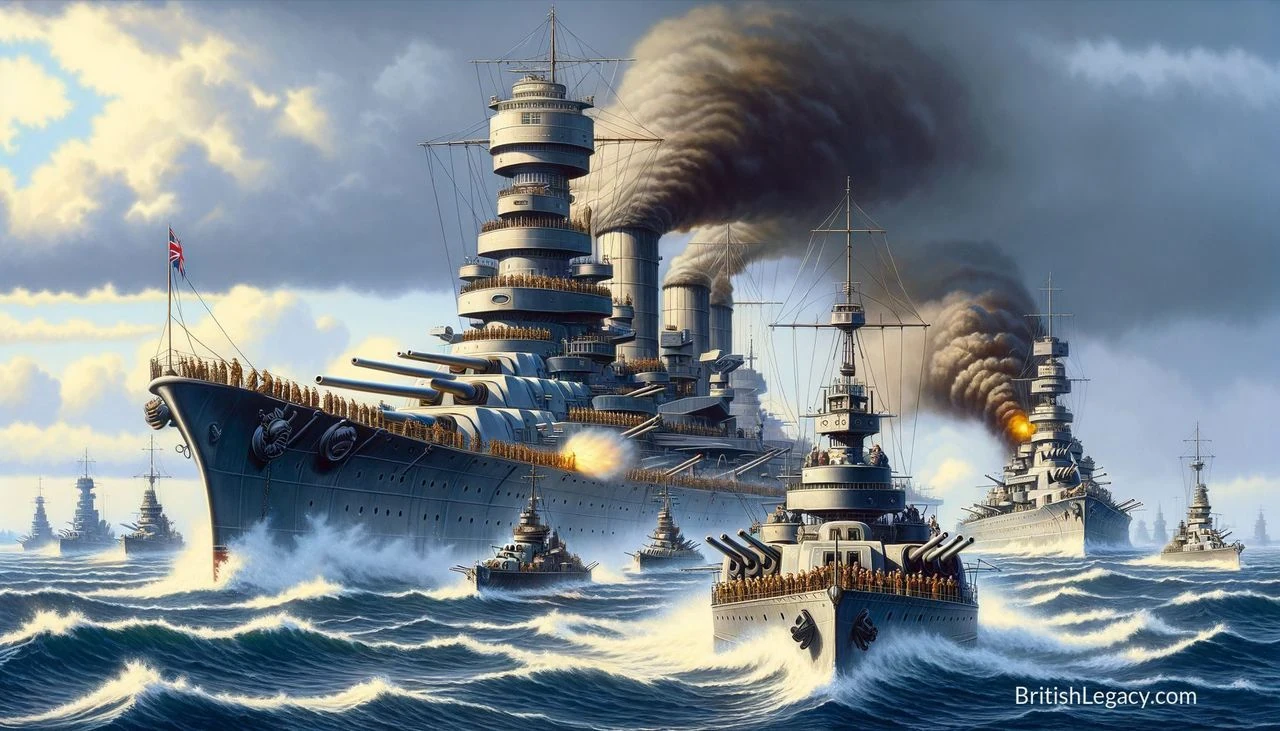
On 13 December 1939, three cruisers led by Commodore Henry Harwood encountered the German pocket battleship Admiral Graf Spee off the coast of South America. In the Battle of the River Plate, HMS Exeter, HMS Ajax and HMS Achilles engaged the German ship near the estuary. Exeter was heavily damaged and withdrew; Ajax and Achilles continued the fight. Four days later, after Admiral Graf Spee had entered neutral Montevideo, it was scuttled by its commander, Hans Langsdorff.
The hunt in the South Atlantic
Before the encounter, Admiral Graf Spee had been attacking Allied merchant ships in the South Atlantic. The German pocket battleship was commanded by Langsdorff. Its attacks made it a threat to shipping, and the Royal Navy sent a group of three cruisers under Harwood to seek it out.
Harwood’s force comprised HMS Exeter, HMS Ajax and HMS Achilles, which the original account identifies as contributed by New Zealand. The cruisers were lighter and less heavily armoured than the German ship. They were deployed in anticipation of contact, and sighted Admiral Graf Spee near the River Plate estuary on the morning of 13 December.
The engagement and its immediate cost
Harwood’s ships closed with the German vessel, beginning a naval exchange in which the cruisers faced a larger, more heavily armoured opponent. HMS Exeter suffered heavy damage and withdrew. The other two cruisers, HMS Ajax and HMS Achilles, continued to attack, using their speed and co-ordinated action against Admiral Graf Spee.
The encounter did not end with the German ship’s destruction at sea. Instead, Admiral Graf Spee entered Montevideo, a neutral port in Uruguay. The account links Langsdorff’s decision to scuttle the ship to international-law constraints and Allied pressure, including misinformation. The vessel was scuttled on 17 December to prevent its capture. Langsdorff died by suicide soon afterwards; the reason for his action should not be assumed.
After the River Plate
The battle’s immediate sequence matters: the cruisers engaged the raider, Exeter was forced to withdraw, and the German ship sought refuge in a neutral port before being destroyed by its own side. This was not a conventional victory in which the British ships sank their opponent during the engagement. The account describes the result as a strategic and moral victory, but offers no specific evidence for broader claims about its effect on Allied morale or later naval operations.
The force also had a New Zealand connection through HMS Achilles. Remembering the action solely as a British achievement would therefore leave out a stated part of the squadron’s composition. Its story joins a Royal Navy search for a German raider with the involvement of a New Zealand-contributed cruiser and the consequences of the ship’s arrival in neutral Uruguay.
Why the Battle of the River Plate deserves a place in British Legacy
The Battle of the River Plate belongs in British Legacy as a specific episode in the Royal Navy’s wartime effort against attacks on Allied merchant shipping. Harwood led three cruisers against a German pocket battleship that was larger and more heavily armoured. HMS Exeter was badly damaged and had to withdraw, while HMS Ajax and HMS Achilles continued the engagement. These details show the risks and limits of the action without turning it into a claim that the German vessel was sunk in battle.
The aftermath gives the episode a further significance. Admiral Graf Spee reached neutral Montevideo and was scuttled there on 17 December; Langsdorff died by suicide soon afterwards. New Zealand’s connection, through HMS Achilles, is part of the same account. Together, the encounter, the damage to the British cruiser and the German ship’s eventual scuttling make this a British and Commonwealth naval story whose details are more illuminating than general claims about bravery or lasting influence.