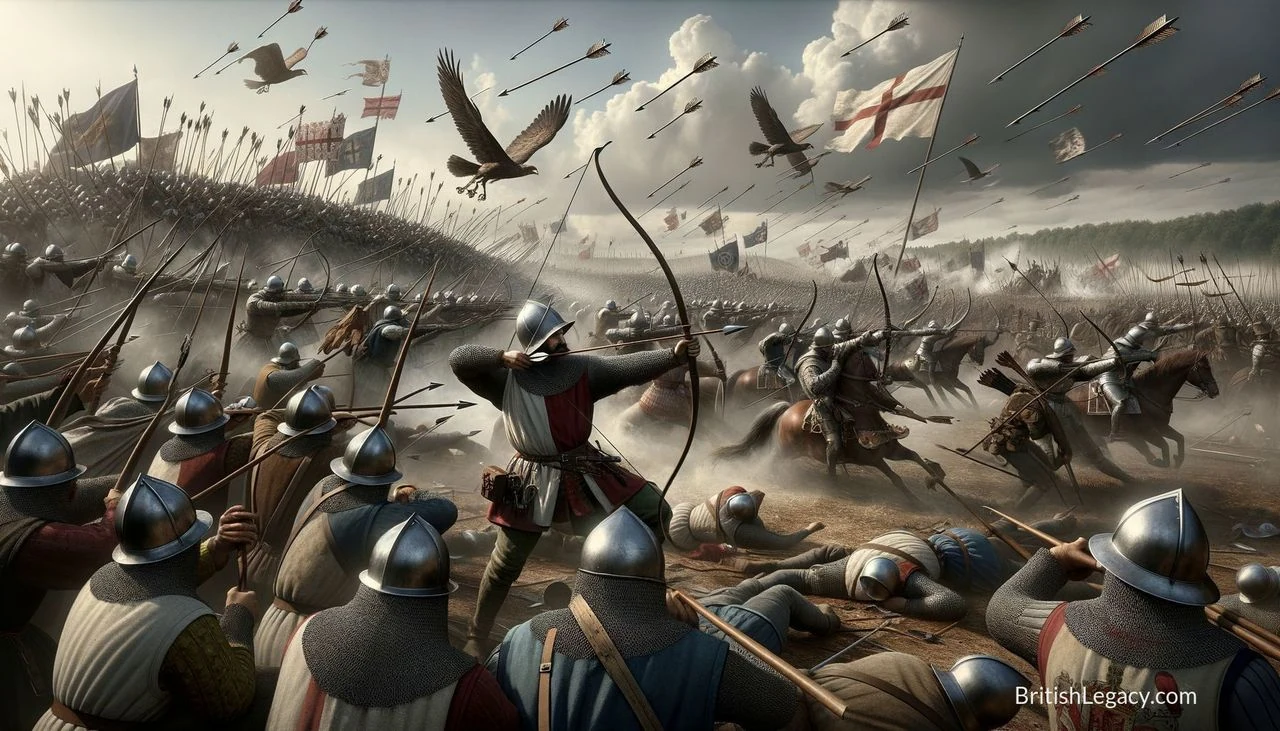
On 25 October 1415, near the village of Agincourt in northern France, the English army of Henry V defeated a French force described as much larger. The English had arrived worn down by disease and hardship after capturing Harfleur. Their victory became one of the best-known episodes of the Hundred Years’ War, remembered especially for the role of the longbow and for the story later told in Shakespeare’s Henry V.
A campaign across France
The Hundred Years’ War, fought between the kingdoms of England and France from 1337 to 1453, involved competing territorial interests and claims to the French crown. It was a succession of campaigns, battles and truces rather than one continuous conflict. In 1413, Henry V became king of England and renewed the campaign to assert English claims in France.
His forces besieged and captured Harfleur, but disease and the difficult conditions left the army weakened. Henry then marched towards Calais, intending to reach the English-held port and return to England. The French intercepted the English near Agincourt. The encounter took place on St Crispin’s Day, a date later made famous in accounts of the battle.
Longbows, mud and close combat
The English army faced a French force that the original account estimates may have been five times larger. Exact numbers are not established here, so that comparison is best treated as an estimate rather than a precise count. The English position and the ground are described as important to the outcome: a narrow, muddy field constrained the French advance, while English archers shot at the approaching force.
According to the account, the archers used wooden stakes to help defend against cavalry. French troops in heavy armour struggled through the mud under a volley of arrows. The fighting then became a close melee involving English infantry and their retinues. The account presents the longbow as central to the English tactics, but the victory was not a matter of archery alone: the terrain, the French advance and the subsequent hand-to-hand fighting also form part of the battle’s story.
Victory and its longer consequences
Agincourt was a major English victory. The French losses are described as numbering in the thousands, while English casualties were comparatively low; these figures are estimates, not exact totals. The defeat damaged French morale and strengthened Henry’s standing as a military leader. It temporarily shifted the balance of the Hundred Years’ War in England’s favour.
Henry later married Catherine of Valois, and their son became Henry VI. The marriage and the succession further connected the royal histories of England and France, though they did not end the conflict. Agincourt’s significance lies both in the immediate military result and in its place within a longer struggle over territory and the French crown.
From battlefield to national story
The battle’s reputation grew beyond accounts of tactics and casualties. Shakespeare’s play Henry V gave it a lasting place in English literary culture. Its St Crispin’s Day speech includes the lines “We few, we happy few, we band of brothers”, words that helped shape later memory of the king and his soldiers. The play is a cultural retelling, not a neutral record of the campaign, but it has become central to how many people encounter Agincourt.
The longbowmen, the muddy field and the victory against a larger force have all become familiar elements of the story. That account can make the battle seem like a simple demonstration of English ingenuity and courage. A fuller view also recognises that it was a costly conflict between two kingdoms, fought on French soil as part of a much longer war. Its place in English memory reflects both the military achievement and the later power of literature to turn a battle into a national story.
Why the Battle of Agincourt deserves a place in British Legacy
Agincourt deserves a place in British Legacy as a defining episode in English military and cultural history. In 1415, Henry V’s army, depleted after the campaign at Harfleur, defeated a larger French force near Agincourt. The account links that result to the terrain, the longbowmen’s volleys and the fighting that followed. The battle became a conspicuous English victory within the Hundred Years’ War and strengthened Henry’s position, even though it did not settle the wider contest between the two kingdoms.
Its legacy also shows how history is remembered. Shakespeare’s Henry V carried Agincourt into English literary culture, and the St Crispin’s Day speech supplied words that continue to be associated with the battle. That influence makes the event relevant beyond military history: it illustrates how a battlefield outcome can be reshaped by later storytelling. Remembering Agincourt responsibly means holding both parts together—the victory’s place in England’s past and the literary tradition that made it an enduring national story.