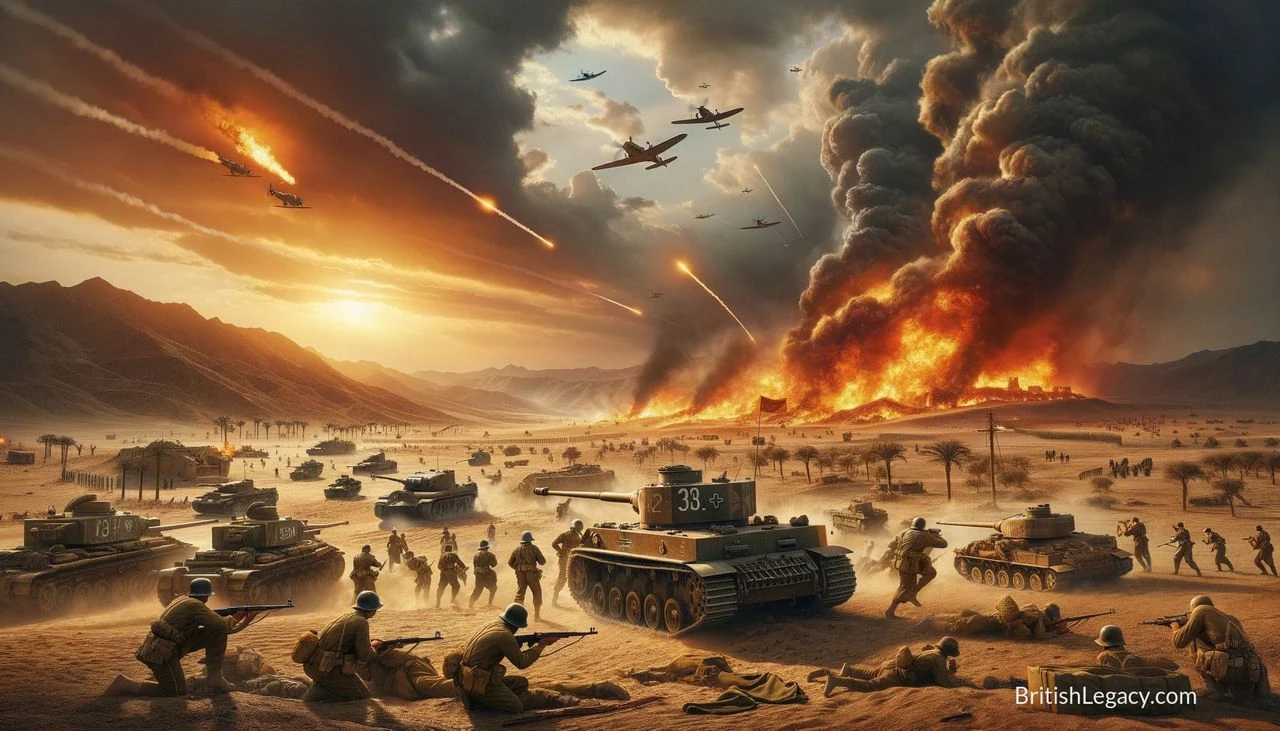
For the British Eighth Army, the Battle of Alamein was an attempt to stop the Axis advance across North Africa. Beginning on the night of 23 October 1942, the fighting brought British and Commonwealth troops against forces commanded by General Erwin Rommel. Operation Supercharge, launched on 2 November, helped break through the Axis lines and contributed to Rommel’s retreat. Alamein became a significant Allied victory in the campaign, though the battle’s importance should be understood as one stage in the wider struggle for North Africa.
A campaign reaching a critical point
By the summer of 1942, Axis forces had gained ground in North Africa. Rommel’s Afrika Korps had won a series of engagements, and the advance threatened the Suez Canal and the oil fields of the Middle East. For the Allies, the region had strategic importance; the conflict was about more than control of the desert battlefield itself.
The earlier campaign had shifted back and forth, with fortunes changing between the opposing forces. In August 1942, General Bernard Montgomery took command of the British Eighth Army. He prepared to halt the Axis advance, with reinforcements and new equipment supporting the renewed effort. The Eighth Army included troops from Australia, New Zealand, India and South Africa, as well as British forces. At Alamein, they faced an adversary described in the contemporary account as tenacious and experienced.
The October offensive and Operation Supercharge
The battle opened on the night of 23 October. Fighting continued across desert terrain as artillery bombardment preceded infantry advances and the deployment of armoured divisions. The account of the battle emphasises both the scale of the contest and the effort required to wear down the Axis defences. It describes twelve days of fighting, during which Montgomery’s forces used their resources to press the attack.
A critical moment came on 2 November, when Operation Supercharge broke through the Axis lines. The breach helped force Rommel’s army into retreat. Alamein thus halted the immediate Axis advance in North Africa and set the stage for further Allied offensives against Axis forces in the region. It did not, by itself, end the North African campaign: the defeat at Alamein was part of a longer sequence of operations that eventually drove Axis forces out of North Africa.
Victory, memory and its limits
Alamein’s effects reached beyond the battlefield. The victory strengthened Allied morale, and Winston Churchill’s words became closely associated with its place in the war: “Before Alamein we never had a victory. After Alamein we never had a defeat.” The line conveys the battle’s value as a public symbol, but it should not be taken as a literal account of every subsequent military engagement.
The battle is also remembered for the participation and sacrifice of Commonwealth forces alongside the British Eighth Army. Its place in British military history is therefore connected not only to Montgomery’s command but also to a wider coalition whose troops fought across the desert. Alamein was a turning point in the North African campaign; claims that it alone determined the course of the war or directly secured every strategic objective risk making a complex conflict sound simpler than it was.
Why the Battle of Alamein deserves a place in British Legacy
Alamein deserves a place in British Legacy because it marks a decisive effort by the British Eighth Army to stop the Axis advance in North Africa. The battle began on 23 October 1942, and Operation Supercharge helped break the Axis lines on 2 November. The result was a retreat by Rommel’s forces and the opening of a further phase of Allied operations in the region. These events give the battle a clear military significance without requiring it to stand as the sole cause of the eventual Allied victory.
Its British connection is also inseparable from its Commonwealth dimension. Australian, New Zealand, Indian and South African troops fought alongside British forces, making Alamein part of a shared wartime history rather than a story of one army alone. The battle’s public memory, reinforced by Churchill’s celebrated words, reflects how military events can become symbols of changing morale. Remembering Alamein in that fuller context honours the forces involved while keeping sight of the campaign’s complexity and the human cost of its fighting.