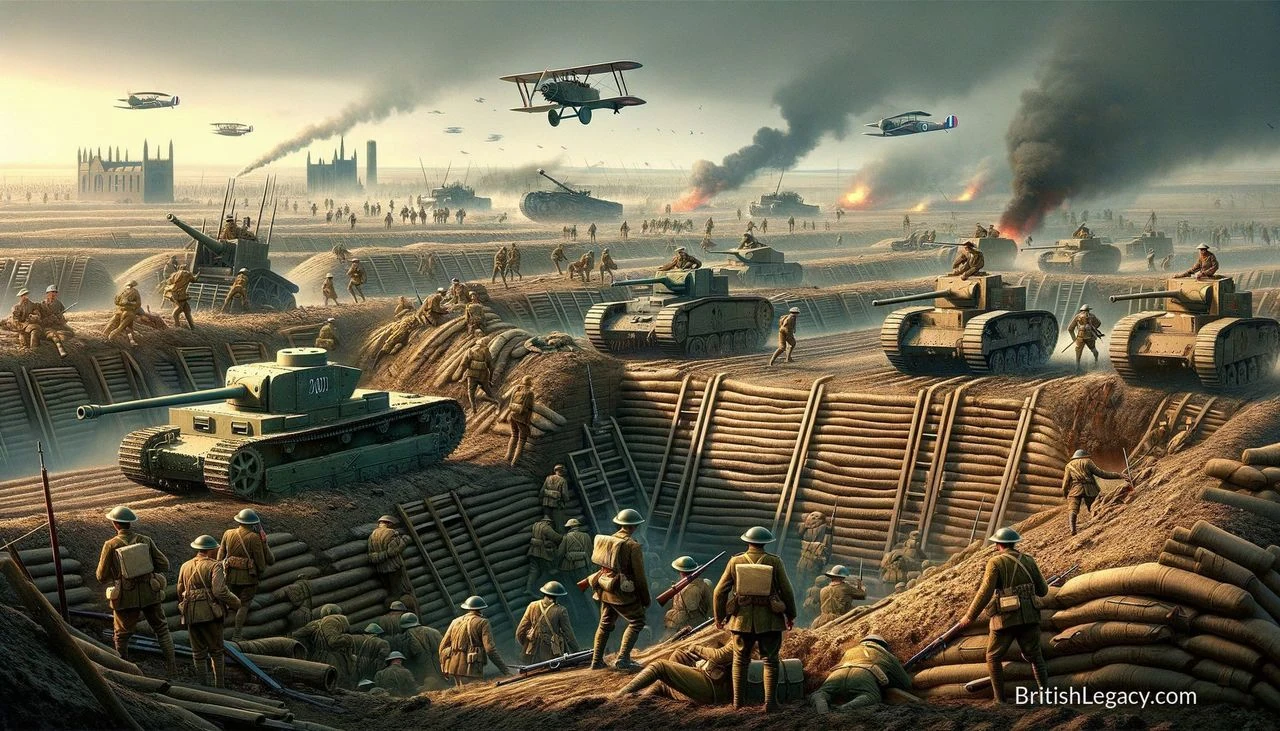
On 8 August 1918, Allied forces attacked near Amiens in an operation that opened the Hundred Days Offensive. Tanks advanced with infantry, artillery and aircraft, while fog helped conceal the assault. The attack broke through German lines and began a sequence of Allied advances that continued towards the end of the First World War.
An offensive planned by Allied commanders
By 1918, four years of war had left the Western Front defined by entrenched positions and costly fighting. Allied forces, including British, French and American troops, planned an offensive intended to exploit German weaknesses. The account of the battle names British commander Sir Douglas Haig and French Marshal Ferdinand Foch among those involved in its planning.
Amiens was the opening phase of the Hundred Days Offensive, not the whole campaign. The operation depended on coordinating different forces and equipment. On the morning of 8 August, more than 600 tanks moved forward alongside infantry, artillery and aircraft. The surprise of the attack and the pressure on German defences made the opening assault a striking change from the prolonged stalemate associated with the Western Front.
Breakthrough and advance
The Allied attack broke through German lines. The scale of the surprise was captured in the phrase “the black day of the German Army”. In the days that followed, Allied troops advanced several miles and captured thousands of German soldiers and territory. The immediate gains mattered both on the ground and as a sign that the Allies could press forward.
British and Commonwealth troops played a part in the multinational force, alongside soldiers from France and other Allied countries. The battle’s outcome is best understood as a coalition effort: the source emphasises coordinated arms and Allied collaboration rather than attributing success to a single nation or weapon. Tanks were prominent, but they operated as part of an attack supported by infantry, artillery and aircraft.
From Amiens to the end of the war
The Hundred Days Offensive comprised a series of attacks that followed Amiens. The campaign continued for roughly three months, after which hostilities ceased in an armistice. Amiens therefore stands as the opening of the final Allied offensive, rather than a battle that by itself ended the war.
The source associates the battle’s methods with later military thinking, but offers no specific examples of doctrines or operations shaped by them. What can be seen in its account is the practical combination of tanks and other arms in a coordinated attack, followed by a substantial advance and the capture of prisoners. Those details give the battle its place in the story of the war’s closing phase without making it a simple, solitary turning point.
Why the Battle of Amiens deserves a place in British Legacy
Amiens belongs in British Legacy because British forces took part in an Allied operation that opened the Hundred Days Offensive. Haig is named among the commanders involved in planning, and British and Commonwealth troops fought within the multinational force. This connection recognises Britain’s contribution while keeping the French and other Allied participants in view. The battle’s story is not one of a single country acting alone, but of forces coordinating their efforts at a consequential point in the war.
The attack also offers a concrete account of combined arms in action: tanks advanced with infantry, artillery and aircraft, and the surprise assault was followed by the capture of German soldiers and territory. Amiens is significant as the beginning of a wider campaign that continued towards the armistice, rather than as an isolated victory that ended the conflict. Remembering the battle can honour those who fought and fell while preserving the scale and context of their service. That balance—recognising a British role within an Allied effort—is the basis for its place in British military heritage.