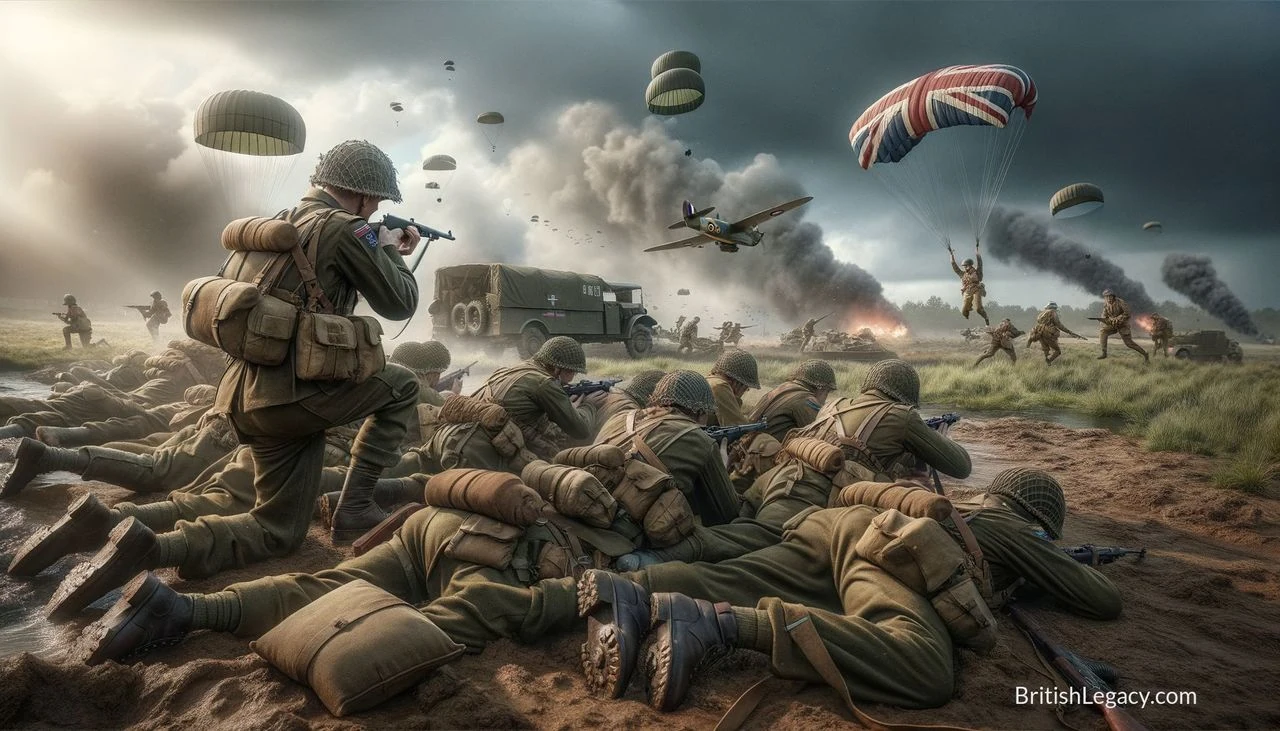
In September 1944, British airborne troops were dropped near Arnhem to seize a bridge over the River Rhine and hold it for the advancing Allied ground forces. The operation was part of Market Garden, an ambitious attempt to cross a series of Dutch waterways and drive towards Germany. The British 1st Airborne Division reached Arnhem, but the planned link-up did not secure its objective. The battle ended in Allied failure and a costly withdrawal; the resistance of the isolated troops became a lasting part of the story of Britain’s wartime airborne forces.
A plan to reach the Rhine
Operation Market Garden joined an airborne operation, Market, to a ground offensive, Garden. The plan, conceived by British Field Marshal Bernard Montgomery, aimed to speed the Allied advance through the German-occupied Netherlands by capturing bridges along the route. British XXX Corps was to advance on the ground and link up with the airborne units. The imported account says the plan promised to end the war by Christmas 1944; that should be understood as an aspiration, not an outcome.
The airborne forces included the British 1st Airborne Division, the US 82nd and 101st Airborne Divisions and the Polish 1st Parachute Brigade. The original account describes the operation as the largest airborne operation ever conducted and gives a total of more than 35,000 parachutists and glider-borne troops. Those figures and the superlative are retained here as claims from the account, rather than independently established facts.
The fight for Arnhem
On 17 September 1944, the British 1st Airborne Division, commanded by Major General Roy Urquhart, landed in the Netherlands near Arnhem. Its task was to capture and hold the Rhine bridge for the approaching XXX Corps. The account says the airborne troops landed further from their objective than anticipated and met stiff German resistance, including elements of the 9th and 10th SS Panzer Divisions.
German forces organised a counterattack, and the British troops became isolated. Lieutenant Colonel John Frost’s men captured and held the northern end of the bridge for several days before German firepower forced their surrender. The account describes the bridge as having become known as “the Bridge Too Far”; the phrase is closely associated in the article with the battle’s popular memory, rather than presented as an official name for the bridge.
By 25 September, holding the position was untenable and the remnants of the British 1st Airborne Division were ordered to withdraw across the Rhine. The account estimates that nearly 10,000 men landed at Arnhem and about 2,000 escaped, with the remainder killed, wounded or captured. It was a severe reverse for the airborne force, while the wider Operation Market Garden failed to achieve its aims. The Allied advance continued, but the hoped-for rapid conclusion to the war did not follow.
Memory and commemoration
The battle has been remembered through books, documentaries and the film A Bridge Too Far. These works have helped bring the Arnhem story to audiences beyond those with a direct connection to the military campaign. The original account also describes annual commemorations in Arnhem honouring the paratroopers and an enduring bond between British veterans and Dutch citizens. It offers no further detail about those events, so the claim is kept at that level.
Arnhem’s legacy is not simply a story of courage set apart from the failed plan. The operation’s ambitious design, the isolation of the troops and the withdrawal across the Rhine all belong to the same history. Remembering the battle means acknowledging both the persistence of the men who fought there and the costly limits of what the operation achieved.
Why the Battle of Arnhem deserves a place in British Legacy
The Battle of Arnhem deserves a place in British Legacy because it reveals a consequential moment in Britain’s Second World War history: British airborne troops were assigned to seize and hold a Rhine crossing as part of a multinational plan to advance through the Netherlands. Their stand at Arnhem, including the defence of the northern end of the bridge by Frost’s men, forms a specific and enduring part of the campaign’s story. Remembering those events gives the battle meaning without confusing bravery with success: the force was isolated, the objective was not secured, and the wider operation failed to achieve its aims.
The battle also connects British military history with the Netherlands. The original account describes commemorations in Arnhem and a continuing relationship between British veterans and Dutch citizens, while books, documentaries and A Bridge Too Far have carried the story to wider audiences. That public memory can recognise the sacrifice involved while keeping the strategic outcome in view. For British Legacy, Arnhem is worth recording not as an uncomplicated triumph, but as a defining episode in which British forces fought within an ambitious Allied operation whose costs and failure remain essential to its remembrance.