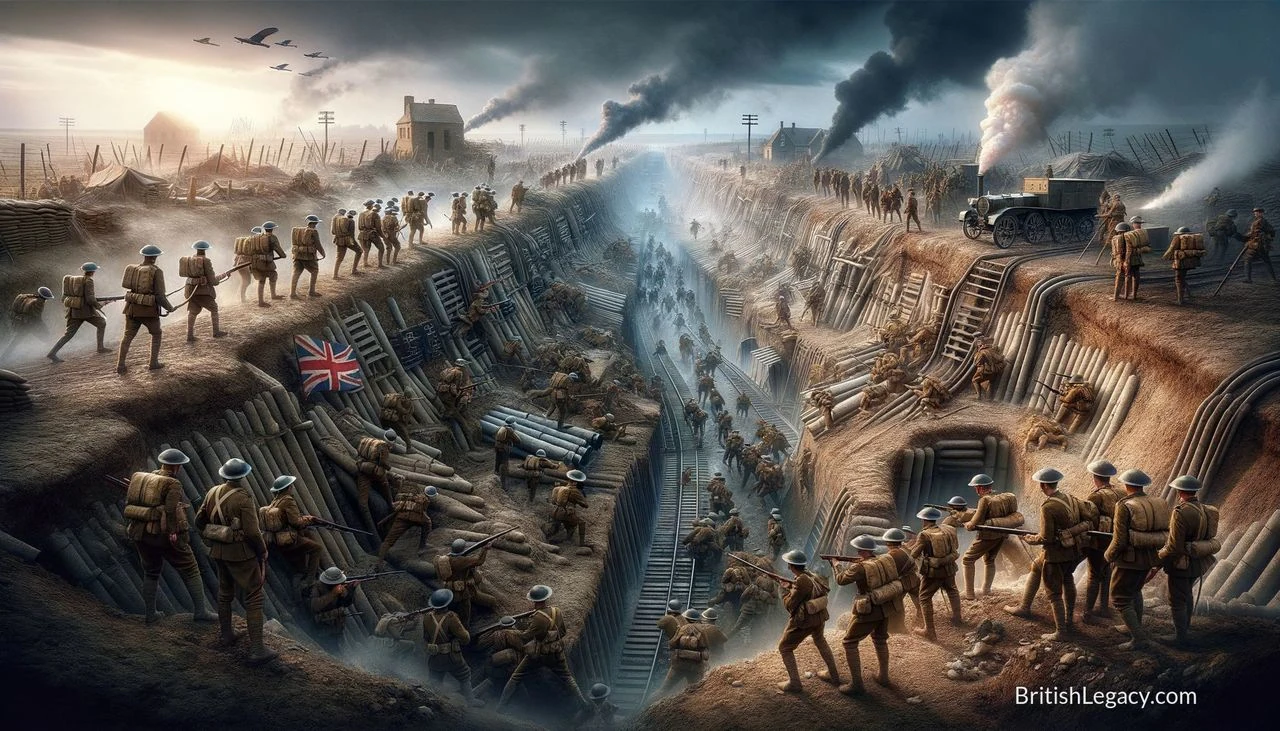
From 9 April to 16 May 1917, British and Canadian troops took part in an offensive around Arras in northern France. The opening brought rapid gains, including the Canadian capture of Vimy Ridge, but did not break the battle’s pattern of fighting: German counter-attacks followed, and the campaign continued for weeks. Its story encompasses not only the assault across the front, but also the work of miners and engineers preparing passages underground.
Arras and the wider offensive
Arras lay near the Western Front, and its position made it a focus of the Allied operation. The offensive was planned while French forces were engaged in the Nivelle Offensive further south; the British plan was intended to relieve pressure on them. British and Canadian forces shared the campaign, though they had distinct tasks within it.
The Canadian Corps, commanded by Lieutenant-General Sir Julian Byng, was assigned Vimy Ridge, an elevated position fortified by German forces. The wider British operation was led by the Third Army under General Edmund Allenby. The source account describes its aim as breaking through the Hindenburg Line. These tasks placed the capture of the ridge within a broader attack, rather than making it the whole of the Arras offensive.
Underground preparations and the opening attack
Miners and engineers worked on an extensive network of passages beneath the German positions. The tunnels were used to move troops and supplies, and some accommodated field hospitals. They also allowed explosive charges to be placed underground and detonated as the offensive began. The work was hazardous; the tunnellers faced the possibility of German counter-mining.
On 9 April, after an artillery bombardment, British and Canadian troops advanced from their trenches at 5.30am. Creeping barrages moved ahead of the infantry, providing the immediate artillery support described in the source account. The Canadians captured Vimy Ridge on the first day. The British Third Army also made early gains, including positions around the Scarpe and Monchy-le-Preux.
These advances were substantial openings, not an end to the campaign. German counter-attacks and continued attritional fighting followed. The offensive lasted until 16 May, turning the first day’s gains into one part of a much longer and more costly struggle. The contrast between the initial movement and the fighting that followed is central to understanding the battle: early success did not settle its outcome.
Loss and remembrance
The source account gives more than 150,000 casualties for British and Canadian forces by the battle’s end, without explaining the basis for the total or separating the figures by force. It is a stark indication of the reported cost, but should be read with that uncertainty in mind. The campaign’s opening gains and the subsequent attrition belong together in any account of Arras.
Memorials and cemeteries across the region commemorate those who fought. The Vimy Ridge Memorial is identified in the account as a tribute to Canadian forces. That distinction matters: the offensive involved British troops, but the capture of Vimy Ridge was the Canadian Corps’ assignment and achievement. Remembering the battle therefore means recognising both the scale of British participation and the Canadian contribution.
Why the Battle of Arras deserves a place in British Legacy
The Battle of Arras deserves a place in British Legacy as a major First World War campaign in which British forces fought alongside Canadian troops. Its connection to the wider Allied effort is specific: the British plan was intended to relieve pressure on French forces engaged further south. The Third Army under Edmund Allenby formed part of the British operation, while the Canadian Corps under Julian Byng was tasked with taking Vimy Ridge. These distinct roles make the battle more than a general story of military courage; they show how British and Canadian forces took part in a coordinated offensive on French soil.
Arras also offers a concrete account of the methods and costs of that fighting. Artillery and creeping barrages supported the infantry advance, while passages made by miners and engineers were used for movement, supplies, field hospitals and explosive charges. The early capture of Vimy Ridge and gains around the Scarpe and Monchy-le-Preux were followed by counter-attacks and weeks of attrition. The reported casualties and the memorials and cemeteries across the region keep the human consequences in view. Remembering Arras in British history means holding its operations, its allied contributions and its losses together, rather than presenting the offensive as an uncomplicated victory.