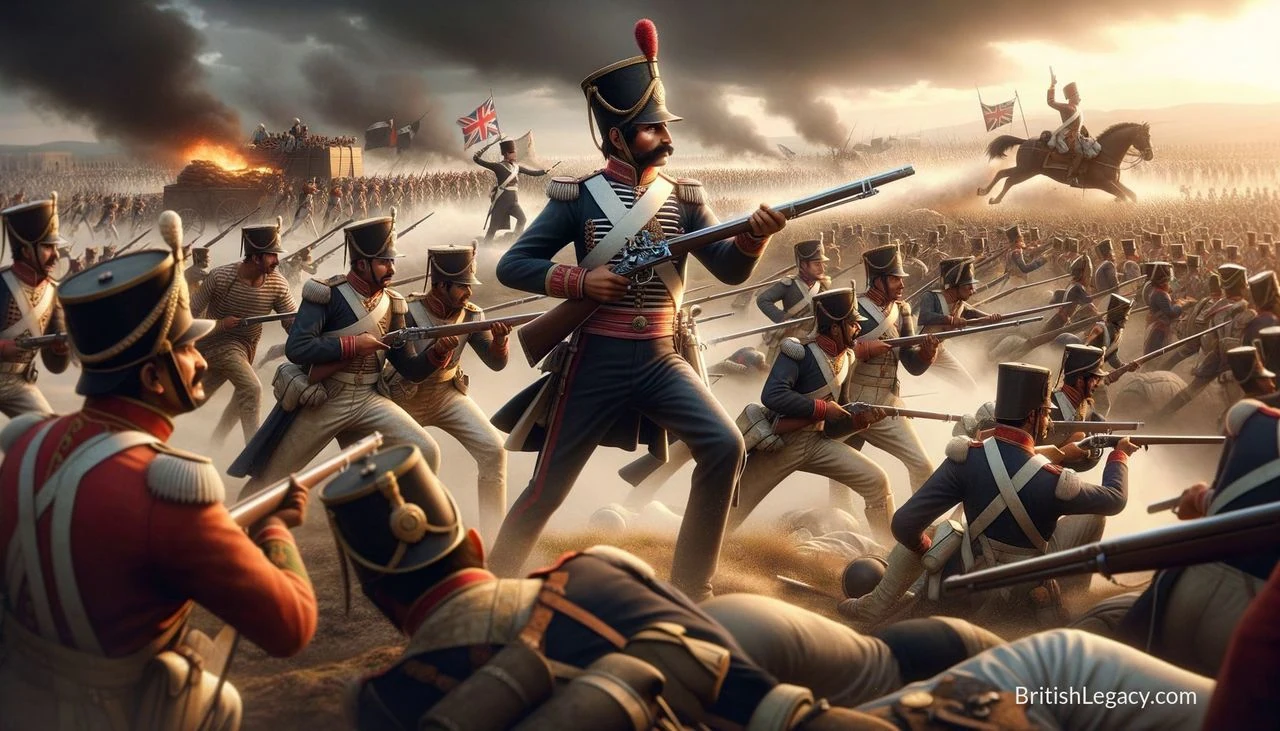
On 23 September 1803, near the village of Assaye in present-day Maharashtra, Arthur Wellesley led British and allied forces into battle against a much larger Maratha army. The victory became one of the defining episodes in his early military career, before he rose to prominence as the Duke of Wellington. It was also one engagement in a wider war over power and influence in India, as the British East India Company sought to extend its reach.
A war between expanding powers
The Second Anglo-Maratha War lasted from 1803 to 1805. The period was marked by political competition among regional powers and the expanding Company. The Maratha Empire was a confederation of states, with leaders including Scindia, Holkar and the Peshwa. Its forces included substantial cavalry, and the Marathas were among those resisting British encroachment. The conflict reflected competing ambitions and fragile alliances; it was not simply a contest between two armies.
Wellesley, then a major-general, commanded British and allied troops at Assaye. Estimates in the existing account put his force at around 4,500, including British infantry, sepoys serving the Company and allied contingents. The Maratha army is estimated there at between 30,000 and 50,000, including a large cavalry contingent. The figures underline the reported numerical imbalance, although they should be understood as estimates rather than exact totals.
The fighting at Assaye
Wellesley chose a direct attack on the Maratha positions. His force was divided into two columns in an attempt to outflank them. Rivers and rocky ground made the approach difficult. The battle was fiercely contested: the account describes repeated Maratha charges, while British and allied infantry held their lines. Artillery also played a significant part in the fighting.
The original narrative credits Wellesley's leadership and the discipline of his troops with helping to secure the victory. It also refers to the use of rocket artillery and to a decisive cavalry charge. Those details form part of the account of the engagement, but they do not, on their own, establish a complete explanation of how the battle was won. The central point is that the fighting was hard-fought and that the British and allied force defeated a substantially larger Maratha army.
Campaign and career
Assaye was followed by British victories at Argaon and Gawilghur during the same war. Together, the campaign's engagements contributed to the Company's growing dominance over large parts of India. Assaye was an important episode in that expansion, but the battle alone did not establish British control across the subcontinent or end Maratha resistance.
For Wellesley, the victory became a notable early success. His later career included service in the Napoleonic Wars and victory at Waterloo in 1815. Assaye consequently became part of the story of the reputation he built over time. That later fame can make the battle appear like an inevitable prelude to Waterloo; at the time, it was a contested engagement in a war shaped by the East India Company's ambitions and Maratha resistance.
Imperial consequences
The victory formed part of the process by which the Company extended its influence in India. The wider legacy of that expansion is complex: the original account describes a colonial period with legal, educational and infrastructural changes, as well as the consequences of British imperial rule. Those broad effects cannot be explained by Assaye alone. The battle is best understood as one episode in a longer history of conflict and political change, rather than as a single event that determined the future of the subcontinent.
This context matters because accounts of Assaye can easily become a story of military achievement detached from the people and political forces on the other side. The Maratha army was not simply an obstacle to Wellesley's career. It belonged to a confederation resisting British encroachment, and the battle's outcome contributed to the Company's growing power. Remembering the engagement therefore involves recognising both its place in Wellesley's military record and its place in the expansion of an imperial company.
Why the Battle of Assaye deserves a place in British Legacy
Assaye deserves a place in British Legacy because it helps explain how Arthur Wellesley's military reputation began to take shape. The 1803 victory was a major episode in his early career, years before Waterloo made him widely renowned. Its account includes the practical demands of battle: a difficult approach across rivers and rocky ground, a reported numerical imbalance, infantry holding their lines and artillery in action. These details give readers a more concrete sense of the engagement than an unqualified claim of strategic genius.
The battle also belongs in British history because it formed part of the East India Company's expansion in India. The Company was not a detached observer: it sought to extend its influence, and the Maratha forces were resisting British encroachment. Assaye and the subsequent victories at Argaon and Gawilghur contributed to the Company's growing dominance over large areas. Placing Wellesley's achievement alongside that imperial context makes the history more complete. It preserves the significance of the battle in his career while acknowledging that its consequences were part of a wider contest for power, not merely a triumph to celebrate in isolation.