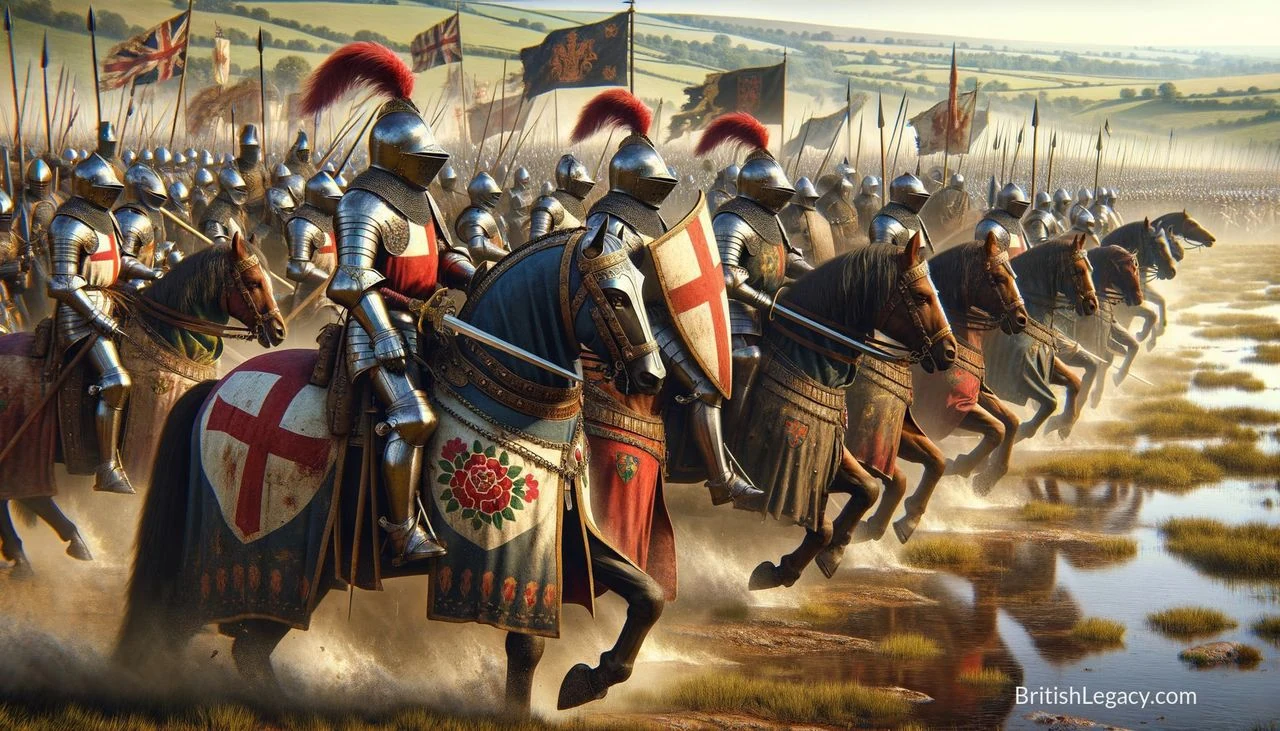
On 23 September 1459, near Market Drayton in Shropshire, Richard Neville, Earl of Salisbury, led a Yorkist force towards Ludlow to join Richard, Duke of York. At Blore Heath, a Lancastrian army commanded by James Tuchet, Lord Audley, stood in their way. The encounter became one of the first major battles of the Wars of the Roses: a victory for Salisbury, won against a force described as substantially larger, but not an end to the conflict over the English crown.
A kingdom divided
The Wars of the Roses pitted supporters of two rival branches of the royal House of Plantagenet against one another. The Lancastrians backed the reigning king, Henry VI; the Yorkists gathered around Richard, Duke of York, whose claim challenged the existing succession. By 1459, political tensions had given way to open warfare, as both sides sought allies and prepared to fight.
Blore Heath formed part of the Yorkists’ effort to bring their forces together. Salisbury was travelling to join York at Ludlow when Audley’s Lancastrian troops intercepted him. The battle’s setting, on heathland near Market Drayton, put the two armies in direct confrontation before Salisbury could complete his march.
Salisbury holds his ground
The account of the battle gives Salisbury about 3,000 men and Audley around 10,000. Faced with this numerical disadvantage, the Yorkist commander used the ground and the discipline of his troops to establish a defensive position. Audley attacked frontally, and the Lancastrians met Salisbury’s prepared line rather than an undefended force on the march.
Yorkist longbowmen inflicted heavy casualties as the Lancastrians advanced. Fighting then became close and intense. Audley was killed, and the Lancastrian force eventually broke and fled. Salisbury’s men had held their position and won a clear battlefield victory, despite facing a larger army.
The outcome demonstrated that numbers alone did not decide an engagement. The Yorkist success depended on the defensive position and the force’s ability to hold it under attack. But the battle did not settle the rivalry between the factions. It was one episode in a struggle that continued through further campaigns and contests for royal power.
A victory within a longer conflict
Blore Heath strengthened the Yorkist cause at a moment when its supporters were trying to combine their forces. The death of Audley and the Lancastrian retreat made the result a defeat for Henry VI’s supporters, but not a final one. The Wars of the Roses continued, and the conflict’s eventual dynastic consequences extended beyond this battlefield.
The original account connects the later union of the houses in 1486 with the rise of the Tudor dynasty and describes that union as a symbolic end to the conflict. That longer view gives Blore Heath a place within a succession of battles and political changes; it does not mean that the result at Blore Heath itself determined the later settlement.
Why the Battle of Blore Heath deserves a place in British Legacy
Blore Heath deserves a place in British Legacy as a clearly situated episode in England’s fifteenth-century civil conflict. Its date, location and commanders make the encounter more than a name in a list of battles: Salisbury was marching to join York when Audley intercepted him, and the resulting fight tested whether the Yorkist force could hold its ground against a larger opponent. The account describes a concrete sequence—defensive preparation, a Lancastrian frontal attack, longbow fire, Audley’s death and the eventual retreat—that helps explain how the Yorkists won.
The battle also matters in the wider story of the Wars of the Roses because it came during an effort by Yorkist supporters to unite their forces, while the contest between York and Lancaster remained unresolved. Remembering Blore Heath keeps attention on the local encounter as well as the dynastic struggle: a clash on heathland near Market Drayton became part of a conflict over the crown. Its British significance lies in that documented connection to English political history, not in claims that one battle alone transformed the kingdom or settled the war.