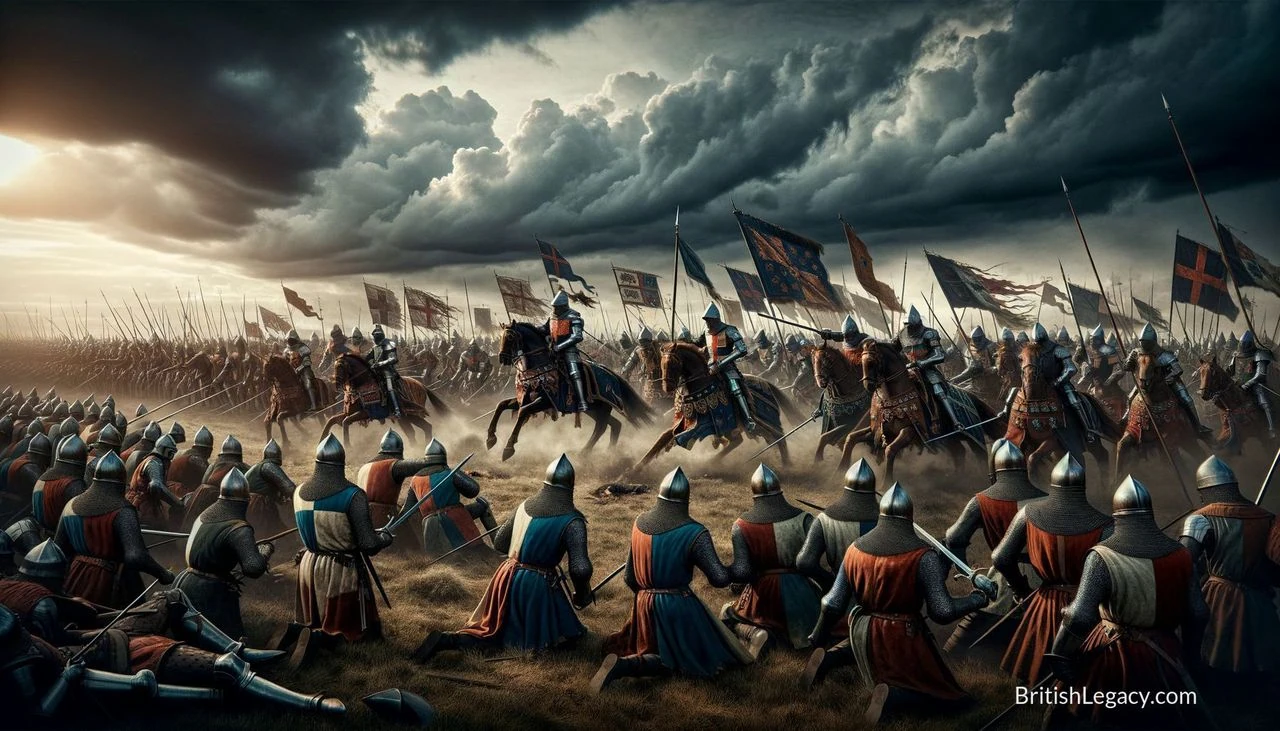
On 22 August 1485, near Market Bosworth in Leicestershire, Henry Tudor’s forces defeated those of Richard III. Richard was killed, and Henry took the throne as Henry VII. The battle settled the immediate contest between the two men, but its significance reached beyond the battlefield: Henry’s victory began the Tudor dynasty and gave him the opportunity to strengthen his claim to the crown.
A contested succession
Bosworth was the climactic encounter of the Wars of the Roses, a series of dynastic conflicts involving the rival houses of Lancaster and York, both branches of the Plantagenet family. Their competing claims to the English throne, and the shifting allegiances of powerful nobles, shaped the struggle. The familiar association of Lancaster with the red rose and York with the white rose gave the rival houses enduring symbols, but the conflict was also a contest over who could command support and rule.
By the mid-1480s, Richard III, a Yorkist king, faced growing opposition. Henry Tudor, a Lancastrian claimant, had a tenuous claim, but he was able to gather forces for a challenge. His army included French mercenaries and received support from English nobles. The outcome would depend not only on the two claimants and their armies, but also on the choices made by those whose allegiance could affect the balance of power.
The battle near Market Bosworth
Richard led his forces in the fighting. The Stanleys—Thomas and his brother William—were among the nobles whose actions proved decisive. Their troops eventually joined Henry’s side, strengthening his forces at a crucial point. The account of the battle describes Richard making a direct charge towards Henry before he was killed. It does not establish every detail of the fighting, but the central result is clear: Richard’s death ended his reign, and Henry emerged victorious.
Bosworth therefore marked a transfer of power, not the end of every Plantagenet claim or the instant resolution of all political divisions. Henry’s victory put him on the throne as Henry VII and began Tudor rule. The battle’s place in the Wars of the Roses comes from that immediate consequence: it brought one king’s reign to an end and enabled his rival to establish a new dynasty.
Henry VII and the Tudor settlement
Henry married Elizabeth of York, the daughter of Edward IV. The marriage joined the new king to the Yorkist royal line and came to represent the union of the rival houses. The Tudor rose, combining red and white, expressed that union in a single emblem. It also offered a visible statement of reconciliation, though the marriage and its symbolism should be understood as part of Henry’s efforts to reinforce his position, rather than as proof that political conflict simply disappeared.
The Tudor period brought changes in royal authority, religion, culture and England’s maritime power. These developments unfolded across the reigns of several monarchs; they were not all immediate consequences of Bosworth. Henry VII’s reign preceded those of his son Henry VIII and granddaughter Elizabeth I, whose rule formed later chapters in the history of the dynasty. The battle’s importance lies in how it opened that succession of Tudor reigns, rather than in attributing every subsequent change to a single day in 1485.
Why the Battle of Bosworth Field deserves a place in British Legacy
Bosworth deserves a place in British Legacy because it was a consequential turning point in the struggle for England’s crown. Richard III’s death ended his reign, while Henry Tudor’s victory brought him to power as Henry VII and established the Tudor dynasty. The battle connects a specific place in Leicestershire to a major change in the monarchy: a victory in a dynastic conflict became the foundation for a new ruling house. Its importance is best understood through those political consequences, without claiming that one battle settled every dispute or created lasting stability by itself.
The events also show how royal succession depended on more than the claims of kings. The Stanley brothers’ eventual intervention strengthened Henry’s forces, while Henry’s marriage to Elizabeth of York later offered a symbol of union between Lancaster and York. Together, these details illustrate the part played by noble allegiance and dynastic marriage in establishing a new ruler. Bosworth’s British legacy is therefore not only the story of Richard’s defeat, but also of how military victory, political support and a carefully presented succession helped shape the next era of English monarchy.