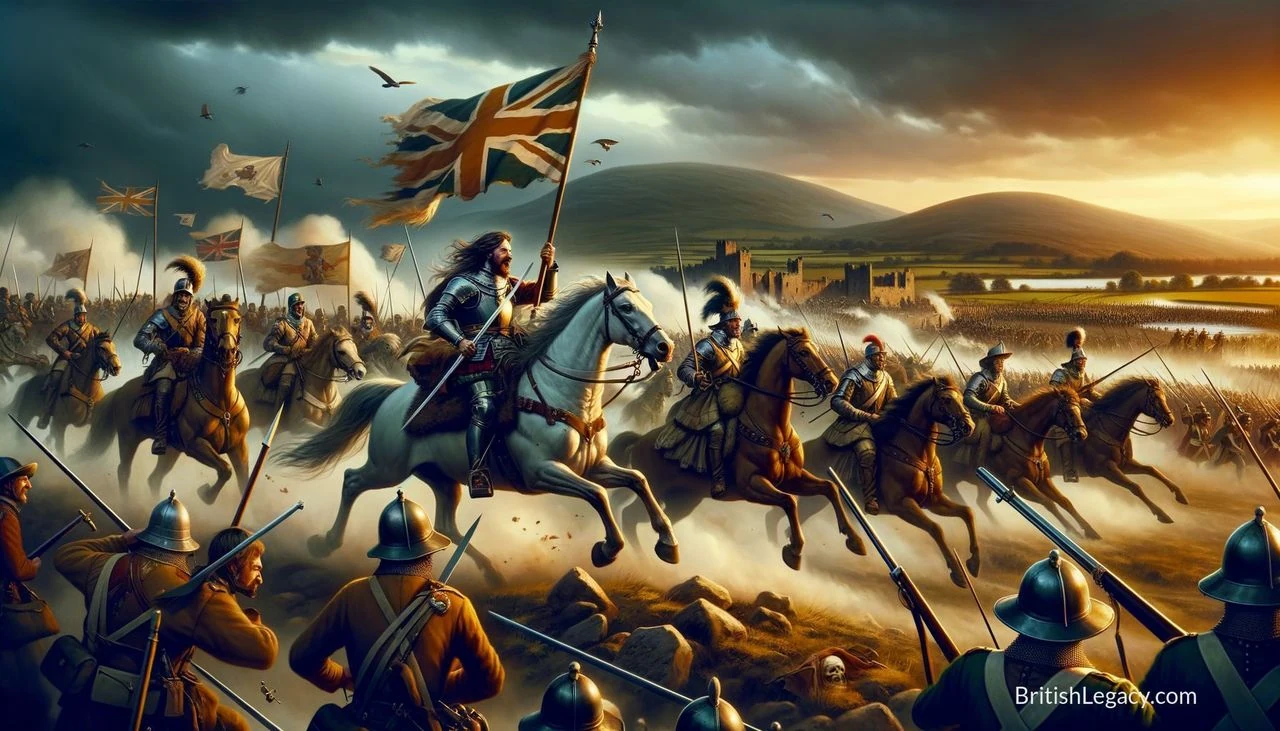
On 1 July 1690 (11 July in the Gregorian calendar), near the River Boyne in Ireland, William III’s forces defeated the army of James II, the king William had displaced. The battle was a major encounter in the struggle over the English crown, but its meaning did not end with the military result. It became part of a longer history of political and religious division in Ireland, and its memory remains contested.
Two kings and a divided Ireland
James II, a Catholic monarch, was overthrown in the Glorious Revolution of 1688. His Protestant son-in-law, William of Orange, became William III and ruled alongside Mary II, James’s Protestant daughter. James sought to regain the throne, and Ireland became a battleground in that effort.
Religious and political loyalties were divided. The majority Catholic population largely supported James, while the Protestant minority, concentrated mainly in Ulster, supported William. These broad alignments formed the context for the conflict, though they do not describe every individual’s allegiance or motive.
The armies meet at the Boyne
The two armies faced one another near the Boyne in County Meath. William’s force included English, Scottish, Dutch, Danish and Huguenot troops. James’s army was predominantly Irish, with significant French support. The composition of the opposing forces reflected the conflict’s connections beyond Ireland as well as its place in the contest over the crown.
William’s forces had numerical superiority, and the account of the battle credits his tactics with helping secure victory. James was defeated and fled to France. The result was a significant Williamite success, but it did not by itself settle the wider struggles over political power and religion in Ireland.
Consequences and competing memories
William’s victory formed part of the wider conflict that followed the Glorious Revolution and strengthened his position in the contest for the monarchy. In Ireland, the longer aftermath included the entrenchment of Protestant control and the development of the Protestant Ascendancy. The Penal Laws constrained Catholic rights and privileges. These were lasting features of the unequal order that followed; they should not be mistaken for changes accomplished on the battlefield itself.
The battle has acquired different meanings. For some, it represents the defence of Protestant rule and the political settlement associated with William. For others, it recalls exclusion, religious division and a struggle whose consequences endured long after 1690. The Boyne’s legacy cannot be reduced to a single celebratory interpretation.
In Northern Ireland, the Orange Order commemorates the battle on 12 July. The anniversary is marked by parades, bonfires and regalia, expressions of a public tradition that has carried the battle’s memory forward. Commemoration is not simply a replay of the events of 1690: it is part of the later history through which the battle has been interpreted.
Why the Battle of the Boyne deserves a place in British Legacy
The Battle of the Boyne deserves a place in British Legacy because it connects a struggle over the crown with the long consequences of political power in Ireland. William III’s victory belonged to the conflict following the Glorious Revolution, while the battle’s wider aftermath included the consolidation of Protestant control. Its history also makes clear that the effects of political change were unequal: Catholic people in Ireland faced later restrictions under the Penal Laws. Remembering the event responsibly means distinguishing the military outcome from the longer processes that followed it.
The battle’s continuing commemoration gives it a place in public culture as well as in political history. The Orange Order’s annual observance in Northern Ireland shows how the Boyne remains present in communal memory, while contrasting interpretations reflect a history of division and resistance as well as victory. Its significance lies in the intertwined histories of Ireland and the monarchy, and in the need to recognise why the same event can represent triumph to some and loss or exclusion to others.