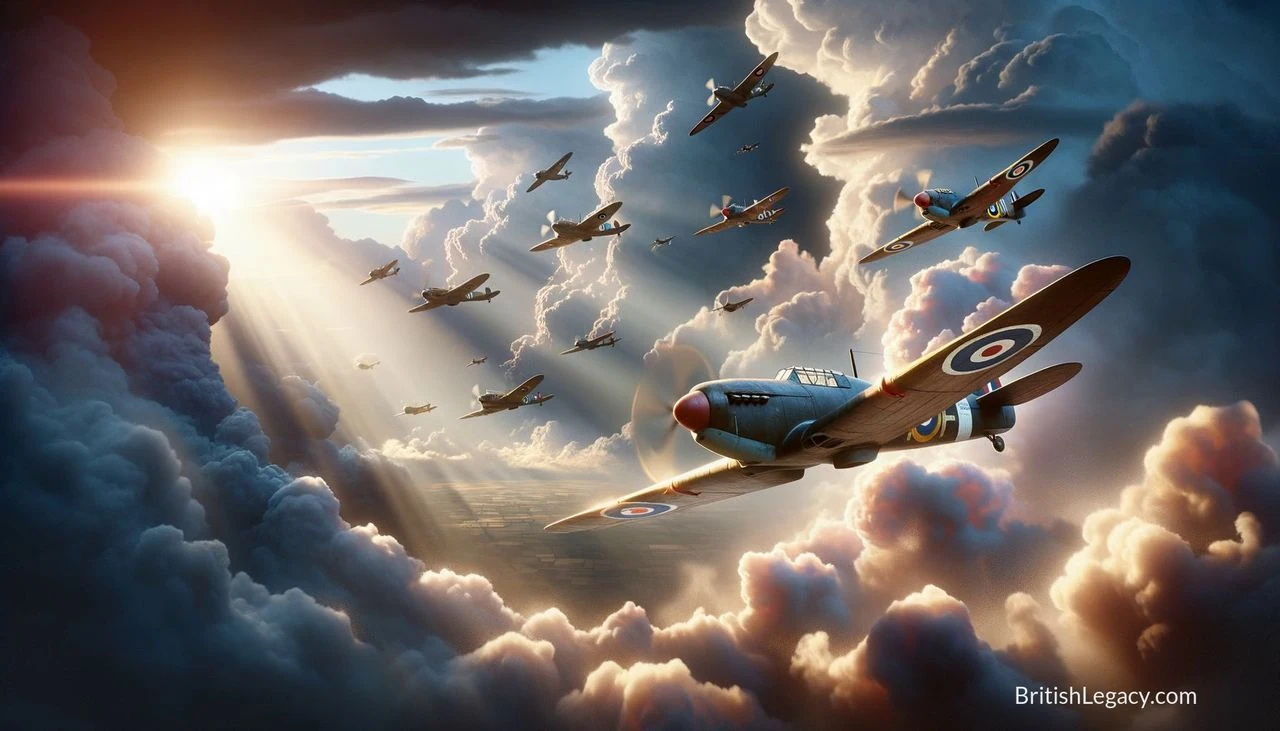
In the summer and autumn of 1940, the Royal Air Force fought to prevent Germany from gaining control of the skies over Britain. The Battle of Britain was bound to Hitler’s proposed invasion, Operation Sea Lion: German forces needed air superiority before an invasion could go ahead. The RAF’s defence, supported by radar warnings and the direction of its aircraft, helped deny the Luftwaffe that advantage.
The air campaign and the invasion plan
The battle is dated from July to October 1940 and is described as the first major military campaign fought entirely by air forces. The Luftwaffe attacked British air defences as part of its effort to establish the conditions for invasion. Its aircraft included Heinkel He 111 bombers and Messerschmitt Bf 109 fighters. The RAF’s principal fighters included the Hawker Hurricane and the Supermarine Spitfire.
Aircraft and pilots were only part of the defence. Radar provided warning of incoming attacks, while the RAF used that information to direct its available aircraft. The system mattered because Britain had to deploy its forces carefully against repeated raids. The battle was therefore also a contest over whether the country’s warning and response network could continue to function under pressure.
Attacks, targets and the outcome
The Luftwaffe focused attacks on RAF airfields and radar stations, aiming to damage the infrastructure behind Britain’s fighter defence. The campaign later shifted towards bombing London and other cities. These raids brought hardship and suffering to civilians and are associated with the Blitz. The change in targets also reduced the pressure on the RAF’s air defences, according to the account of the campaign.
By the end of October, the German offensive had been blunted. The RAF’s resistance meant that the Luftwaffe had not secured the air superiority required for Operation Sea Lion. Hitler postponed the invasion plan and eventually abandoned it. The battle’s outcome was thus closely connected to the threat of invasion, while the bombing of cities formed a separate and painful part of the period’s experience.
“The Few” and the battle’s remembrance
Winston Churchill’s words, “Never in the field of human conflict was so much owed by so many to so few”, became closely associated with the RAF pilots who fought in the campaign. They came to be known as “the Few”. The phrase places aircrew at the centre of the battle’s public memory, but the defence also depended on radar, the direction of aircraft and the wider work of the RAF.
The battle is remembered through accounts of the pilots and the raids, as well as through memorials, museums and literature. Its story includes both the effort to defend Britain and the civilian hardship caused by bombing. Keeping those parts together avoids reducing the campaign either to individual heroism or to an abstract contest between air forces.
Why the Battle of Britain deserves a place in British Legacy
The Battle of Britain deserves a place in British Legacy because it was a defence of the United Kingdom at a moment when Germany was preparing an invasion. The RAF’s resistance denied the Luftwaffe the air superiority needed to make Operation Sea Lion viable. That result depended not on fighter aircraft alone, but also on radar warnings and the effective use of available forces. Those details make the battle significant as a military campaign and as an example of how information and organisation supported the defence of the country.
Its legacy also needs to recognise the human consequences of the campaign. The attacks on London and other cities brought hardship to civilians, even as RAF pilots continued to resist the Luftwaffe. Churchill’s words about “the Few” remain an enduring element of the story, but remembrance is fuller when it includes the systems behind the pilots and the people affected by the raids. The battle’s outcome frustrated an invasion plan; its place in British memory reflects both that defence and the suffering bound up with it.