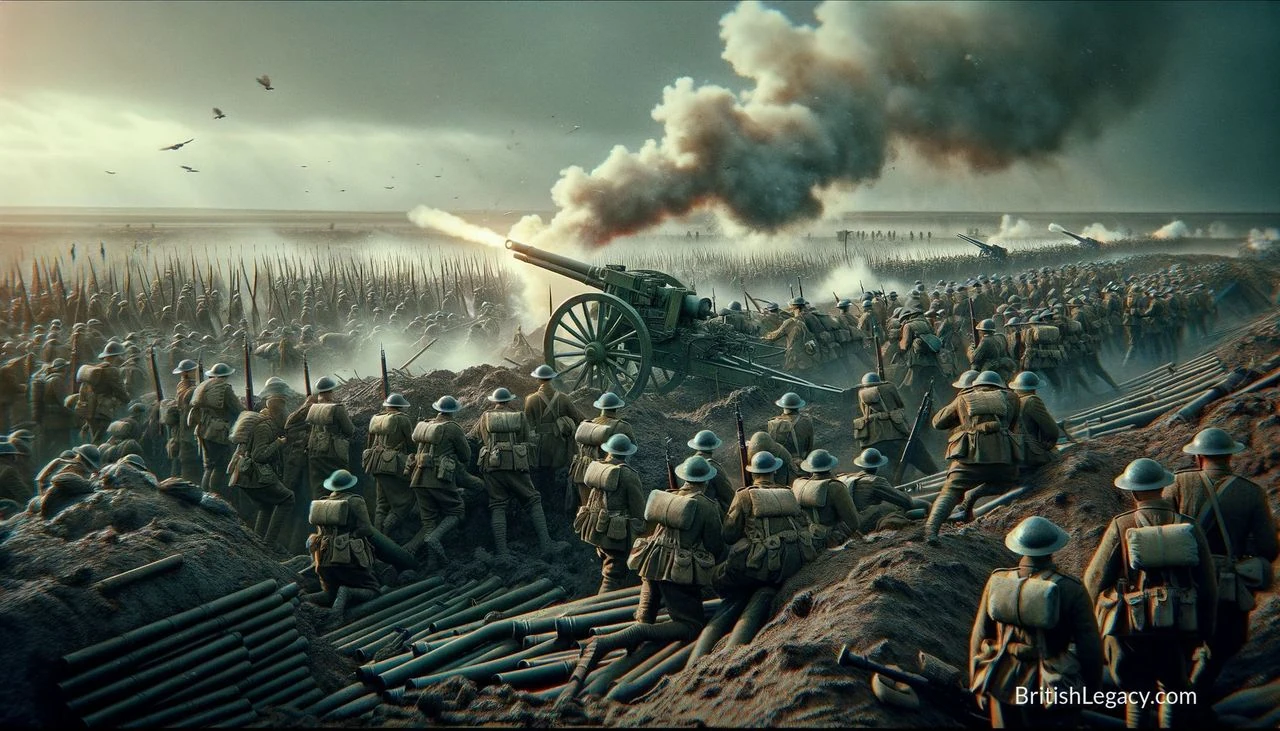
On 4 October 1917, British forces attacked at Broodseinde as part of the wider Battle of Passchendaele, or Third Battle of Ypres. The fighting took place amid mud and shell-cratered ground, in a campaign whose larger objective was the Passchendaele ridge. The account of Broodseinde centres on a methodical approach: artillery fire was intended to support infantry moving forward in stages, rather than leave soldiers to advance without a moving barrage.
The battle within the Passchendaele campaign
Broodseinde came at a difficult point in the First World War. British forces, under General Sir Herbert Plumer, were engaged in a gruelling struggle on terrain described as muddy and cratered. The effort to take the Passchendaele ridge was presented as a way to break the deadlock on the Western Front, but the objective was perilous and the fighting costly.
The battle was not an isolated action: it belonged to the larger campaign at Ypres. Its significance in the account rests on the way British forces sought to make incremental gains under artillery protection. This contrasted with the large-scale offensives that the original account describes as less effective. The emphasis was on advancing to selected positions and holding them, rather than assuming that a single, sweeping attack would settle the contest.
Artillery and infantry moving together
The method is described as “bite and hold”: infantry advanced in stages while artillery barrages disrupted German defences and covered the troops’ movement. Synchronising the infantry’s pace with the guns was central to the plan. A creeping barrage—a line of shellfire moving forward at a predetermined rate—was intended to keep German forces off balance and make it harder for them to regroup as the British advanced.
On the morning of 4 October, a planned barrage preceded and accompanied the infantry attack. Soldiers moved in tandem with the advancing shellfire, seeking to reach objectives while the bombardment continued to interfere with the opposition’s response. The account says that most primary objectives had been secured by noon and that German defences were left in disarray. That description conveys the reported progress of the attack; it does not mean that the wider campaign or the struggle for the ridge had thereby been completed.
The approach depended on coordination: artillery had to advance at a pace the infantry could follow, while the troops had to take and hold the ground reached. Broodseinde is presented as an example of carefully planned, incremental operations succeeding where less discriminating large offensives had failed. The account also describes the result as a boost to Allied morale. It offers no figures with which to quantify casualties or measure that change in morale, so neither should be overstated.
What Broodseinde came to represent
The battle has been described as a precursor to modern combined-arms warfare, with its emphasis on coordination between military forces and the careful timing of operations. That is a broad interpretation of its legacy, rather than a claim that one engagement alone created later military practice. The more specific lesson in the account is the importance of linking artillery support to infantry movement and of setting limited objectives that troops could seek to secure and hold.
In this telling, Broodseinde’s place in the Passchendaele campaign lies both in its reported gains and in the methods used to pursue them. Its narrative is not simply one of an advance: it is an account of planning, timing and movement under difficult conditions. That distinction makes the battle a useful subject in the history of British military practice, without turning tactical success into a claim that the wider war had been transformed.
Why the Battle of Broodseinde deserves a place in British Legacy
Broodseinde deserves a place in British Legacy as a focused account of how British forces attempted to adapt their methods during the First World War. The battle is associated with an incremental “bite and hold” approach and with the use of a creeping barrage to support infantry advances. These details give the episode a clearer significance than general praise of military ingenuity: they show the intended relationship between artillery, infantry and limited ground objectives.
The account also places the action in its necessary context. Broodseinde formed part of the Battle of Passchendaele, fought over difficult ground in a wider effort to capture the ridge. Its reported capture of key objectives and its contribution to Allied morale belong to that campaign, not to a claim of a decisive end to the fighting. Remembering the battle in these terms helps explain both the tactical ideas it represents and their limits. It preserves a specific British military episode while avoiding the assertion that a single engagement established modern warfare or resolved the deadlock on the Western Front.