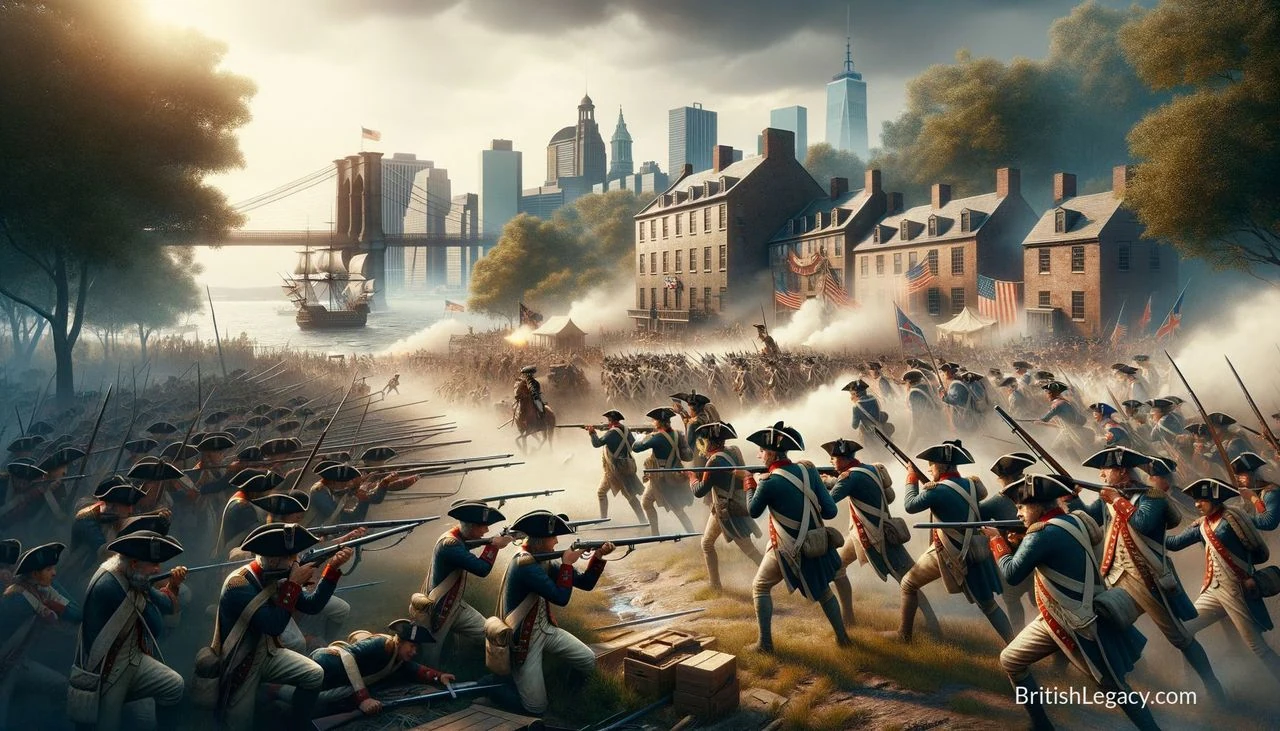
In August 1776, British forces landed on Long Island to contest control of New York. The ensuing Battle of Brooklyn, also known as the Battle of Long Island, was a major early engagement of the American Revolutionary War. British troops outflanked American positions and won the battle, but George Washington’s army escaped across the East River to Manhattan. The result was a British military success, not the destruction of the Continental Army.
New York becomes the objective
The Declaration of Independence had been issued on 4 July 1776. Washington’s Continental Army was then trying to defend New York City and its surroundings, while the British sought control of the city and its ports. After evacuating Boston earlier that year, British forces turned their attention to New York, where a victory could secure an important harbour and put pressure on the revolution.
The British campaign was led by General Sir William Howe, with his brother Admiral Richard Howe commanding the Royal Navy. The account describes a British force of about 32,000, including British regulars, Hessian troops and Loyalists. The American force on Long Island is estimated at around 10,000. These figures are approximate, but they convey the imbalance in numbers described in the account.
The flanking manoeuvre
The British plan relied on more than a direct attack against the American lines. Some troops engaged the front, while the principal force moved through Jamaica Pass, described as almost unguarded, to strike the Americans from the rear. This flanking movement took the Continental Army by surprise and helped the British encircle part of the opposing force.
The battle began on 27 August, with fighting around the Gowanus Heights. American troops resisted, including the Maryland 400, whose rear-guard action is singled out in the account. The British attack nevertheless overwhelmed the American positions. The account dates the wider engagement from 27 to 30 August, distinguishing its span from the fighting that began on the 27th.
Washington had sought to hold Brooklyn Heights, but the British success made the position increasingly dangerous. The Continental Army suffered about 1,000 casualties, including men captured; British losses are put at about 400. Despite the defeat, Washington withdrew his troops across the East River to Manhattan. The escape prevented the army from being trapped and destroyed, leaving it available to continue the war.
Victory and its limits
The battle demonstrated the advantage Britain could draw from greater numbers, naval support and a flanking attack. It also exposed weaknesses in the American defence, particularly the failure to secure the route through Jamaica Pass. These are concrete military lessons, rather than proof of an inevitable British victory: the Continental Army survived the defeat and continued its campaign.
New York’s strategic importance explains why the British sought to capture it. Control of its port and surrounding territory offered military and logistical advantages, while the American effort to defend the city placed Washington’s inexperienced force against a larger expedition. The outcome showed both the effectiveness of Howe’s operation and the difficulty of turning a battlefield victory into the end of the rebellion.
Why the Battle of Brooklyn deserves a place in British Legacy
The Battle of Brooklyn belongs in British Legacy as a significant episode in Britain’s military history and in the conflict that produced the United States. British forces used their numerical advantage and a successful flanking movement to defeat the Continental Army on Long Island. The engagement offers a specific example of how planning, terrain and coordination shaped a campaign, including the risks that followed when American defences failed to cover Jamaica Pass.
That legacy should include the limits of the victory as well as its execution. Washington’s withdrawal across the East River meant that the British did not destroy the army they had beaten; the war continued. Remembering the battle in this broader context makes it more than an uncomplicated celebration of British power. It connects British military history to the American struggle for independence, acknowledges the opposing army’s survival, and shows how a clear battlefield success could still fall short of its larger political purpose.