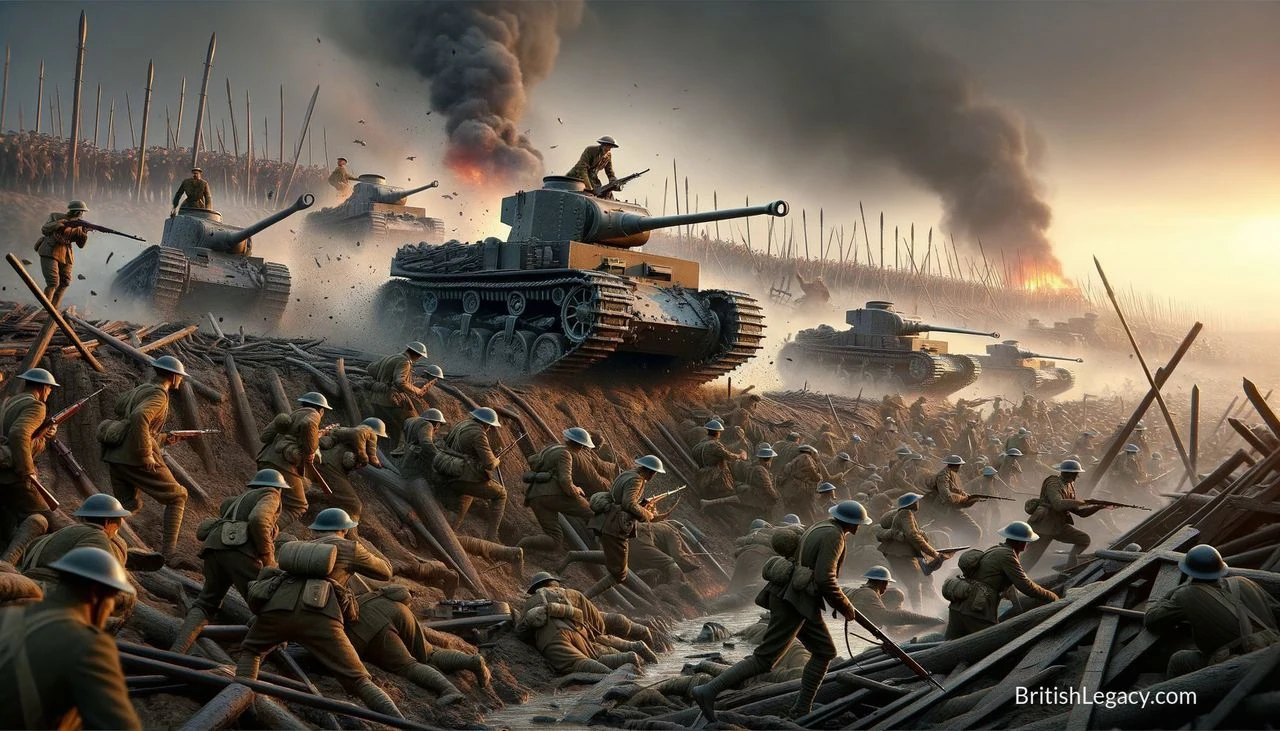
On 20 November 1917, British forces attacked the German Hindenburg Line near Cambrai in northern France. More than 400 Mark IV tanks advanced with infantry and cavalry, supported by artillery. The assault initially breached the German defences: tanks crossed trenches and crushed barbed wire, helping the attackers make rapid progress. Yet the breakthrough did not endure. Mechanical failures and mud slowed the tanks, German forces counterattacked, and by early December much of the ground had been recaptured.
A plan centred on tanks
The tank was a relatively new weapon, and earlier engagements had exposed its limitations. At Cambrai, General Julian Byng envisaged using tanks on a large scale against the Hindenburg Line. The German defensive position was protected by fortifications, barbed wire and artillery. Rather than rely on tanks alone, the plan brought them into an assault involving infantry, cavalry and artillery.
On the morning of 20 November, the tanks moved forward as the artillery barrage prepared the way. The Mark IVs were robust but cumbersome. Their ability to cross trenches and break through wire helped open routes through the defensive line, while infantry and cavalry advanced alongside them. The early results demonstrated the potential of deploying armoured vehicles in numbers as part of a coordinated attack.
The initial success was significant, but it did not make the operation straightforward. Some tanks broke down; others became immobilised in the mud. The difficulties of moving and coordinating so many mechanical units became apparent as the offensive continued. Cambrai’s early progress depended on both the capabilities of the tanks and the work of the other forces taking part.
Breakthrough, counterattack and retreat
The British assault breached the Hindenburg Line, but German forces regrouped and launched counterattacks. By early December, the gains had largely been recaptured, and the battle had returned to stalemate. The result was therefore mixed: the attack achieved a notable initial breakthrough, but did not secure a lasting territorial advance.
Cambrai is associated with the first successful large-scale use of tanks in warfare. Its importance lies in what the opening assault demonstrated, rather than in a decisive victory. Tanks could help overcome trenches and wire when deployed alongside other forces; at the same time, breakdowns, difficult ground and an opponent’s response could blunt their effect. The battle made the promise of armoured warfare visible without making its practical challenges disappear.
Combined arms and the limits of innovation
The operation brought tanks, infantry, cavalry and artillery together in a single offensive. That combination matters to the story: the tanks were central to the initial breach, but the attack was not simply a contest between machines and fortifications. The artillery barrage supported the advance, while infantry and cavalry moved with the armoured force. Cambrai showed the potential of coordinated action across different parts of an army.
It also showed why an early breakthrough could not be treated as a victory in itself. Tanks that broke down or became stuck could not sustain the pace of an advance, and German counterattacks helped reverse the gains. The battle’s course thus held two lessons at once: new equipment could alter what an attack could achieve, but its usefulness depended on mobility, coordination and the ability to hold ground.
Why the Battle of Cambrai deserves a place in British Legacy
The Battle of Cambrai deserves a place in British Legacy as a significant British experiment in the large-scale use of tanks. The assault of 20 November 1917 brought more than 400 Mark IVs into an attack on the Hindenburg Line. Their capacity to cross trenches and crush wire helped the British forces breach the German defences. The tanks operated alongside infantry, cavalry and artillery, making the battle an example of a new weapon being used as part of a wider military effort.
Its legacy is not a simple story of technological triumph. Some tanks failed or became stuck in mud, German forces counterattacked, and much of the ground gained was recaptured by early December. Those limits are part of what makes Cambrai worth remembering: innovation could open new possibilities, but it did not guarantee a lasting result. The battle records both the potential of armoured warfare and the practical demands of coordinating forces, overcoming terrain and holding an advance. That combination of achievement and limitation gives Cambrai a specific place in Britain’s First World War military history.