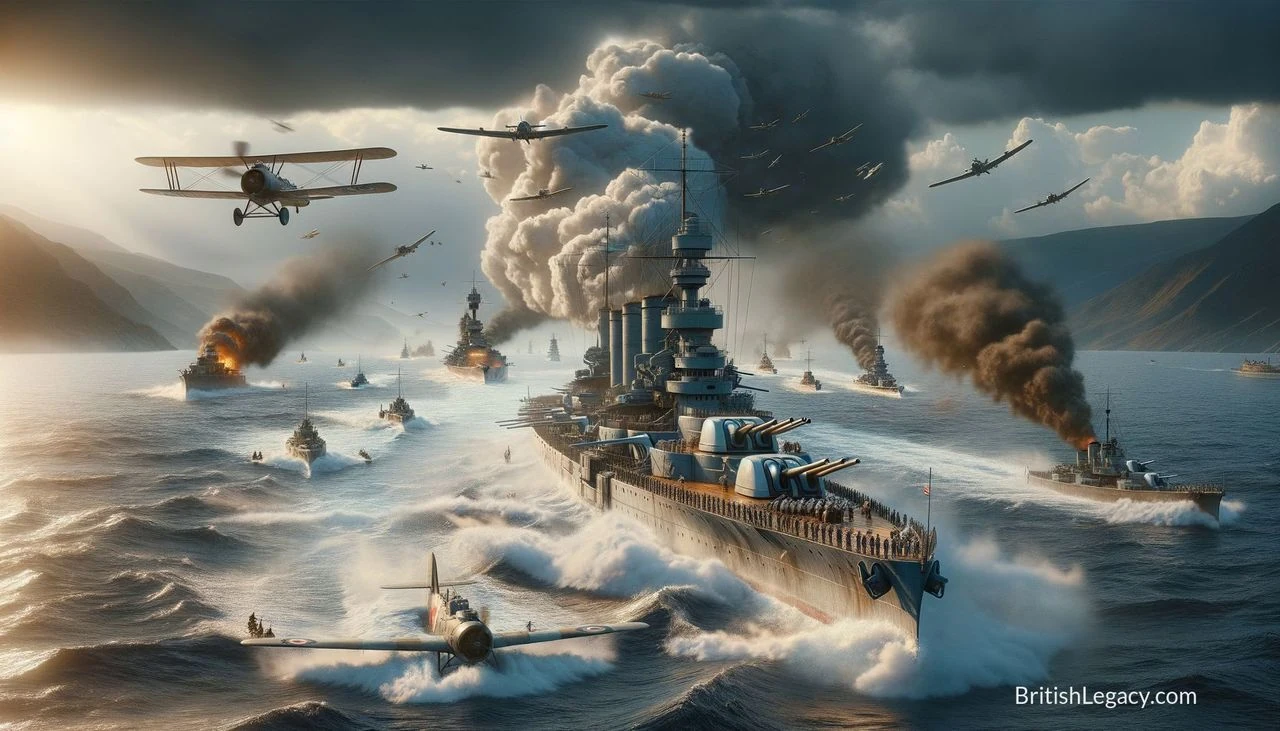
Between 27 and 29 March 1941, the Royal Navy and the Italian fleet fought a major engagement off Cape Matapan, near Greece’s Peloponnesian Peninsula. The battle ended in a British victory: Italian ships lost three heavy cruisers and two destroyers, while the battleship Vittorio Veneto was damaged during the fighting. The result strengthened the Royal Navy’s position in the Mediterranean at a time when control of the sea mattered to the wider Allied war effort.
A contest for the Mediterranean
The Mediterranean was strategically important to both sides. Its sea routes supported operations connected with North Africa, while control of the waterway offered a foothold in southern Europe. Italy’s Regia Marina, aligned with Nazi Germany, sought to challenge British naval strength in the region.
Admiral Andrew Cunningham commanded the Royal Navy’s Mediterranean Fleet. The account of the battle describes British intelligence as having detected plans for an Italian naval operation through the deciphering of Ultra signals. With warning of the Italian movement, Cunningham could prepare his fleet to meet it. The Italian force, under Admiral Angelo Iachino, included the battleship Vittorio Veneto, heavy and light cruisers, and destroyers. The British force brought together the battleships HMS Warspite, HMS Barham and HMS Valiant, the carrier HMS Formidable, and cruisers and destroyers.
Carrier attack and night fighting
Aircraft from HMS Formidable struck first, damaging Vittorio Veneto. The Italian ships then withdrew, but the retreat led to further fighting after dark. British ships used radar, which helped them locate and engage their opponents at night. The account presents that advantage as important in an encounter where darkness and the difficulties of night combat shaped what each fleet could do.
British destroyers launched torpedoes during the night actions. The heavy cruisers Fiume, Zara and Pola were sunk. The account also describes British battleships closing in without being detected, illuminating their targets with searchlights before opening fire. Together, the air attack, night engagements and losses to the Italian fleet made the retreat costly. The action was not simply a contest between opposing groups of ships: intelligence helped the British prepare, carrier aircraft damaged an important Italian battleship, and radar supported night-time operations.
Consequences of the battle
The loss of three heavy cruisers and two destroyers was a severe blow to the Italian navy. The Royal Navy, by contrast, reinforced its strategic position in the Mediterranean. The battle therefore mattered beyond the ships destroyed: it affected the balance of naval strength in a region tied to Allied operations in North Africa.
Cunningham’s leadership and the British use of intelligence and technology have become notable parts of the battle’s account. He is associated with the order “Stick to them, boys!” as British ships closed with the Italian force. The words capture the determination of the final action, while the wider outcome rested on the combination of warning, air power and night fighting.
Why the Battle of Cape Matapan deserves a place in British Legacy
Cape Matapan deserves a place in British Legacy as a consequential Royal Navy victory in the Mediterranean during the Second World War. Its significance lies in the specific means by which the British fleet gained and used an advantage: intelligence provided warning of the Italian operation, carrier aircraft damaged Vittorio Veneto, and radar supported engagements after dark. Those elements helped turn the Italian withdrawal into a costly retreat, with three heavy cruisers and two destroyers lost. The battle strengthened the Royal Navy’s position in a sea whose routes were important to operations connected with North Africa.
Remembering the battle also helps explain how naval strength depended on more than the size of a fleet. Ships, aircraft, intelligence and the capacity to fight at night all shaped the result. The British victory at Cape Matapan was part of the wider Allied war effort, and its outcome had strategic consequences beyond the immediate loss of vessels. Its place in British history rests not on general claims of national character, but on this defined achievement: a successful operation that used intelligence and technology in combat and reinforced British naval power in the Mediterranean.