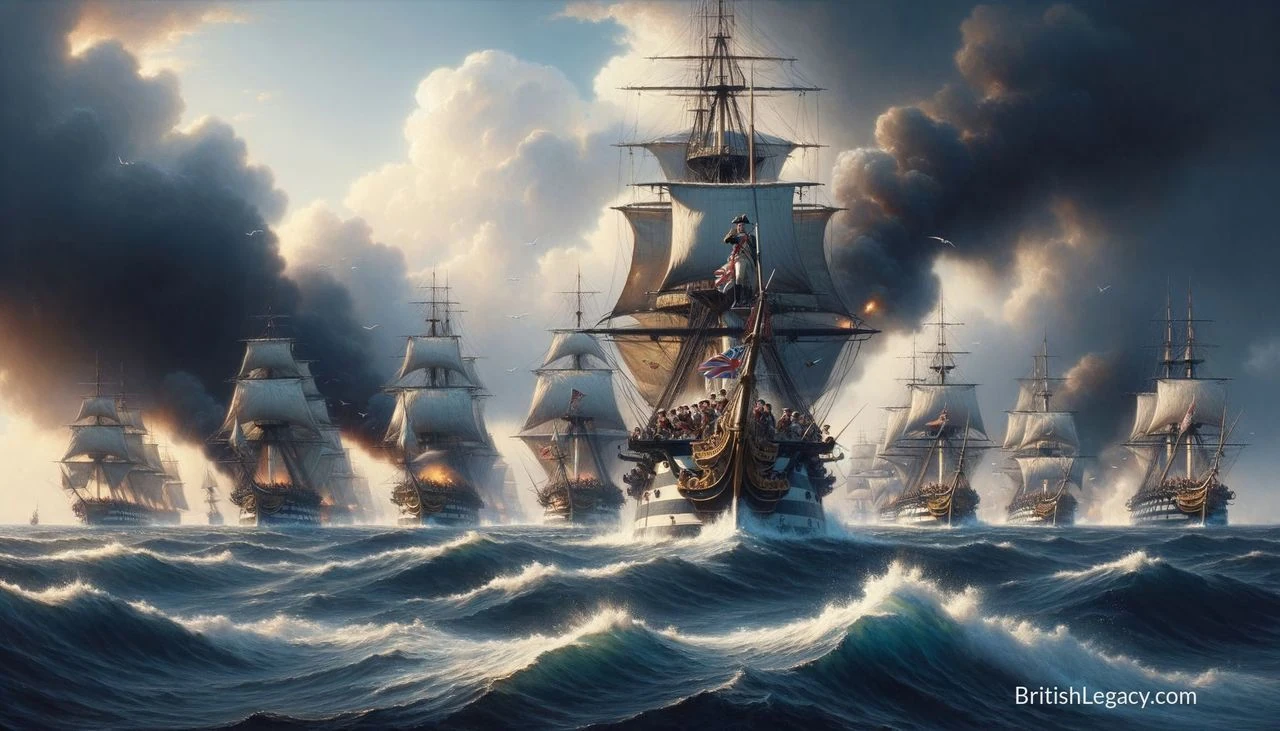
On 14 February 1797, off Cape St Vincent on Portugal’s coast, a British fleet under Admiral Sir John Jervis met a much larger Spanish force. The British had 15 ships of the line; the Spanish fleet numbered 27 warships. Commodore Horatio Nelson’s close-range action, including the capture of two Spanish ships, became one of the battle’s defining episodes. The victory also raised morale in the Royal Navy and among the British public.
A fleet engagement in a wider war
The battle took place during the Anglo-Spanish War, amid the wider conflicts of the French Revolutionary Wars. Spain was allied with France, and the engagement reflected the maritime contest between Britain and its opponents. The Spanish fleet was described as seeking to challenge British control at sea; Jervis’s Royal Navy fleet went out to meet it.
The British were outnumbered, but their fleet was characterised as better disciplined and more manoeuvrable. The outcome was not simply a matter of numbers: the encounter also depended on command and action at close quarters. Jervis led the British fleet, with Nelson serving under him as a commodore.
Nelson in the Spanish line
Nelson took HMS Captain directly into the Spanish line, where he engaged enemy vessels at close range. He captured the San Nicolas and San Josef. The manoeuvre was later known as “Nelson’s Patent Bridge for Boarding First Rates”. The episode helped bring his aggressive approach to wider attention and became an important part of the story of his rise as a naval commander.
Jervis’s command and Nelson’s intervention are distinct parts of the battle’s account: Jervis led the fleet, while Nelson’s action carried the fight into the opposing line. The British victory was followed by an increase in morale in the navy and among the public. Jervis was made Earl of St Vincent, and Nelson’s career advanced.
Consequences and reputation
The battle mattered in the account not only for its immediate result but also for what followed. It was presented as a check to Spanish naval ambitions and as an affirmation of British strength at sea. The victory helped establish Nelson’s reputation before his later victories at the Nile and Trafalgar. Jervis’s new title likewise marked the standing he gained after the engagement.
Claims about the battle’s broader effects on trade, alliances and European politics are less specific. Its clearest stated consequences are the British victory, improved naval and public morale, Jervis’s elevation and the advance of Nelson’s reputation. These provide a concrete basis for understanding its place in British naval history without turning the engagement into a general claim about British dominance.
Why the Battle of Cape St Vincent deserves a place in British Legacy
The battle deserves a place in British Legacy as a documented example of the Royal Navy facing a larger opposing fleet and securing a victory. Its details give the story substance: Jervis commanded 15 British ships of the line against a Spanish force of 27 warships, while Nelson took HMS Captain into the enemy line and captured the San Nicolas and San Josef. The engagement brings together fleet command and a particular act of close combat, rather than relying only on broad claims of national courage or maritime supremacy.
Its consequences connect the battle to the later history of two British naval commanders. Jervis became Earl of St Vincent, and the victory advanced Nelson’s reputation before his later successes at the Nile and Trafalgar. The reported rise in morale among the Royal Navy and the British public also explains why the outcome mattered beyond the immediate fighting. Remembering Cape St Vincent in this way preserves its specific place in Britain’s naval story while avoiding unsupported claims about its wider political or economic effects.