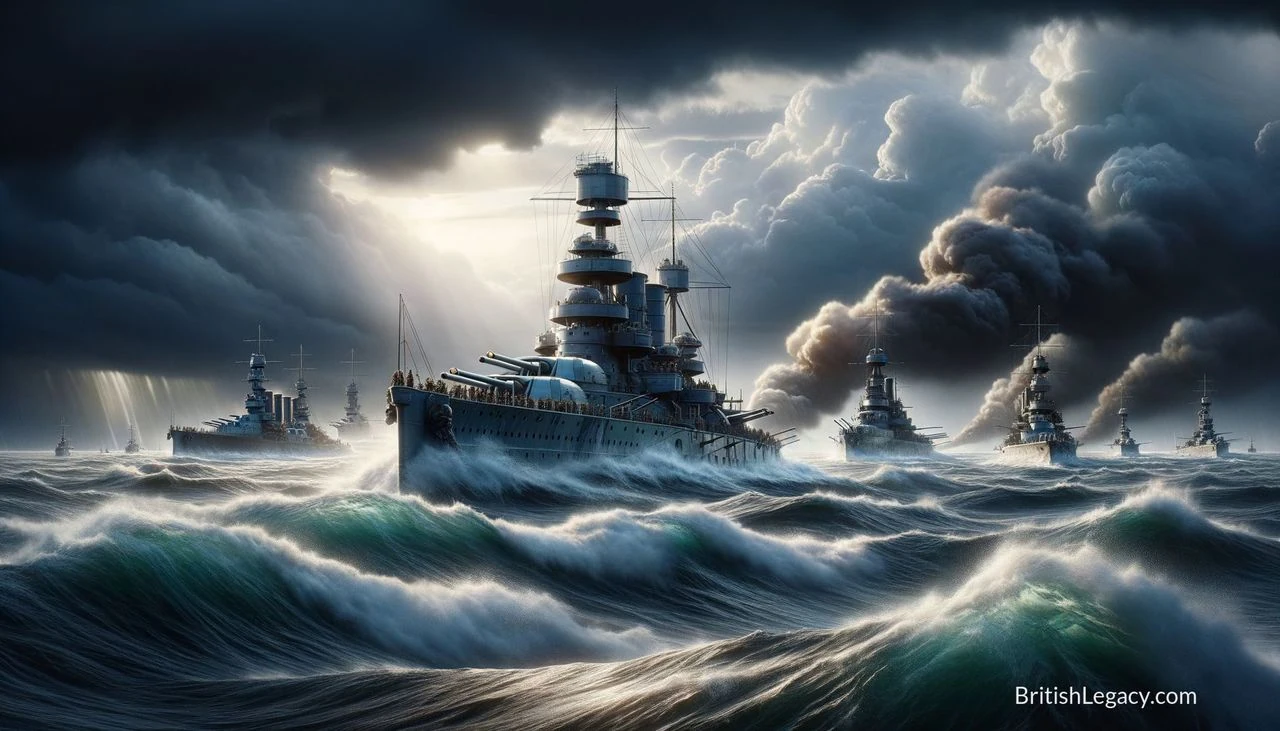
On 1 November 1914, off the coast of Chile, the Royal Navy suffered a sharp defeat. German ships under Vice-Admiral Maximilian von Spee sank HMS Good Hope and HMS Monmouth, and more than 1,500 British sailors were lost. The Battle of Coronel exposed the danger of sending a weaker squadron against a better-armed opponent. A little over a month later, British forces met von Spee’s fleet again at the Falkland Islands.
A squadron at a disadvantage
At the outbreak of the First World War, the German East Asia Squadron operated across the Pacific. Von Spee’s force threatened Allied shipping and military movements in the region. In response, the British Admiralty sent a squadron from the Atlantic under Rear-Admiral Sir Christopher Cradock.
Cradock’s force included the armoured cruisers HMS Good Hope and HMS Monmouth, as well as lighter vessels. The British ships were inferior to the German fleet in firepower and armour. On the evening of 1 November, the two squadrons engaged off Coronel, a Chilean coastal city. The German cruisers Scharnhorst and Gneisenau were more modern and heavily armed, and their range and firepower gave von Spee’s force the advantage.
The defeat at Coronel
The engagement ended with Good Hope and Monmouth sunk, both with all hands. More than 1,500 sailors died. It was a serious loss for the Royal Navy and a stark demonstration of what could happen when British ships were outmatched. The defeat prompted the Admiralty to reassess its naval strategy and the deployment of its ships.
Coronel was not the end of the campaign against von Spee. The British response included the dispatch of the battlecruisers HMS Invincible and HMS Inflexible, with a force commanded by Vice-Admiral Sir Doveton Sturdee. The aim was to find and defeat the German squadron. The encounter that followed would reverse the result of Coronel, but the earlier loss remained a grave cost in lives and ships.
From Coronel to the Falkland Islands
On 8 December 1914, Sturdee’s force engaged von Spee’s squadron at the Battle of the Falkland Islands. The British battlecruisers had greater speed and firepower. The German cruisers Scharnhorst and Gneisenau, along with several other vessels, were sunk. Von Spee and most of his men died, and the German naval threat in the South Atlantic was effectively ended.
The two battles form a connected episode: at Coronel, British ships and sailors paid a heavy price against a superior force; at the Falkland Islands, reinforcements and a better-equipped British squadron defeated von Spee. The later victory did not erase the earlier loss, but it brought the pursuit of his squadron to a decisive close.
Why the Battle of Coronel deserves a place in British Legacy
Coronel deserves attention as more than a prelude to a British victory. The loss of Good Hope and Monmouth and the deaths of more than 1,500 sailors give the battle its own significance. It records the human cost of a naval engagement as well as the consequences of a force being outmatched in armour and firepower. Remembering the defeat keeps the story of the Royal Navy’s First World War campaigns from becoming a simple account of eventual success.
Read alongside the Battle of the Falkland Islands, Coronel also shows how quickly the balance of a campaign could change when a new force was sent to meet the threat. Sturdee’s battlecruisers helped defeat von Spee’s squadron and end its threat in the South Atlantic. The sequence connects loss, reassessment and a later operational victory without turning defeat into a tale of inevitable triumph. For British Legacy, that combination of strategic consequence and human cost is the reason to remember Coronel: it makes the wider naval campaign more comprehensible, while keeping the sailors who died at its centre.