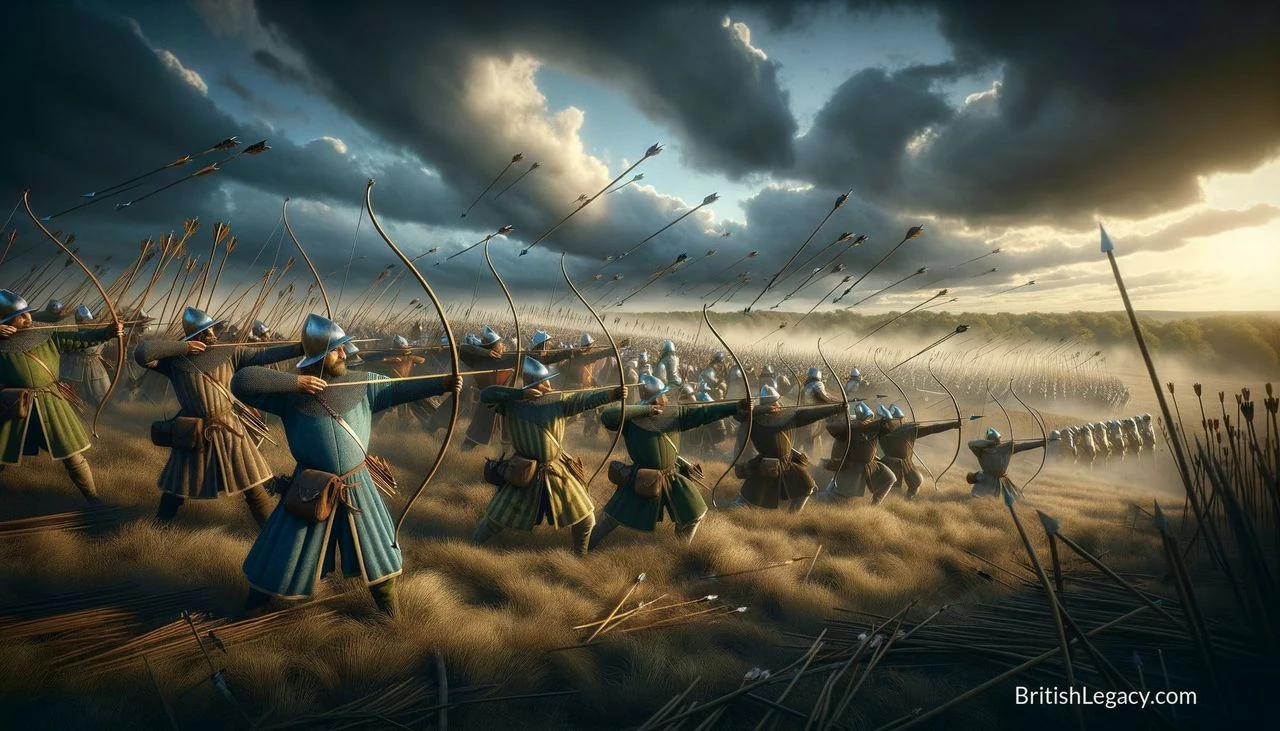
On 26 August 1346, an English army under Edward III met the forces of Philip VI of France near Crécy-en-Ponthieu. The English victory became one of the best-known encounters of the Hundred Years’ War. Its account is closely associated with the longbow: English archers helped disrupt French attacks, while the battle’s place in the wider conflict gave it a lasting presence in the history of English warfare.
A campaign across France
The Hundred Years’ War, conventionally dated from 1337 to 1453, grew from disputes over territory and the French crown. English monarchs held lands in France, and Edward III’s claim to the French throne added to the tensions between the two kingdoms. The conflict was not a single, continuous campaign but a prolonged series of wars and truces.
In the summer of 1346, Edward led an expedition into France, landing in Normandy and moving east. The original account estimates his force at around 15,000 men and Philip VI’s at approximately 30,000; these figures should be treated as estimates, not exact totals. Edward’s army included men-at-arms and knights as well as longbowmen. The French king assembled a force to confront the English advance.
Edward chose a position near Crécy-en-Ponthieu. The English held higher ground, according to the account, and prepared to meet the approaching French army. That defensive arrangement mattered: the English were outnumbered, and their position helped them withstand a series of attacks.
Longbows and the course of the battle
As French forces advanced, English archers shot into their ranks. The account describes French cavalry faltering under the arrows and subsequent assaults being repelled. The longbow was not the only element of the English army: men-at-arms and knights were also present, and English infantry took part in the fighting. The result came from the conduct of the battle as a whole, rather than from one weapon acting alone.
Crécy is often treated as a turning point in medieval warfare because it demonstrated how archers could challenge the battlefield dominance of mounted knights. The English longbowmen could strike from a distance, making them a significant part of the army’s defence. The battle is therefore remembered both as an English victory and as an example of changing tactics in the conflict between England and France.
Consequences and remembrance
The victory strengthened English morale and added to Edward III’s reputation as a commander. It also formed part of a longer struggle that continued for generations. The original account connects Crécy with later English successes, including the Battle of Agincourt in 1415. That connection is best understood as part of the war’s continuing history, rather than as a claim that one battle alone determined what followed.
Accounts of Crécy often present it as a defining moment in the history of the longbow and of English military organisation. Such broad claims about the battle’s influence on later warfare require caution. What can be said here is more specific: the English victory at Crécy became an enduring reference point in accounts of the Hundred Years’ War, and the performance of the archers is central to that memory.
Why the Battle of Crécy deserves a place in British Legacy
Crécy belongs in British Legacy because it is a major episode in the history of the English kingdom and its long conflict with France. It shows an English army campaigning on the continent under Edward III, facing a larger opposing force and winning a battle that later became closely associated with the longbow. The story also brings military tactics into focus: archers, infantry and men-at-arms operated within a wider army, and the English position helped them meet repeated attacks.
The battle’s significance is not that it created a simple national tradition or single-handedly transformed warfare. Its value lies in the way it connects a particular campaign to wider questions about power, territory and changing military practice in medieval Europe. Remembering Crécy makes the history of English warfare more concrete, while recognising that the Hundred Years’ War was a conflict between kingdoms and that the later idea of a unified British military identity should not be projected uncritically onto 1346.