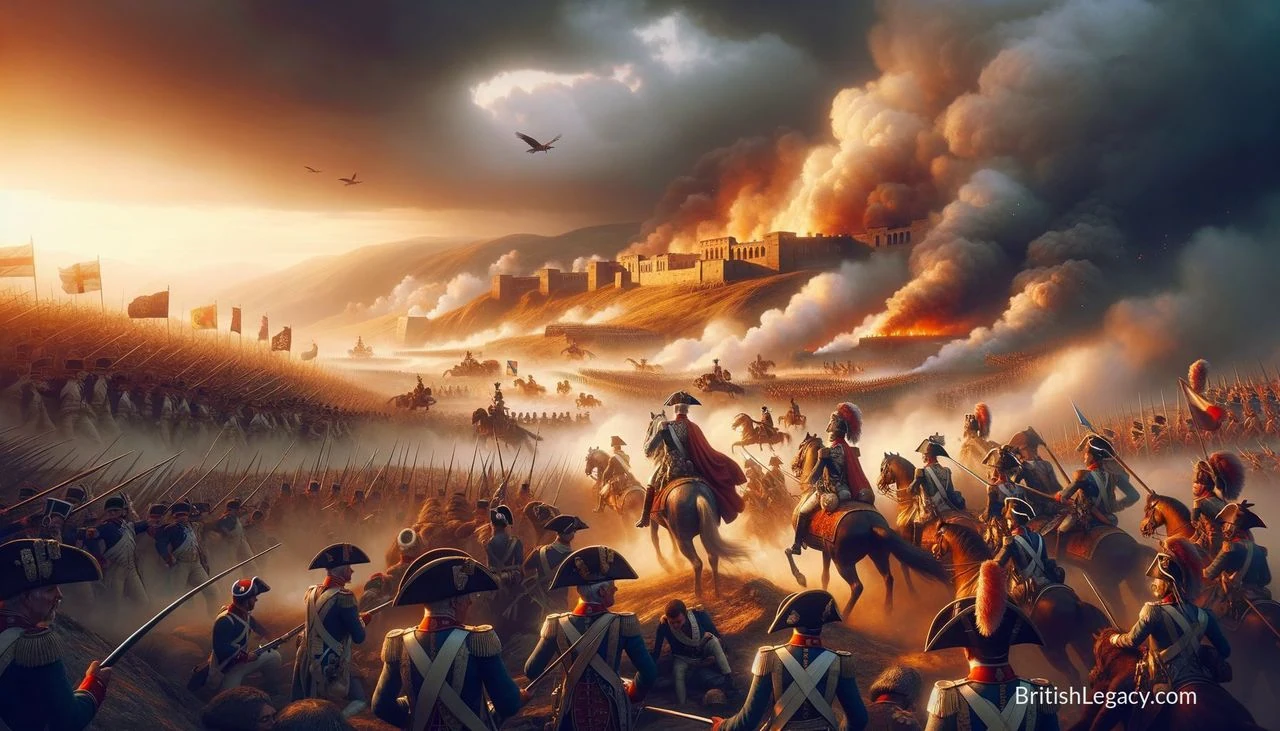
On 27 June 1743, British, Hanoverian and Austrian forces fought the French near Dettingen, in Bavaria. The allied army was in a difficult position, but it won the engagement. The battle is remembered in Britain for a distinction that outlasted the campaign: George II was the last British monarch to lead troops into battle in person.
A European succession war
The War of the Austrian Succession began after the death of Emperor Charles VI in 1740. His daughter Maria Theresa succeeded him, but her claim to the Habsburg dominions was contested. France was among the powers opposing her. Britain supported Maria Theresa alongside the Dutch Republic, Hanover and Austria, drawing the British Crown and its European interests into a wider conflict.
In the summer of 1743, British, Hanoverian and Austrian forces were moving through Bavaria to relieve an Austrian army besieged by the French. George II joined the army and took command on the field. His presence made the king a participant in the campaign, not merely a distant emblem of the coalition. Dettingen would give that personal involvement an enduring place in the history of the British monarchy.
The army at Dettingen
Near the village, the allies faced a French force commanded by the Duc de Noailles. The French had placed the coalition army in a precarious position, cutting off its supplies and routes of retreat. Their forces, however, were not all concentrated together: some were dispersed on skirmishing and foraging, reducing the strength of the main body facing the allies.
The original account describes the fighting as taking place across marshy ground by the River Main. It depicts allied troops meeting French cavalry and holding their position during a confused engagement. British troops fought alongside Hanoverian and Austrian contingents; the outcome was not the achievement of one national army acting alone, but a victory by the coalition.
George II was present during the battle and rode among the troops, according to the account. Later descriptions have cast his actions as a model of personal courage and claimed that he was at the fiercest point of the fighting. Such dramatic detail is not necessary to establish the central fact: the king accompanied his army in the field, and Dettingen was his final battle in that role.
Victory and its limits
By the end of the day, the allied forces had won and the French had retreated. The victory relieved the immediate danger facing the coalition army, but it did not end the War of the Austrian Succession, which continued until 1748. Dettingen was one engagement in a prolonged European conflict, rather than a conclusive settlement of the dispute over the Habsburg succession.
Its importance in British history rests in part on the unusual presence of a reigning monarch among his troops. George II’s participation gave the battle a royal dimension, but the result depended on allied forces and circumstances on the field. The episode can be remembered without turning it into a simple story of a king personally deciding the course of a war. Its place in the broader conflict was more limited than the later language of national triumph suggests.
Why the Battle of Dettingen deserves a place in British Legacy
Dettingen belongs in British Legacy because it connects British military history with the continental politics of the eighteenth century. Britain’s involvement was bound up with support for Maria Theresa and with alliances that included Hanover, Austria and the Dutch Republic. At Dettingen, British troops fought as part of a coalition in Bavaria, not in isolation. That setting makes the battle a useful example of how British interests and military action could be shaped by partnerships beyond the island.
The engagement also marks a specific moment in the history of the monarchy: George II personally led troops in battle, and no later British monarch did so. That distinction gives Dettingen lasting significance without requiring exaggerated claims about its strategic consequences or the king’s individual feats. The battle was a coalition victory within a war that continued for years; its legacy lies both in that European context and in the exceptional fact of the king’s presence. Remembering those two aspects together offers a more grounded account of Britain’s past: one that recognises the role of its forces while keeping their actions, their allies and the limits of the victory in view.